An identification ritual much like this one had nearly killed Cynthea, years ago.
In a cramped, unlit cellar west of Valgrund, a miller had warned her of an ancient-looking goblet stamped with strange texts that supposedly charmed the eyes. Admar had been upstairs, asking the miller for more details as the quern-stone moaned laboriously and the riverwater rumbled beyond the cellar wall.
She’d had all the components correct. Her salt lines were immaculate, her articulations clear. But she’d rushed the ritual, hadn’t known, as she knew now, that magic could never be forced by technical mastery. As with making love, or duelling, even, one’s magic must ebb and flow with its object, giving and taking.
The artifact had been, to use the officially forbidden but ever-apt terms, pre-Cataclysm, High Anlaitheran, and from what little she could read of the cup’s strange scripts, a gift fit for a king. Such a thing would be coveted by the Archive, prized above countless sherds, tattered manuscripts, and bone fragments strewn from The Krasm to Baillus that still hummed with the heinous glow of ancient powers.
Compared to those common finds, this goblet was an untarnished treasure, whose magic, whose history, was bare for all to see. And which must, therefore, be rescued.
Hidden.
Guarded.
Blinded by the glorious prospects of this retrieval, Cynthea had gone too far too soon. She requested too much of the goblet’s essence, stepping on its toes mid-dance when she should have been following its lead. As a result, there in the cellar, it had arrested her eyes.
All else had gone dark. The mill had vanished, absorbed by a creeping black that encircled but never covered the goblet.
Blind to all but its gleaming shape even as she held it, she had somehow ventured upstairs and begged Admar and the miller for their help, only for the charm to claim them too. All vision had been absorbed by the perfect chalice, its form and color pure and unblemished, not by the hand that held it, or even by the light itself.
The effects worsened. Soon the afflicted three could not move, glued to the floor by some strange and concentrated atrophy, by the all-consuming effort of seeing. Reading its text again and again, as hours became days, then a week of silent and terrible hunger, Cynthea finally read it true, understood its text, and caught the ancient joke.
It wanted her eyes.
Gaunt, nearly dead, she plucked them out, placed them in the cup, and when it filled, she drank.
The desperate move had worked. And over the course of a very tense ritual, Admar had helped reattach the organs, though Cynthea had had trouble reading text up close ever since. In combination with a strenuous return involving a few grave robbers and an ignorant greenguardsman, Cynthea’s genius recovery of the chalice had earned her a promotion to Magis. Admar, for his efforts, had received a commendation.
The Pupil’s Chalice was one of the few artifacts whose story had earned such a reputation that its name could be repeated outside Archive walls without fear of censure. With its notoriety, she’d blossomed, then recovered artifacts of increasingly wild complexity and terrible power. She’d robbed the graves of ancient generals, found temples buried in the snow, reclaimed the misplaced relics of the wyrm cults of Firenest.
But now, years later, in a shack outside of Threehill, she was stumped.
“I just don’t understand,” Cynthea said, wiping the browned blood from her fingers and emptying the bowl of its holly. “It’s like we haven’t even tried.”
Harkital, Vorik, and Ollis sat just beyond the outer ring of salt she had drawn a few hours ago. The stone was in the middle with her, surrounded by her own, smaller salt circle, which connected to the outer ring with intersecting lines marked by channeling herbs at each juncture. A rat carcass lay on a bed of salt between her and the stone itself.
Admar was out in the overgrown garden, gathering more channeling herbs for what was shaping up to be a long string of days in this makeshift ritual bureau. Ollis sat in a chair across the room, having eyed her casting from the start with considerable interest, if not a little judgment of her unrefined form.
“Well, what all have you tried today?” Harkital stepped closer, observing the splayed rat.
“That was transmutation, then before that I checked conjuration. Before that, I think…illusion. And I’ve turned up nothing.”
“No obliteration, then?”
“Obliteration spells or clauses don’t create material or illusory effects on their own,” Ollis piped in from his chair. “They have to be augmented by another school.”
Cynthea nodded at him. “Boy’s right.”
Harkital huffed. “So what else is there?”
“That’s just it,” she replied. “I don’t know. If the rock were affected by magic of any normal sort, we’d have seen the effects replicated, transferred to the receptacle.” She gestured helplessly at the rodent. “But our furry friend is unchanged.”
“Don’t he look hairier than before?”
“No.” Cynthea buried her face in her hands.
For one thing, this was a hit to her pride. What sort of Magis couldn’t, after hours of casting, identify the magic endowed upon a rock? For another, it was terrifying. To have worked at it for so long, with no result, meant that whatever this thing was, it was more inscrutable and more powerful than she’d been prepared for. Either that, or she was just getting rusty. She massaged her knuckles, strained from the many positions and gestures the work required.
“Chin up, yrig.” Vorik picked at a scrap of breakfast, still stuck between his gold teeth. “Just because we don’t have it sorted doesn’t mean we haven’t learned somethin’, eh? What have we eliminated?”
“Good point,” she said, kneading a knot in her neck. “It’s unlikely to be an arcane focus, which would be charged with resting spells and clauses for expediency’s sake.”
“Indeed.”
“A cursed item—properly cursed—would have had transmutory magic written all over it, no matter what the intended effect might be.”
“Right, right.”
“But then…what?”
With the boy here, narrowing down possibilities was more difficult than usual. Ollis surely hadn’t been clued into the nuances of Waithen history, into other considerations she was fearful to name, even to herself. That it may be Anlaitheran, like the chalice. That it could be cursed by something ancient and unknown. That the Archive likely had no business acquiring it, nor the Courts demanding its retrieval. The pride, the foolishness, once again began to appall her—
“It could be a yegstone.” Vorik shrugged.
“A what?” Ollis piped in.
“A yegstone. You know? The mineral structure, the residual magic…”
Harkital rubbed his brow. “Like that bit of petrified wood, up at Rot and Row. Takes on traits of powerful magic cast in its vicinity, then leaks them out, quite unpredictably, over time.”
“Indeed,” Vorik said. “The mineral structure augments the magic a bit, injecting a bit of chaos.”
“And the original magic absorption is accidental, meaning its signature could be unconventional for an enchanted object to begin with,” Cynthea confirmed. “I hadn’t thought of it, but sure, it is possible. Perhaps even probable. But I would still expect to have seen something after all this work today. Some sign, some signature.”
“Might need to change our approach,” Vorik suggested.
She frowned.
“If magic isn’t working,” he shrugged, “then perhaps we pivot to some, erm…material testing. Might point us in other directions.”
“Material testing? And how would you suggest we do that?”
Vorik raised his brows. “Cynthea, only now asking me for suggestions on how to handle a rock?” He shook his head slyly. “Took you long enough.”
* * *
As usual, everyone had gotten in their heads again: Cynthea, uncertain and afraid, Admar, bitter and impatient, and Harkital, lost in self-pity. When a party reached that point on their expeditions, as they inevitably did, Vorik had learned it was his job to keep things moving.
The sun hung fat and warm above the trees and the insects rattled briskly in the knee-high grass. He’d found an old hardwood trunk, dry and sturdy, that had fallen and rolled a ways from the treeline ahead, and stood on it now with the stone in-hand and two jars by his unshod feet.
Ollis, Harkital, and Cynthea—at her cautious request—were all perched on the stoop of the shack, Ollis bright-eyed like some forest rodent, Cynthea looking nervous as a paranoid mother, and Harkital grinning with a voyeur’s lurid glee. Admar was still stalking through the garden, unbothered.
Vorik smiled. From this far off, he probably looked a few feet taller; the trunk he stood on was obscured by grassy stalks, and he surely cut an imposing figure with his brawn at full height.
He signaled he was about to start.
Cynthea waved back half-heartedly.
“Psh.” Vorik tossed the stone lightly in his hand. “I’ll show you, you big worry-wart.”
From a fold in his cloak, Vorik pulled a short, oltherite-edged blade, a prized dwarven utility. With a few quick strokes, he whittled away at a nub on the stone, then checked the exposed surface. It shone, fine striations from the blade clean and colorless. Then, he pounded at another spot with the back of the blade, precisely where the hardened steel tang peeked through the handle. The tang, when he checked it, bore new marks from the impact.
“Right, right,” he muttered. “Harder than steel, softer than oltherite. Unlaminated. Seems to be darker granite or somesuch.”
Dropping the knife back into his cloak, he waved the stone in the air at them, just to show it hadn’t killed him yet. Cynthea looked stoic, but Harkital signalled a thumbs up.
With a last, swinging motion, Vorik threw it in the air and caught it.
“Vorik,” Cynthea shouted, “don’t drop it!”
He tossed it up again, higher this time, watching its edges catch starbright points of sun. “Drop it?” the dwarf shouted back. “Who said I’d drop it?”
He caught it, feeling his flesh smush against his bone from the weight of the rock, then sent it even higher.
“Vorik, don’t—”
He dropped it. Or, rather, let it slip past his hands and fall another few inches before his uncovered foot shot up before him, coarse skin catching the rock at his ankle with a violent, fleshy thud, which sent the thing back up in the air just above his head.
Cynthea shouted. Harkital hollered. Even Admar stopped to watch the show.
The rock came back down and Vorik kicked it again, the pain bright and familiar to his battered inside ankle. He kicked with his left insole, then the right outside ankle, then let it roll down his shin and fly up on the curve of his foot, before coming back down again to meet his backwards-flung heel with a satisfying smack.
The stone popped into the air and down, over and again, his legs and feet working like pistons with their well-built muscle. With each kick, he was feeling for the stone’s bathri, or ‘give,’ checking its momentum in the air, its balance, speed, and yaw. Imbalanced stones enabled different tricks than balanced ones, and faster, lighter stones were prized for their lofty arcs. This one, dense, lopsided, and lumpy-surfaced, would be excellent for passing around a skilled group of kickers, all in a wide circle, using tricky flicks and turns. Not that any of these morknithik—grasswalkers—had the limbs for it.
Vorik sent it once more into the air with an audible slap off the top of his foot, watching its shape wobble in the light before falling with a vicious cunk upon the bare dome of his skull, from which it rolled into his waiting hand.
“A little heavy on the right,” he said, head ringing with the old and welcome pangs. “But it spins just fine. That puts the core here,” he pointed, “and perhaps it runs through there.” He drew a finger along an invisible spine, then frowned as he caught the edge of the stone.
Funny. As far as its bathri showed, it seemed like this stone might have split from another. But from its shape alone, he could tell this must have been long ago, surely.
“Did that knock some sense into you?” Harkital shouted from the stoop.
Vorik pretended to wobble on the trunk, nearly falling over before catching himself as Cynthea yelped. Then he gave a quarter-bow, the old pose of the minstrel ending his bit, though the show wasn’t quite over yet.
He bent down to where the jars sat on the log—one full of grains, the other of oil. Using the first, he poured a mound of saltpeter onto the rock where it was flattest, sprinkling a bit extra around the edges for good measure. Then, after dipping a fleshy pinky into the other jar’s oil, he let it drip down with a careful spiral atop the granules. Carefully, he lifted the garnished stone back up in one hand, keeping his palm flat on its underside, and tucked the other hand into his robe for his flint and steel thimble.
Connected by a chain, the two thimbles attached to his middle finger and thumb with a perfect fit. Sure, he could get a similar effect with a cantrip, but the dwarven method had a certain precision that Vorik’s clumsy casting couldn’t touch—his magical sensitivities had never been too refined. With careful positioning, he snapped, bright sparks flying in a perfect beam from his fingers to the waiting pile, which burst with a loud pop.
At the instant of ignition, he saw bright orange light, a purple edge at the bottom of the flame. At the pile’s ends, more sparks fired off, giving the whole event a beautiful shimmer. Behind the light came dense, curling smoke, drifting in globules and wisps that wandered off, caught by the breeze.
Vorik inhaled the burning scent and the unique mineral tang of the rock beneath it.
“Purple augments,” he said to himself. “Sunk globules indicating magic affectation, a bit watery…minty…right on the nose.” He licked the stone where the powder had just been. “And on the palette.”
He rolled and eyed the stone’s edges again, then grabbed his jars and made his way back to the shack, bouncing the rock in his palm as he went.
Truth be told, the dwarf had hoped to learn more. The broken-off core troubled him somewhat. In general, the object was unsettling, its power palpable even to his blunt magical senses. But finding answers to the stone’s mysteries had not been the purpose of his little show. Cynthea—their leader—was the sort who needed assurances, something to cling to, so she could progress without fear of catastrophe. Even if he had no answers, it was the idea of progress, the appearance of stability, that he must provide. Hence the brazen display, the confident throwing, the easy-going manner, no matter how forced.
“Well?” Harkital asked. “What’d you learn?”
“I’d be surprised if he learned anything, the way it came down on his head,” Cynthea said through pursed lips.
“Please,” Vorik said. “Don’t insult my skill in stone-throwin’—I’ve taken boulders to the dome that you couldn’t hardly lift.”
“And was it worth it?” Cynthea nodded down at the stone.
“There’s certainly a magical effect.”
“As if we didn’t know that,” Admar chimed in, ever jolly.
“It is, likely as not, some dark granite type, old and deep. I think it stemmed from a much larger formation, cracked off some time back—wasn’t an independent node, you see. As far as its magical properties go, I say it’s well-baked in there, not attached to any particular lump or vein or nothin’, just all about.”
“Meaning…?” Cynthea asked.
Vorik smirked. “It’s probably a yegstone,” he tossed it back in the air and caught it again with a speed that made the others wince, “and it’s definitely a rock.”
* * *
Cynthea was clearly frustrated when they returned to the shack’s makeshift ritual bureau. Between Vorik’s risky tricks and an exhausting morning of failed identifications, Ollis could imagine why.
At Yaelfand, not a year ago, his first attempt at a complex ritual casting had taken three days, all to get a broom to sweep on its own and play a song while it did. The ritual had been quite difficult—made no easier by his lack of musical ability—and each successive failure added exponential exhaustion. Divination spells, like those used to identify the magic within an enchanted object, were similarly taxing, and often felt like looking for a single patch of water in the whole of the ocean.
He had eventually enchanted the broom to sing a voluminous, if tuneless, ballad, and had practiced divinations time and time again, earning superlative marks in Applied Ritual Elements by the end of the term—his name had even been carved above the advanced bureau’s entrance among the other bests-in-class. He’d made a pinecone that turned endlessly like a spinning top, locked a door that even Idris Toble could not open, and found a charm of weightlessness in a single grain of rice.
Suffice to say, Ollis was quite confident in his belief that—Magis or not—Cynthea had gotten almost everything wrong.
That morning, when she’d laid out the salt and channeling herbs, Ollis had been excited to watch a master at work. The pattern was complex yet precise, the herbs expertly chosen. Then she’d started casting, and he’d wondered instantly whether she’d thrown out even the fundamentals of spellwork.
From his chair in the corner, he’d barely restrained himself from asking about her unconventional casting form, from pointing out her unbent third finger, the too-slumped crook of the neck, how her dictation of the mantra was so relaxed it made torel sound like tirel. With each successive attempt, he’d pictured exactly how he’d have sat as he cast the identification, how his fingers and back would revert to muscle memory at a moment’s notice.
So when Cynthea pouted and shook her head at the stone, now back in the salt ring on the shack’s kitchen floor, he could restrain himself no longer.
“I could try it,” he said nervously.
“Try it?” Cynthea’s eyebrows raised, either impressed or appalled.
“I mean, I really don’t mean to presume,” though, to some extent, of course he did, “but I did receive superlative marks in Advanced Ritual Elements this past year, and think I could—”
“Drunt, are you joking?” Harkital said sternly.
“Not at all. And I don’t mean to critique the Magis,” his face flushed a little, “but I couldn’t help but notice certain adjustments that might improve our chances.”
At this, Cynthea smirked. Why was she smirking? “I don’t see why not.”
“Cynthea, you can’t possibly be serious,” Harkital said.
“I can’t?”
“The kid hasn’t handled anything more dangerous than a magethumb and is liable to piss himself the second he sits down with the thing.”
“You thought you two were mere feet from a Gorderak, not three days ago. That would have been dangerous enough, no?”
“But it wasn’t a Gorderak in the end, now, was it? Good thing, too, for a real one could’ve ripped his throat out without trying,” Harkital snapped back.
“Methinks someone cares more about the boy’s safety than he lets on,” Vorik said in a low tone.
Harkital bristled. “You want to clean him up from the floor of this reeking hut, so be it. Ain’t like the smell in here would get any worse.” The Idris eyed Ollis, looking weary, looking afraid, and Ollis was suddenly unsure whether the teacher’s vehemence came from the same place as the disdain he’d shown on the trek here, or from some other, stranger place.
“I’ll take care of him,” Cynthea said. “It’s a controlled environment, hardly different from his classrooms. If he falls in I’ll get him out of it. The real danger is in doing it alone, as you know,” she said, looking at Ollis. “Come on over.”
Excited and surprised that his suggestion had been accepted, Ollis joined Cynthea by the small, salt-outlined semi-circle. He took his seat, crosslegged and facing the stone.
Cynthea put a hand on his shoulder, then leaned in and said, quietly, “With any other upstart I’d let them jump right in and find out the hard way, but this is dangerous, and Harkital, for one, is clearly growing quite fond of you. So listen carefully.”
Ollis’s excitement quickly waned. What was she talking about, finding out the hard way?
“It won’t feel like a classroom. It won’t be perfect, and it won’t be easy. Here, rigidity is the enemy, alright? If you sit there expecting to break through the way you would a basic enchantment, forcing your way into the thing, you’ll be the one that breaks. We don’t want that. Take a receptive posture, and allow it to come to you.”
Ollis had absolutely no idea what she was talking about. The words ‘receptive posture’ might have been somewhere in a book he read once outside of class, but he had never practiced anything of the sort.
“What’s the most powerful thing you’ve identified?” Cynthea asked.
Ollis thought. “A crop ward, enchanted to keep the bugs off a couple hundred acres of wheat.”
“And the spell in that ward?”
“Written out, it took three whole sheets of parchment. It targeted a lot of bugs.”
“The schools?”
“Divination, obliteration, and a little bit of illusion.”
“Alright.” Cynthea still looked a little concerned. “Well enough. Just be careful, will you?”
Uncertain, yet undaunted, he nodded. Cynthea stepped back.
Now, facing the stone alone, his ears itched as they had back at the magistrate’s office. The energy of the salt and the stone within it, the ensemble laid out before him like a meal, or a map, or a mission, reverberated with severe magic. Really, how much harder could it be than class? He’d done so well at the exercises before. Even if it were too difficult, beyond him, he could probably at least escape from it without trouble. That was why she trusted him to try it, anyhow. He’d heard what Cynthea said—she wouldn’t let him get hurt. And he felt in his bones that she meant it.
So before he could change his mind, he closed his eyes, inhaled, and leaned in.
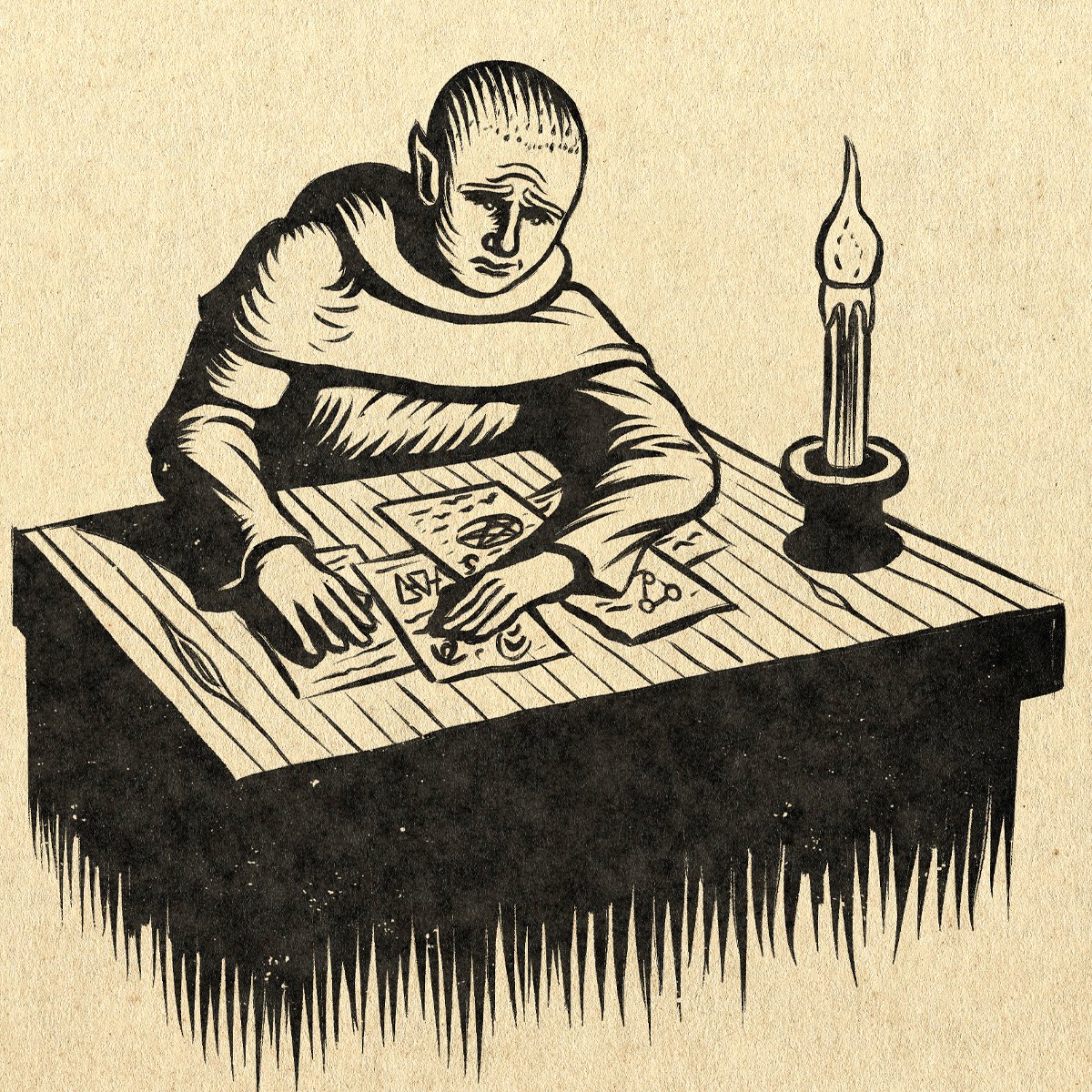
His right hand rested on his knee, the tip of his thumb aligned with his outstretched middle finger, the hand relaxed but poised, his pinky and ring finger tucked against his palm. His left hand sat on his thigh, all fingers curled but the outstretched thumb, palm facing upward with a particular bend in the wrist. There was an awkwardness to the position, but he knew the feeling well and could sustain it perfectly for a good while. Ollis exhaled, settled in, and his lips began to move, the words whispered as quietly as he could manage:
Isentileris definirum ak abissereth
Hinterion irid eridicce clamac
Isentileris definirum torel
Hinteriot redex
Isentileris definirum ak abissereth…
The words continued. ‘Isentileris definirum,’ the declaration of definition, the spell’s intent, declined for the yegstone, his target. ‘Hinterion eridicce,’ the sanctification of the area, honing of the auras, amplification of energies. ‘Hinteriot redex,’ the sanctification of the receptacle, the carcass of the rat, prepared to receive the unfiltered qualities of the stone itself and reveal the nature of its power.
As he whispered on, and the words faded into one another, he could feel—almost see—the energy of the room amplified around him. First were the material auras and fields, fabric-like sheets that vibrated along every object’s edge and curve, from the length of a bookcase’s hardwood to the delicate, hair-like threads of the cobwebs in each darkened corner. Then, he felt the auras of those behind him, wan lights in the dark, the thrumming power of a person’s heart and soul amplified for Ollis to see even as his eyes were closed, even as they stood at the back of the room. Finally, Ollis trained his mind on the items just before him. The rat hardly had any aura at all, now more object than living thing. The salt circles were strong and pure, their mineral structure alchemically solid and unassuming.
So far, so good.
Then, eyes shut and ears unhearing, he turned his mind toward the stone, its force becoming clear, the rest of the room slipping into the back corners of his mind like a sheet of satin pulled around a corner.
The stone was a simple thing; its aura read as that of a precious stone might, emanating a frequency not dissimilar to the salt’s, only more complex in its lattice, more definite, but less refined. He could see its essence reflected in the salt’s circular geometry, allowing him to glimpse a shadow of the thing’s power from all angles. There, he noticed something strange. Something slow and strong, trapped beneath the ground, that moved and eddied with the tide of mud-like rock, which the greatest thinkers hypothesized to be in the earth’s unknown depths—unholy realms of pressure, ice, swirling minerality, endless black clay, compounding upon itself for miles upon miles. The dark heart of the earth. This was in the stone.
It seemed he was doing everything right. Slowing his recitation a little, the auras came into greater focus, as if a looking glass was finally held at the proper distance. He watched as the lattices of the stone’s architecture rose and bent in the darkness of the innerweave, the refracted spirit of lead, clay, and warping granite cast against the rows and curves of the salt rings. He began the process of reigning in those energies, that he might soon channel them into the rat.
Then things became more difficult.
Normally, to reign in the aura of the desired object would take but a moment for Ollis—that was the easy part. With the crop ward, it hadn’t taken long at all, once the extensive spell and energies had been drawn out. Now, however, it seemed that every attempt to bend the stone’s energy to his will was making it more volatile.
The lattices curved and bounced in odd directions. The steely movements of its earthen energies began twitching, cracking, revolving in jittery half turns. They rose against other objects, then hurtled toward the earth and faded away. What was this? He directed his disembodied mouth to recite even more cleanly, with an even stabler rhythm, and tried again. Now the energies flew all over, impacting other things, causing other vectors to shoot out from behind and around him in chaotic trajectories.
Getting uncomfortable, Ollis backed off, released his grip and paused the incantation, the best thing one could do if a ritual was going awry.
But the stone did not stop.
Sporadically, it shot off its weighted energy, an unpredictable machine—images and sensations of stone, mountain, cavern, and cliff expanded, careened out, and crashed into him.
Afraid, unable to focus, Ollis remembered the corrupted stole of Rittenhour, the pox that had brought an entire town and once-beloved Waithen hero to their knees. He pictured the same thing happening now, to the town of Threehill, as the result of a novice’s identification ritual gone wrong.
In a panicked surge, Ollis gathered his focus again and tried once more to force the stone into submission. It kicked him like a mule. The stone’s lattices struck him repeatedly, the feeling of a cliff growing in his belly, of a cavern being carved away inside his legs, of tumorous rock expanding behind each eye.
This had gone terribly wrong, and it was only getting more dangerous. Why didn’t they stop him? Surely, just behind him, there was Harkital, and Vorik, and Cynthea; they said they’d keep him safe. Why didn’t she—
Reception, he recalled, somehow. That’s what she’d said. The receptive posture.
Flailing in the unseen dark, Ollis turned his addled mind back to the stone. He directed the cadence of his whispers to relax, to become freeform, to ebb and flow as the black clay did. He felt, somewhere far away, as his hands moved and became limp, their gestures loosening, resolving from their academic rigidity.
At first, nothing changed, and he thought that might be it. Then the stone’s ponderous aura centralized and beamed outward, collecting and firing off toward Ollis, or rather, just above him and to the right. A split second later, the aura calmed itself, coalescing into a bundle of small, constrained patchworks of infinite line. The object of his labor. The magical ‘signature’ of the stone, impossibly complex, illegible, yet beautiful in its calligraphy.
As his breath returned to him, he pulled these patchworks down toward the rat, coaxing them as one would a fish on a line, rather than forcing them in with great speed and direction, as he’d been trained to. The auras converged, approached, and at last entered the receptacle. He held them there for as long as he could bear, until he felt them settle and dissipate. Success.
Over the course of another minute, Ollis regained control of his face and hands. Opening his eyes felt like lifting a rock from where it had embedded in the grass.
“Yrig, there he is,” Harkital said. “Someone tell the magistrate we won’t be needing the new sexton after all.” He joked, but his words carried profound relief.
“Or the cavalry, for that matter,” Cynthea said, smiling as she entered Ollis’s bleary field of view and knelt beside him. “Are you alright?”
“I…I did it,” Ollis said in a hoarse, soft voice.
“Harkital, Vorik, please fetch a clean cloth and some water from the well. And tell Admar to grab more bluemane while he’s out there.”
Harkital and Vorik left, but not before Ollis caught another look in Harkital’s eyes, the glint of a burden relieved.
When they’d exited, Ollis turned back to Cynthea. “I saw it, and at first it was violent and powerful, and I couldn’t, but then…” He looked down. His hands were a mess of bent knuckles and unusual wrist angles, just as Cynthea’s had been during her attempts. “You were right. I feel so foolish, trying to fight it, to force it. I shouldn’t have doubted you.”
“This was a very advanced exercise, one you might not have seen for another year or two, at Yaelfand. You did just fine.”
“And the rat?” Ollis looked at the opened corpse.
“Nothing, I’m afraid,” Cynthea replied. “Same as we’ve had with all the others. Do you see how confusing it is?”
“But I saw the signature, right before me, beautiful—and it went exactly as it should, right into the receptacle. With any typical school of magic, we’d have a sign, wouldn’t we?”
She nodded. “So what do you think?”
Reaching back into himself, Ollis searched through what he’d felt—what he’d ‘seen’—over the course of the ritual. “Well, when I first approached it, it was heavy, and moving, and dark. It felt like the earth, deep down.”
“I felt the same.”
“Then I started wrangling with it, and it reacted, grew worse.”
“That’s to be expected. Objects of great power, by their nature, resist control. That’s one thing that’s easier to learn through experience than a textbook.”
Ollis scratched his irritated ear. “There was this moment where I had agitated it, gotten it to its worst point, and it was firing these things off, so I had to adjust my approach—softer, as you said—”
“The receptive posture.”
“Yes, just that. And as I did so, the trajectory changed. Just for a moment. The stone fired off a bit of energy, very directly, just there,” he said, looking over his right shoulder and pointing at the wall behind them, where a window overlooked the side garden and the road to town. “It was focused. At least, for a moment. And just a bit unusual, I think, with how volatile its other energies had been, and I can’t help but wonder if…”
“But you say it was firing off in all directions already?”
“Yes. And I suppose—well, I know it could have just been another one of those random firings, but it just seemed different.”
“Of course.” Cynthea smiled, not trying to be condescending, but still making him feel ignorant. “I didn’t see that during my own attempts, but then again I never made it quite so angry. Maybe a bit more experimentation tomorrow will help us sort it out, eh?”
Ollis furrowed his brow. He’d thought, for sure, that he could do it. He’d been so very wrong.
“Bluemane,” Admar said, entering with greenery in his hand. “Did the boy hurt himself?”
“No.” Cynthea took the herbs from him and rubbed them between her hands. “He did fine. Just took him a while to sort things out.”
She pressed the herb against his head, a small, dry sprig, like rosemary, and he smelled a savory mintiness and felt his muscles finally relax from the ritual’s ordeal. With her thumb upon his skin, and the anxious, daunting feeling of caverns and cliffs still carved within him, he remembered what it felt like to be a new Waithen. What it had been like to know nothing, to be ignorant, there at the holy Bay. Ollis thought he’d gotten past that ignorance by becoming an Adresil, by climbing the ranks to such a high status. But now, beneath Cynthea’s kind hand and Admar’s austere glare, he felt smaller than ever.
“Tomorrow, we’ll try again,” Cynthea said. “And you’ll get more chances to practice.”
“I’d hope not,” Admar said.
Cynthea glared at him.
“The bluemane’s in the thorns, is all.”
* * *
Late that evening, Ollis dreamt of the Bay.
At first, his dream only contained a wall of moving, slurry-like earth. A dark, writhing clay, mythically deep below the surface of the world, flowing at strange intervals, almost pulsing.
Then, after a while, the eddying earth gave way to another vision: the holy Bay of Vindac. He saw its dark, tumultuous waters, opaque, layered, and jagged, the cliffs crowned by Waithen halls and gates. But it was not a view he recalled from his pilgrimage to Vindac’s Grace, when he’d deigned to take the pledge, all those years ago. This was no memory of the Rite.
Ollis saw anew how the bay’s cliffs ran high and flat for a vertical mile, miraculously tall, impenetrably strong against the onslaught of the fuming, boiling sea. Splitting them was the crack in the cliff—called Craez—which all pilgrims to Vindac’s Grace descended into, entering it through the Ryg’s Gate to then scramble down the impossibly narrow, salt-filled hollow of the dank, dark, and wuthering gorge. There, years ago, he had reached the place where the water squalled and billowed and lapped with furious tongues at the boulders that marked the chasm’s end. There, the skeletons of less fortunate pilgrims, jammed between rocky gaps and caught beneath the swelling water, lay and rotted. There, Ollis had filled his flask with a holy draught at the white pool and said the Convert’s Orison.
South of the Craez was the Bridge of Echoes, stretching out from the cliff’s noble stone, extending above the ocean until its walkway ended abruptly, jagged and broken. Famously, the bridge had no supports extending to the sea below, only upheld by its cantilevered anchoring—oltherite cords attached to the spires of the Hall of the Redeemed—though stories held that the bridge had hung tall for centuries, even before the Hall was built, supported by unremembered magic to give the Prophet’s earliest followers access to the divine.
But now, to stand upon the Bridge was to know only death, to see only your final view of the shattered terminus.
The terminus, Ollis realized with horror, where he now stood.
A mile below him, black water bellowed. Around him, wind whipped and howled with all the rage of Gael. In his hands was the Ryg’s alabaster bowl, filled with the Craez’s clouded brine. He drank, just as he had on the day he’d emerged from the chasm, the symbolic abandonment of his life as Ryg—as a heathen—and his acceptance of the holy waters of the Bay, the tears of Vindac, whose grace is mighty, whose terrific salvation is always just.
Even in this dream, the water was salty, and bitter, and black, the taste of pilgrims’ corpses coating his unready tongue. But where it had once given him new life, now the holy water began to choke him. Suddenly he could not breathe. He fell onto his hands, looking down over the edge of the Bridge, to the raucous surface so far below him. He had only just enough time to perceive the water’s primordial chaos, to wonder at its raw power, before his body wretched violently for air. And he tumbled forward, over the bridge’s edge. And fell. And fell. And fell.
Endlessly, Ollis whirled. The wind sliced across his face like a cold blade as he continued to heave, his eyes watering, mind barely comprehending the dark vision of the waters beneath him, whose surface approached with unstoppable force, propulsive speed, as the massive field of black sea grew, and yet grew.
Until, at long last, Ollis’s body and the water met, fluid stone against tender flesh, with a dull, dark crack unlike any sound he’d ever heard.
And the mountains beneath the sea roared their pleasure.
* * *
At the sound of his own gasp, Ollis’s eyes opened. He could still taste the tainted water on his tongue, could feel the ache of broken bones crisscrossing beneath his muscle.
But the scent was probably just the shack’s foul mess creeping through Cynthea’s enchantment. And the ache, just a side effect from his wobbly, low-lying cot. His heart rate descended from its great height, the vision of the towering Bridge of Echoes fading gradually from terror back to dream. Ollis calmed a little, but still his mind brimmed with energy, unwilling to let him rest.
Where he lay in the shack’s dark central room, their ritual area was just beside him. At his feet was a bookshelf, at his head, the wall’s corner, which made stretching out in the night impossible. Cynthea and Admar had taken a bed in the master room—something that had given him a bit of a giggle when he’d first heard it, though he knew nothing would come of that intimate proximity. They’d been terse with each other ever since Admar had said ‘qyrdran’ and Cynthea had told him off.
Surrendering to his wakeful mind, Ollis sat up. The images of the dream came back to him for a moment, strange and unsettling. To drink the waters of the Bay and fall… The day he had actually tasted them, the day he had become a Waithen, had been one of the best of his life. But tonight he had not celebrated. He had choked. And fallen. And his body had cracked against the black.
Quietly, he rose and wandered around the central room, the floorboards creaking beneath his feet in tired groans. He found a small candle on a counter and took it in hand. “Igaris cantis,” he whispered. Fire flared between his poised knuckles and soon the wick caught, heat nicking his pinky for a second.
Candle in-hand, Ollis perused the odd, cloudy jars and slipshod piles left all over the counter. One jar was full of small eyeballs, another of what looked like hair but turned out to be an algae of some sort.
He turned, about to peruse the bookshelf at the foot of his cot, when he noticed the kitchen’s central table. The light of the candle bounced against the feast of objects laid upon it: Cynthea’s bag, a bowl of crushed holly berries, a bit of parchment where she’d been taking notes, some of Admar’s channeling herbs from the garden outside, and then, laid out on a thick bit of cheesecloth with plenty of space around it, there it was.
The ‘yegstone’.
Its surface was like that of a small moon in the light of the candle’s distant sun, round and mysterious in its angles, cavities, edges, and subtle lines. Its color was nearly indiscernible, a grey that was blueish here and warmish there, which faded between hues along its uneven face. It glimmered where the light hit fragments of glass or quartz embedded within it, delighting him with their star-like shine. Ollis had become intimate with the object just a few hours ago. Molding its energies, he had come so close to understanding its power. He had seen so much of it, unclothed it.
But Ollis realized, just now, that he hadn’t actually touched it yet. Cynthea had positioned it with her bare hands before each ritual attempt, and Vorik had practically knocked himself out with it. They were well enough. Perhaps he could….
With a steady, curious hand, Ollis extended his fingers toward the stone. Even as he neared it, his ears began to itch again, the skin just behind them irritated and warm. Power, he knew. Great power. He pulled back a moment, unsure whether this was a good idea.
Then his hand moved forward, and he touched it.
Fingers came to its smooth, cold surface, grazing its curves, finding each crevice, feeling where it rose and where it ran smooth. A familiar feeling. He recalled that one feverish incident with a classmate…Aria…in one of the musty, forgotten corners of the Yaelfand library. Tremulous touches, the quickening heart, the thrill of discovery.
This felt no different.
Soon he had it in his hand and lifted it, grasping tightly. The candle illuminated it as it would a skull. He turned and twisted it in the light, his ears attuning to its frequencies, softening in their agitation. Even holding it in his hand, so close, Ollis realized he was still only on the cusp of the thing, not experiencing it in full. And all he had to do, he knew, was lean in.
A voice in his mind begged him to recall the aftermath of that fumbling with Aria, the embarrassing awkwardness and pangs of the heart for months after; to remember, too, a Waithen hero turning to heresy to satisfy his foolish curiosities; to remember the black waters rushing up to meet him as he careened through salty air—a portent, a warning.
But that voice did not speak loudly enough to hide the blinding, twisting lurch of wonder. With one hand wrapped tight around the stone and the other holding the candle, Ollis closed his eyes.
And leaned in.
At first, all he felt was the continuation of the stone’s great power, a reverberating hum. Then the energy coursed against his grasp, and slowly receded. Over the course of minutes, he felt the stone’s energy surge and dissipate by a small, minuscule amount, as if a gust of air came and went. Ollis focused on this pulsing rhythm, unbothered as, somewhere in the distance, the candle’s hot wax dripped onto his right hand. The gust came again, and this time he noticed it moving somewhere, washing over him from left to right, pointing in the same direction as that very beam—
Ollis opened his eyes, and from his curled, oddly strained fingers, the stone slipped, hitting the creaky floorboards with a dull thud.
Kneeling quickly he picked it up, careful to make no other noise. There seemed to be no movement from the bedroom opposite him, yet he waited, listening for sounds of Cynthea or Admar’s alarm, sure that one of them would wake up and accost him. None did.
He looked to the right, to where the stone’s waves—its tide, its pulse, its echoes—had rolled over him and beyond, just as that spark of aura had shot over his right shoulder during the identification.
The stone’s energy was going somewhere. Toward something. He was sure of it.
Ollis considered knocking on the bedroom door, telling them of this discovery. But he recalled Admar’s comment about the bluemane. Remembered how Harkital had looked aggrieved, even disappointed in him, when he suggested trying the ritual to begin with. The comments of Cynthea after he’d failed, how she had ‘not seen’ the same things he had seen, in a somewhat patronizing tone. How more experimentation was required tomorrow, because he had found nothing today.
But here, now, Ollis knew a way he could help. He could show he wasn’t just some student, some upstart unaware of the finer mechanics of magic. If he woke them now and was wrong, he would have led them on some wild, embarrassing excursion. But if he pushed himself just a little farther, he could, perhaps, find an answer, a clue, something glorious to surprise them with come morning that proved, after all, that he wasn’t just a drunt.
As Ollis ventured out into the dark, he estimated it was early morning, not terribly long before the sun would rise.
He followed the path from their hut back up to town, mild hills cradling Threehill like the billowy hay walls of a nest. As he walked, he held fast to the stone, discovering that it took less effort to sense the pulse now that it was out here in the full light of the moon.
Once he reached Threehill proper, with its streets and homes and barriers and squares, if he wasn’t sure where to go, he would stop for a moment and lean into the stone again, feel for its signal, then take whatever route best fit that direction. He worried some early riser would see him with it—the thing that had caused the town its grief—and raise the alarm in some way. None did. All the while, he did his best to ignore the growing tingling in his hand, a vague sense of stiffness that faintly grew.
Passing through the town’s center, further to the north, Ollis eventually reached a squat, one-room house with open windows, an unlocked door, a large yard of upturned earth beside it—the brickmaker’s house. Feeling the stone’s call, he crept up to the window and pulled its shutter wide to see into the kitchen. It was a modest room, unoccupied, and the stone seemed to pull him right through it. Ollis leaned into the stone once more and found it calling him right through a wall by the hearth, where a pan hung on a hook.
His eyes widened. Vorik had said something about this, not two mornings ago, that the brickmaker had found himself transfixed to a pan on the wall, called there by the stone in his hand.
As Ollis proceeded around the house, however, he confirmed his suspicion. The stone’s signal continued straight on. The pan itself was nothing, though someone untrained in magical attunement could easily miss this subtlety. Through the pan, through the wall, beyond the house, even beyond the yard where the stone had emerged from the earth, the energy pulled him on. Something else, further out, was the object of the stone’s desire.
He walked onward.
Soon, Ollis was outside of the town altogether, leaving it behind to wander into the rolling hills to the northeast. The stone’s signal became stronger, clearer, more direct. There was a little while of ambling about, tripping in gopher holes and breathing heavily as he crested rise after rise. Then, looking down into yet another dell, with Threehill’s tallest buildings barely visible above the tree-topped hills behind him, he saw it.
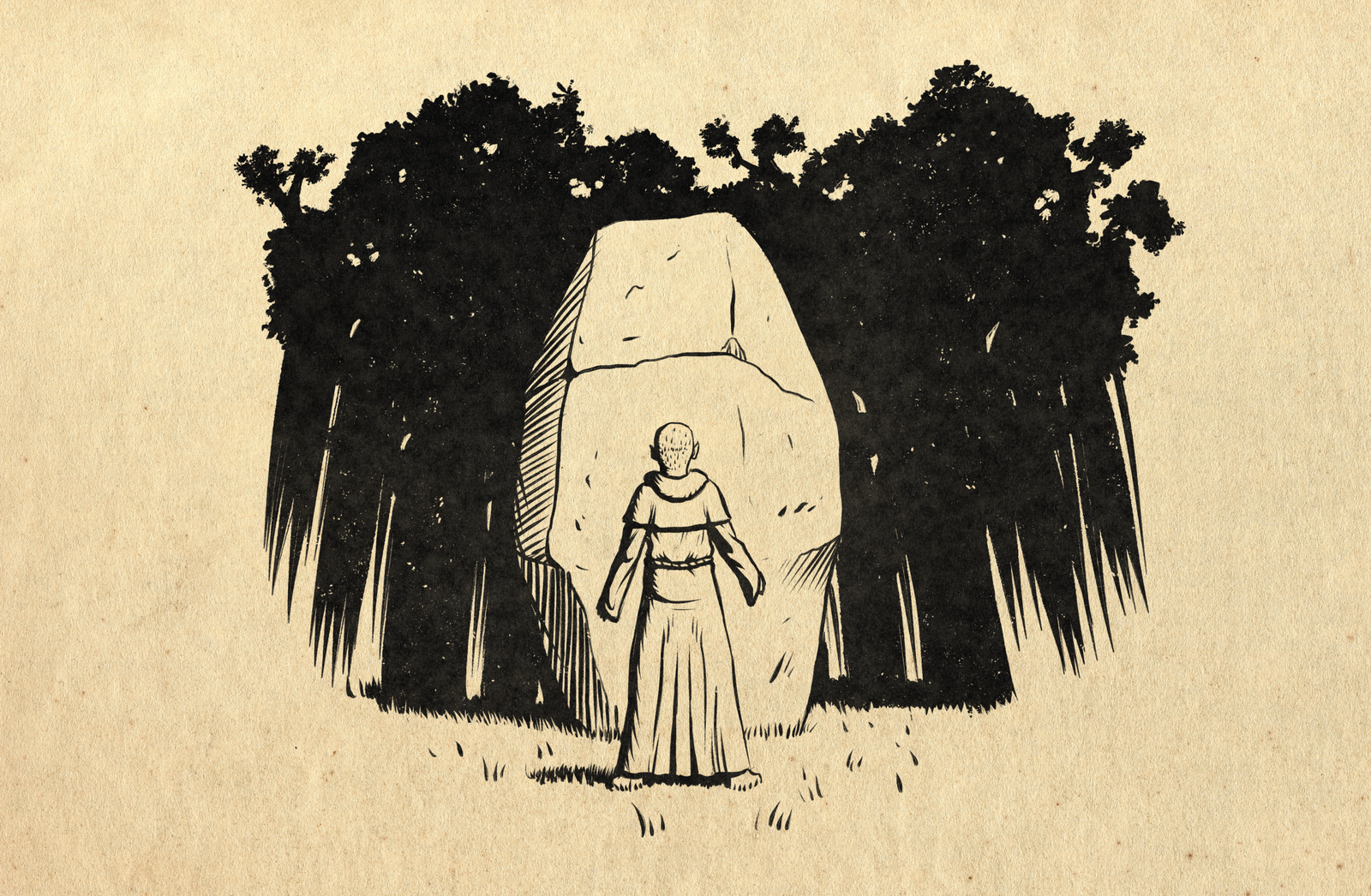
At first he thought it was a hole in the earth, leading down to some black abyss. But it was no hole. It was another stone, whose warmish and coolish grey, moon-like surface was scratched, pockmarked, and filled with scintillations of quartz and amber.
And as he and his unseen follower stood there in the glen’s uneasy dark, they both realized, with terror and in awe, that it was much, much bigger.