I dreaded the climb. After dragging taro and water spinach through the waist-deep marsh, the ladder was an unbearable hurdle to end my day. Even the thought of my pillow-laden home, steaming with rice and hot fish broth, couldn’t tempt me to make the forty-foot climb immediately. If I had been the man my town expected, the exhaustion wouldn’t have stopped me. But the rope ladder’s rungs were spread so wide that I had to grab for each one like picking fruit from a high branch. They had to be far enough apart that the mire people’s short limbs couldn’t reach. I understood the design was for our safety, but it didn’t make my thin arms or legs any less tired at the end of a workday.
I waited for my hunger to outweigh the fatigue on an isolated gravel mound. It offered the most sun to dry my soggy clothes. Lattice shadows from Spanish moss fell over my skin.
Frogs croaked at the banks. The mosquitoes buzzed distantly, waiting for the sun to sink beneath the trees so they could take my blood in the shadows.
And there were no nuns to watch me.
The early evening was cooler than normal for the mid-summer swelter. Even in the humidity, my sweating slowed enough for the sticky layer on my bare skin to evaporate. Feeling dry was a luxury. I removed all my clothes⎯a small sin⎯and stayed longer than normal, stomach growling. That’s when I saw her for the first time.
She pulled her long body from the lake onto the wooden dock, an old water spigot mounted in the center, supplied by our tower. We used it to wash produce during overflow times when the rice and water chestnuts ripened too fast for our main facility. In late summer, it stayed dormant.
I never noticed how gracefully mire people moved outside of the water. Their elongated bodies, short arms and legs, and webbed hands allowed them to flow through the murky ponds effortlessly. I expected that, on land, they would pull their bodies in lumping thrusts like a slug. She didn’t. As a jewel snake gleaming in the sun, she glided fluidly over the planks.
I had also never seen a mire person use a human-made tool. She opened the spigot’s valve and rinsed her body in a clunking stream of clear water. Mini rainbows ornamented her bath. And then she was not so different from humans. Her trunk was a little thicker, longer. And, of course, the arms. As I looked closer, I saw an extra layer of skin lying over her ears, presumably to keep out the murk while she swam. I shouldn’t have looked⎯shame upon my mother and to every nun⎯but without a mud coating, her skin was pink, every bit of it, making her seem less naked.
I was naked.
I rolled on the gravel to retrieve my still-wet pants, aroused and ashamed. Her teeth, her hunger, should have terrified me. Instead, I choked at her nakedness. The women I worked beside⎯because at twenty-four years old, my town still only deemed me fit to be a harvester⎯wrapped their bodies tightly in bamboo fabric. It cut imprints into their skin so nothing fell loose as they bent and twisted. Even though they were so entirely clothed, I could never look at them directly. The nuns taught me well that an unmarried woman will break your tether to the sea. Becoming too close could steal your chance at sailing into the next life.
This was a mire person, though, not a human. I stopped dressing when she laughed. While my pants were still at my ankles, she draped her body over the wetted planks, staring. Her golden irises caught the sun. Supple, pearl-pink skin gleamed in the evening light. She beckoned me with her webbed hand.
Frantically, I pulled at my pants to dress, to run.
“No, no,” her voice rang. “As you are.”
I froze, pants only at my knees. I didn’t know mire people could speak.
“Come here!” She rolled toward me, one alluring turn, and giggled.
Something crawled into me, made me move. Painfully, I stepped barefoot over the gravel and onto the floating dock. I sat cross-legged six feet in front of her and covered my groin with my hands.
“Silly,” she chuckled and then rolled the rest of the way to me.
I couldn’t breathe. She propped herself on one elbow.
That close, the differences between humans and mire people seemed less. Their bodies were longer, but it wasn’t by much. The difference only seemed exaggerated by the lack of clothes to separate the form with a beltline. Even the arms and legs weren’t that much shorter. I should have known by how stupidly far we had to reach for each rung of our rope ladders. And her face was better. Just better. Her nose was flatter and less pronounced. She had a sleeker jaw, a chin focused to a point, thicker lips, wider eyes.
It really was the eyes⎯golden eyes, wide and wet. When she blinked, an extra, clear lens followed just behind her eyelid. Unobstructed, her golden irises shone even brighter. The way she gazed made me unafraid.
“Touch me,” she said.
* * *
The orange sun sank beneath the cypress trees, and she slid into the water without a goodbye. I watched her sleek body ripple into the distance, then returned to my ladder. Somehow, I had more than enough energy to make the climb.
As I prayed the next morning, my thoughts drifted more toward Goggles than to the sea. I called her “Goggles” because of the lenses over her eyes. Mire people don’t have names. She had told me in the small moments between lovemaking, the moments when my cheek rested on her collar, that I should call her anything I liked.
Goggles had never asked for my name.
The next day, when it was my turn to state the Promise in our morning prayer, I stumbled over words I’d been reciting since I was a child. I neglected to flip my clamshell upward to receive the holy destiny, and Nun Willow swatted my ears with a reed.
I had never sinned in the eyes of any nun, especially not hers.
Nun Willow watched me as I dressed in my overclothes. She glared through the slit between her knitted head dress and scarf. Other than around her eyes, the gray fabric covered every bit of her skin. Even her hands were gloved.
But her eyes were enough. Brown and dull and judgmental, they were nothing like Goggles.
After that day’s work, I returned to the floating dock. As I sloshed through the mud, I found myself terrified. At first, I assumed my fear was of destiny. Would I be permitted to the sea in the next life? Was copulation with a mire person the same as with a woman? After all, Goggles was not the animal the nuns had always described.
But that wasn’t my fear. It saddened me to realize at that moment how little I felt for the sea. Yes, it had my heart. Yes, it tugged at my mind. But I would not serve it that day. That toothy fish tearing between my ribs was a new worry. I feared that Goggles would not be on the dock, washing in the spigot’s clunking water. We had not discussed meeting again.
She was there when I climbed the gravel mound. Sunlight filled my lungs, chasing away the churning. Rinsed and giggling, she beckoned me just like the evening before. I did not hesitate. I went to her, and we made love again and again.
And it was love.
This time, before the sun could dip into the cypress, I held her head on my collar as a man should hold a woman. She looked confused with her golden eyes as I guided her into the position. But she let me, and we listened to the frogs.
“We’ve been taught wrong about you,” I said, stroking her coarse, short hair.
“Really?” she responded dryly.
She was adept in languages. I only knew the tongue of my town, but she had learned several. Her anatomy was slightly different. She couldn’t make all of the same sounds. T’s were represented by clicks and S’s hisses. L’s and R’s were identical to my ear, and I had to decipher her intent through context. She could only make the hard G and compensated tonally, using a higher pitch to represent the soft sound. Acclimating to those differences was simple, natural.
“Yes.” I tensed. My heart flickered, and I dug my fingers into her ribs.
“Ready to go again so soon?” Goggles flirted.
I chuckled and said, “No, I’m just…I don’t know.” I made myself take a breath. “The nuns taught me that mire people are like animals. That you can’t talk. And they say you’re dangerous. I’m sorry, that’s probably hurtful.”
She nuzzled her head into my chest and laughed. “Why would that be hurtful?”
“I know what it’s like to be hated,” I said.
That was true. Everyone in town mocked me for my small body and squeamish stomach. I contradicted manhood, though I was a man. The potential of me was in them, so they feared their weakness in a world of poisoned mushrooms and hungry jaguars. Fear presented as disgust, and behaved as hate.
I had decided to never blame someone for being afraid. But it still hurt. I assumed it would hurt Goggles, too.
“It bothers you to be hated?” Her prurience dissipated into actual curiosity.
“Of course.”
“Why?”
The root was hard to dig, such an obvious question. I wanted to give her the sour feeling in my stomach for an answer.
“Because everyone you love, or at least depend on…” I had to pause to gather the feeling, distill it into words. “They might stop.”
“Stop what?”
“Stop everything, I think,” I replied. “Stop sharing, talking. Stop taking care of you if you’re sick. Maybe stop letting you live with them.”
I couldn’t think of anything else at the moment because Goggles rolled three hundred sixty degrees on my bare, sweaty body. She bellowed laughter for nearly a minute while I stiffened.
“You’re so funny,” she said finally.
“Why am I funny?” I blurted, a shimmer of anger at the edges of my tone.
“Not you, you,” she answered. “All of you. Humans. You live in little turtle traps and sing when someone makes you. You harvest when someone makes you. You sleep when someone makes you. And the most hurtful thing is that they might not let you live like that?”
I felt mocked. Life was about cooperation, about taking care of your people and journeying to the sea.
“Well, how would you feel if the other mire people stopped caring for you? If they hated you?” I bit the words.
“Chestnut,” she said softly, caressing my shoulder with her webbed hand. She had started calling me that. “We’re different. Our mothers leave when we can hunt. I guess I don’t have to worry about being hated.”
She kissed me with her thick lips. My anger faded like rice husks over water, down current. I would have happily never taken another breath if the kiss could have lasted a few more seconds.
We made love again. Then, she built a fire and skewered salamanders over the flames. Instead of a fern ceiling, that night, I lay viewing the stars. Before fading into a dreamless sleep, I realized why the town hated mire people. Goggles was free. Humans saw the potential for freedom within themselves, and it frightened them as it did me. Fear turns to disgust, and disgust to hatred.
Fear keeps you dragging water spinach through a swamp.
* * *
I tugged on a net filled with taro, dripping sweat into the marsh. Every leaf clung to the water, making my net drag heavier with each sloshing step. The day was boiling. Even the mud that buried my feet was warm. Being one of the only men who worked the harvest, I was tasked with dragging the nets, even though there were women stronger than me. They never gave me the less strenuous labor of digging roots on the bank or cutting water spinach.
Before Goggles, it was never annoying. I thought the labor would make me as strong as the other men and, one day, I could join the hunters or builders. In the wake of my affair with a mire person, however, I was growing to resent my work. For whom did I need to be strong?
Goggles loved me.
For over a week, I had not climbed my ladder after finishing with the day’s harvest, and spent every night with her. Some of them, we only lay beneath the luminous night sky and she told me stories about the stars. One night, she had pointed to a string of stars that had once been a toothless snake. It swam through the swamp banks, stealing eggs from bird and alligator nests. Even though she swallowed them, the toothless snake did not ingest the eggs, but incubated. When they hatched, baby birds and alligators emerged from the toothless snake’s mouth. The birds could swim and the alligators could fly. When the toothless snake was old, all of her children carried her into the sky, and never returned to the swamp after. That’s why the frogs chirp, to mourn their absence.
I was thinking about the toothless snake, about the thrilling sting of changing into something that flies instead of swims, to distract from the grueling weight of my net. The lack of sleep weakened my legs. Spending every night with Goggles after a full day of labor put me to bed late, and I had to rise before dawn so that the nuns wouldn’t catch me sneaking back into the town. We hadn’t even made it to the midday meal and fatigue throbbed in my bones. I closed my eyes, hoping that my body would endure until the nuns released us that evening.
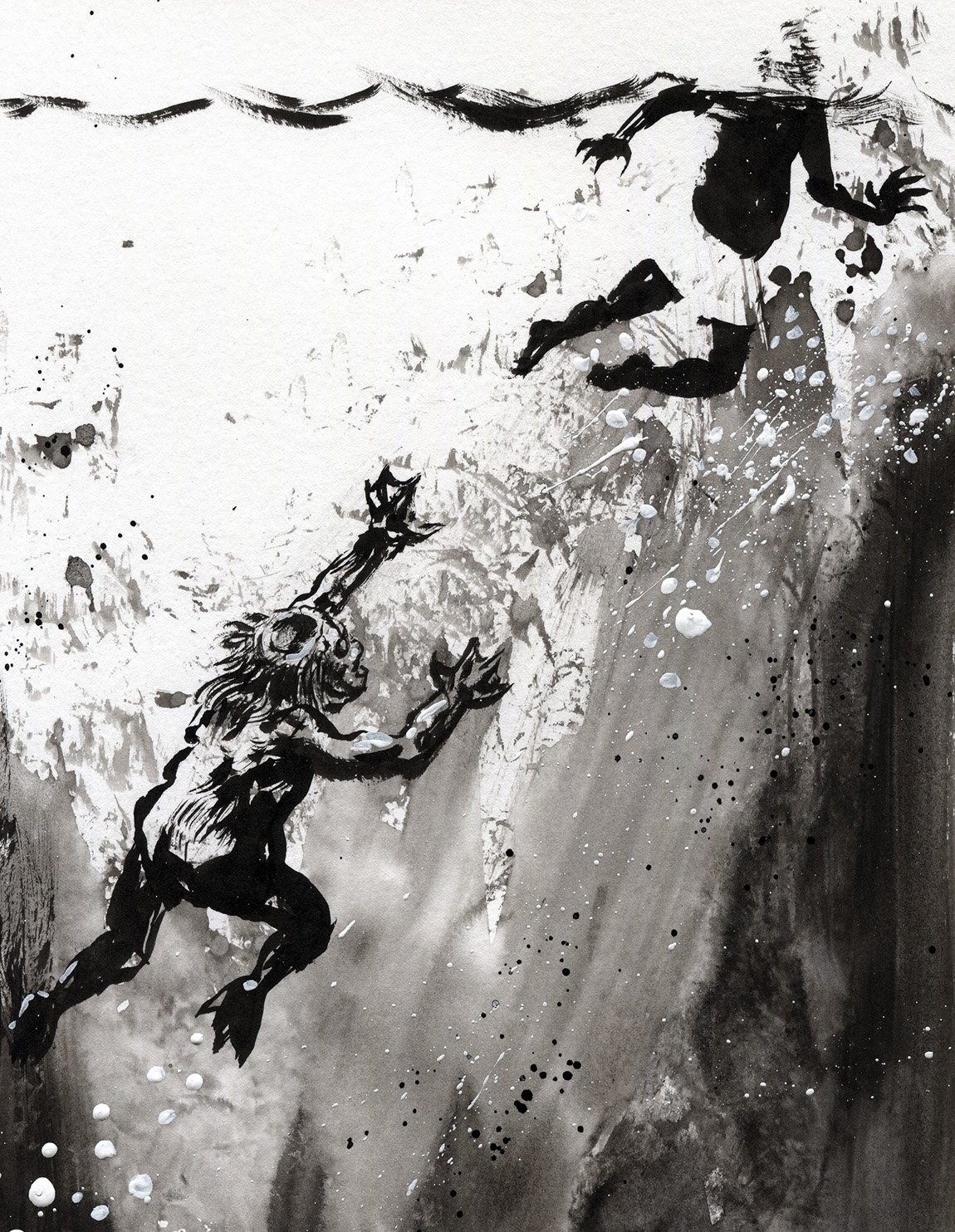
There was a splash. A cool droplet landed on my cheek. Two women who had been digging roots shouted and climbed high on the bank. Another splash, and this time I saw it. A mire person jumped in the lake where the marsh floor dropped steeply into deep water. It wasn’t Goggles, I knew instantly. This person was too large and definitely male.
Nun Iris blew a horn. Its sound was sharp in my ears, and I was suddenly afraid, not for my townspeople but for the mire person. He needed to swim away.
The other harvesters dropped their work and fled. I let go of my net. As it floated freely in the current, I pumped my legs toward him.
“Get out of here!” I shouted.
The horn stopped blasting.
“Child!” Nun Iris paused to scold me. “Go with the others!”
I had never ignored a nun.
“Leave, now!” I yelled again, staying put.
The mire person stopped splashing. He bobbed his head above the water and retracted the clear lens from his eyes. They burst with a familiar gold. Course hair grew on his head and down his cheeks. His face was plump. He seemed younger than Goggles, younger than me. A teenager, likely, in human terms.
With my back to Nun Iris, we locked gazes for what felt like minutes. He must have seen in my face the fear, the danger, and started to shake. The horn sounded again as Nun Iris continued calling for hunters. He jumped at the sound, but kept eye contact. Instead of yelling, I mouthed the word “go.” After a moment of hesitation, he swam away.
I let the breath I had been holding stream from my lips like an evening wind. Within a minute, a flat boat sliced past me on the shallow water. It carried one shotgun and three harpoons. The shotgun fired as the mire person breached in the distance, but he was too far. The shooter was scolded for the waste, and then all four hunters turned to look at me.
* * *
At our break meal, the hunters gathered around my wicker stool. The large men, thick in the gut from eating well and riding in boats, loomed. I stopped slurping my brothy rice.
“So this is the man who stood down a mire person,” one of them said. I couldn’t read his tone, but I couldn’t with most people. In his shadow, I hunched my shoulders.
“Nobody’s done that since the first Henry drowned,” another said.
He was talking about a bedtime story. The first Henry, as the legend went, fought a mire person bare-handed. All mire people were bigger than us, but in this story, the mire person’s body was as long as a cypress trunk. The first Henry wrapped him in a net and swam to the bottom of the lake. He held onto a rock, tethering both of them underwater. Mire people can hold their breath for over ten minutes, and most humans can’t go longer than three. However, the first Henry outlasted the mire person, drowning him to save the town. Just before surfacing, the first Henry also drowned, dying a hero. Only the firstborn of the most respected families can be named “Henry.” They bear torrential pressure to honor the legacy, despite no one really believing that the story was true.
“It was more of a staring contest than a fight to the death,” I said almost under my breath, realizing the town had mistaken my desperation to save the mire person as an act of bravery. They thought I had been protecting the harvesters.
“No one else in my boat would have done it,” said another hunter. He stood in the back of the group, slightly up the bank. Older and broader in the stomach, his face was clean-shaven, whereas the other hunters grew scraggly beards. With light green eyes like glass, he stared at me. I stopped breathing.
“Sometimes the sea puts a giant’s heart in a runt’s body,” the older man continued. He turned and looked at Nun Iris, who had been supervising the conversation. Actually, she had been supervising me since the incident, and I expected to be accosted at the end of the workday for not obeying her order. She squinted at the hunter.
He said to her, “May I request this man be reassigned to my boat? I think he’s wasted as a harvester.”
Nun Iris crossed her arms and looked to the side. Then she nodded.
Just like that, I was accepted as a man.
* * *
That night, I made love to Goggles with a veracity, a heat that lived deep in my gut, one I had never before mined. She giggled and twirled as I repositioned her body under mine, digging my toes into the boards to create force. With her sharper-than-human teeth, she bit my collar, and I started to bleed. I didn’t care. I was thrilled, even.
We watched the stars, sweating and exhausted. A hunter. The thought swelled in my mind like a rainstorm.
My feelings were confused, though. Something pinched in my lower stomach. Everything I wanted could be had as a hunter. Still, I couldn’t tug from the feeling that I was stepping out of a turtle shell and into an alligator’s jaws. Hunters shot mire people. It was rare, but once I learned to use firearms, would I have a choice?
Goggles nuzzled her forehead into my cheek to draw my attention.
“You’re lost in the stars,” she said. I smiled and stroked her hair. She pointed to a corner of the sky containing a constellation of scattered clusters. “Do you want to hear about the frogs and tadpoles?”
“Where do you hear so many stories?” I asked.
I had heard the story of the first Henry from the nuns, sat cross-legged in the school room, silent for fear of not being served dinner. Goggles lived such a different, solitary life.
“From my kind, I told you.”
“But when?”
She looked up at me from my chest, her lips curled up. “Usually in moments like this.”
I paused, considered. A heaviness pressed on my legs. The thought of Goggles with other lovers had wafted through my mind. The nuns called it evil to have more than one. Suddenly, Goggles felt like she was still covered in mud, even though her pink skin shimmered cleanly in the starlight. I didn’t like the feeling, or myself for feeling it, or thinking of myself as a hunter who might one day draw blood from pink skin. I took a long breath to balance myself.
“Any other times?” I asked.
She rolled off my chest, then pulled me into hers. Her fingers ran over my scalp. A tingle rolled over my skin, beginning at the neck and ending at my hips.
“We are with our mothers for a while,” she said, her voice deepening. “They hold us like this and tell the stories. It’s strangely warm.”
I remembered my mother, how she had always asked the nuns’ permission on which book to read to me at night. When I was very young, she would climb into my bed and I’d snuggle against her shoulder. But the nuns had eventually told her to stop because I was too clingy, because I cried when she left me in the school room before going to the swamp for harvest.
“My mother told me stories, too,” I said.
“That’s one of the few things that’s the same of your kind and mine,” Goggles responded.
“How do you know so much about us?” I asked, realizing I hadn’t questioned that before, so enthralled by my own feelings.
“I’ve watched humans my whole life,” she answered. “It’s so curious how you live.”
“Turtle cages.” I smirked.
“Yes, but…” She bit her plump lower lip. It was the first time she hesitated with me. “There’s something beautiful about you. I love some of the things, like showering in the water spigot. Not hunting for every meal because together you create surplus. Clothing can be beautiful, too.” She looked at my gray clothes piled at the edge of the dock. “Other towns have much more attractive clothing.”
Laughter bubbled in my throat. I’d never considered making something like clothing attractive.
“Other towns?” I asked. “Is that where you learned our language?”
“Sort of.” She squeezed me tightly.
“Sort of?”
“I’ve been with others like you. They mostly taught me.”
Oh. Of course. She had not only had other lovers, but human lovers. People in other towns didn’t get to see the sea when they died, after all.
Goggles squeezed me in her short arms, then stroked one hand down my stomach, over my pelvis, on my groin.
“But you’re my only Chestnut,” she whispered into my ear.
* * *
I didn’t sleep much after our conversation, and spent the night wondering whether I should have told Goggles about being reassigned. Hunters mostly killed deer and alligators. I would never hurt her, but I could be told to. I could have to watch as another hunter took a shot.
At the end of prayer the next morning, I flipped my clamshell. One at a time, the nuns nodded to the other harvesters, releasing them to their day of work. They skipped me, though. The harvest left immediately after prayer, but I knew better than to dismiss myself. When I was the only one left, two of the three nuns glared, then descended the ropes themselves. The remaining nun, Nun Willow, stepped toward me in her knitted tunic that hung like Spanish moss in a frost.
“Henry,” she said, standing over me.
I didn’t know she was talking to me immediately. No one had called me “Henry” since my mother died.
“Yes, Nun Willow,” I said after hesitating, the familiar sourness churning in my gut from hearing the name my father had given me.
“We need to discuss your reassignment.” Her voice was higher than average and had a faint rasp. Even so, it was a heavy tone.
“Yes, Nun Willow.”
“You will join the hunters the day after the solstice.” She paused, eyed me.
“Yes, Nun Willow,” I said again as soon as I was sure it wouldn’t interrupt her.
“Nun Iris told me about you and the mire person.”
While I knew it must be the male from the day before and not Goggles, I was instantly terrified.
“She said the hunters admired your bravery in protecting the other harvesters,” Nun Willow added.
I blinked a little too long and let air leak from my nostrils.
“But she doesn’t agree with their assessment.” She knelt beside me. It was uncommon for a nun to lower herself to anyone’s level. I pressed my elbows into my ribs.
“Nun Iris believes you feared for the mire person,” Nun Willow whispered.
Nuns never whispered.
“I was…” I tried. I had never had to lie to a nun. Even as a child, when other children practiced their lying, I couldn’t make myself.
“We went to your room last night.”
I wasn’t there.
“By your hair, I can see you’ve been less groomed,” she went on. “Where have you been spending your nights, Henry?”
Salamanders swam in my stomach and lungs. I looked straight ahead at the bamboo wall, unblinking. Her breath tingled on my ear.
I jumped when her hand touched my shoulder. Nun Willow turned to sit on the floor. She leaned her back against the wall and faced me.
“I saw, Henry.” Her tone was conversational rather than authoritative.
“Saw?” I had never hoped for anything as much as I hoped that Nun Willow had not seen Goggles.
“Henry, I don’t know how we’ve let you drift so far.” Her words were slow. “Having relations with a mire person is a detestable sin. Nakedness under the sky is a detestable sin.” She looked at me as tears gathered in my eyes. Her brown irises shone scarcely, but brighter than I had ever witnessed. “Henry, do you know what my role is in our town?”
Their role had always been to give instruction and to be pleased by my obedience.
I choked out, “To lead us to the sea.”
She sighed and rested her head against the wall. “That’s how we summarize it. But really, it’s to protect you from the currents that lead away, even when you don’t like us for doing it. I never saw you drifting, even though you’ve gone so far. I’m sorry, Henry.”
She invited me to rest my back on the wall by her side. My heart pounded, but I obeyed. We sat silently for several minutes.
“Your father would be so happy if he knew of your reassignment,” Nun Willow finally said.
“Yes, Nun Willow,” I replied automatically. The words were suffocating, interrupting my rapid breath.
“But your mother was already proud.” She looked at me. I could tell she was smiling by her eyes. Nuns weren’t supposed to smile.
“I won’t take away your assignment,” she said.
My eyes popped open. I hadn’t yet thought of being denied the reassignment as a possibility, but I was still shocked.
“Really?” I asked.
“No,” she replied. “There are many streams that lead to the sea and many that lead away. But they all connect, Henry. Even though you’re headed away, you can still reroute, choose a different stream.”
The salamander fattened and hibernated at the bottom of my stomach.
She continued, “You must never again have relations with the mire person. As penance, you will never be permitted to marry, defiled as your body has become.”
The weight of her words made me wilt. A life alone. No wife. No Goggles.
Nun Willow added, “However, to atone for my shortcomings, I will offer two kindnesses.” Now, her eyes were fully wet, truly shining. “No one beyond you and the nuns will ever know of this sin. Also…” She wrung her hands together through knitted gloves. “I will wait until tomorrow to tell the hunters of a mire person sighting. Under my supervision, you may warn her to leave.”
* * *
The nuns stood in a line like birds on a branch. Nun Willow, Nun Iris, Nun Lily, and seven others I would have needed to see up close to identify. They stood on the gravel where I used to dry myself after harvesting.
Goggles was usually waiting for me by the time I finished work. I had skipped the harvest to walk with my nun shadows from the prayer room to the gravel. Still morning, I was unsure when she would arrive.
I also didn’t know what I would say. The next day, hunters would be there with their shotguns and harpoons. Would I tell her to leave me so I could become a hunter, honor the name Henry, make my father proud?
My mother was proud of Henry the harvester.
Goggles loved me regardless of my assignment.
Would Nun Willow love me even on a current that flowed away from the sea?
No.
Hours passed. I sweated into the boards. My stomach roared with hunger. My throat scratched with thirst. As the sun kissed the cypress treetops, I heard a splash. In the lake on the other side of the marsh, I saw a dim breach in the water’s surface. Goggles was coming.
I kicked out of my boots. Facing the nuns, I stripped my overclothes, then my under. Naked, I stared down the nuns the way the hunters thought that I had stared down the mire person. As still as stone, they returned my gaze.
“Nun Willow,” I said with a shake in my voice. “I love Goggles. She’s the mire person I had relations with.”
All but Nun Willow dropped their eyes to the ground.
“I want her more than the sea,” I said.
Nun Willow’s dry eyes pierced me, sent worms beneath my skin. Finally, I had to turn away. The worms calmed as I watched Goggles approach.
“What’s this?” she asked, pulling her muddy body onto the dock and eyeing the nuns. I leapt to her, threw my arms around her shoulders, coating myself in her murk.
She giggled and said, “Let me shower first, Chestnut.” She paused. “I don’t normally perform for an audience, but if that’s how you’d like it…”
That shook me out of my stupor. “No, no. They found us, but it doesn’t matter.” I stepped back and looked into her golden eyes. “I have something to tell you.”
“What is it?” She tilted her head.
“We can’t stay here because of the hunters,” I said. “They’re coming tomorrow, so you have to go. And I want to go with you.”
Goggles threw her head backward, splattering mud on my face. “What do you mean?”
“I want to be with you,” I said. “If I stay with the town, they won’t let me. And I’ll have to be a hunter and maybe hurt people like you. I’ll be in the turtle trap for the rest of my life, and I’ll never see you again.”
I expected Goggles to understand. We loved each other. We had to stay together.
But she smiled softly, too much like my mother had when I asked her to lie down next to me for the stories at night, and when she said no. Goggles held my cheek with her muddy hand.
“Chestnut, we can’t stay together.” She said it so softly. “I have to swim south soon to follow the fowl.”
I paused for a long moment, then whispered, “I’ll go with you.”
She chuckled. “I don’t want you to go with me.”
The tears gushed from my eyes so suddenly. It was as if they had been held behind a glass that Goggles, with eight words, shattered. I couldn’t say anything. I wrapped my hands around her waist and squeezed. She stroked my head for several minutes.
“You’re strangely warm, Chestnut,” she whispered.
I coughed out the worst of the cry and pulled away. My eyes felt swollen, and I had to squint.
“I love you, Goggles.” A lingering sob caught in my throat. “I thought you loved me.”
Goggles let her hands slide off my shoulders like limp fronds. She tilted her head and blinked. When she opened her eyes, the lenses covered her irises. The shining gold looked cloudy through the barrier.
She said, “I don’t know what that means.”
Goggles fell backward lavishly into the marsh, and swam toward the lake. She left me naked and mud-soaked on the wooden planks.
“Come home, Henry,” Nun Willow called.
All around me, the world looked fuzzy. The green cypress, brown mud, blue sky, it all smudged together⎯a gray static. Every sound muffled except the frog chirps. Sharp as thorns, they pierced through my haze, and they were deafening.
Perhaps Goggles was my toothless snake, and I was a bird who could swim, an alligator who could fly. I stumbled my feet back into my boots and picked up my clothes. I walked into the marsh, away from the lake and from the town. I walked away from the sea. I walked away from the rope ladders.

