
When the sexton returned from digging the poor man’s grave, moonlight carved a thin sickle of white through the shed’s window. In the pale light, the corpse’s fingernails still looked wrong: grey-black and dry, almost earthy, splitting with web-thin fractures that exposed the dead flesh beneath.
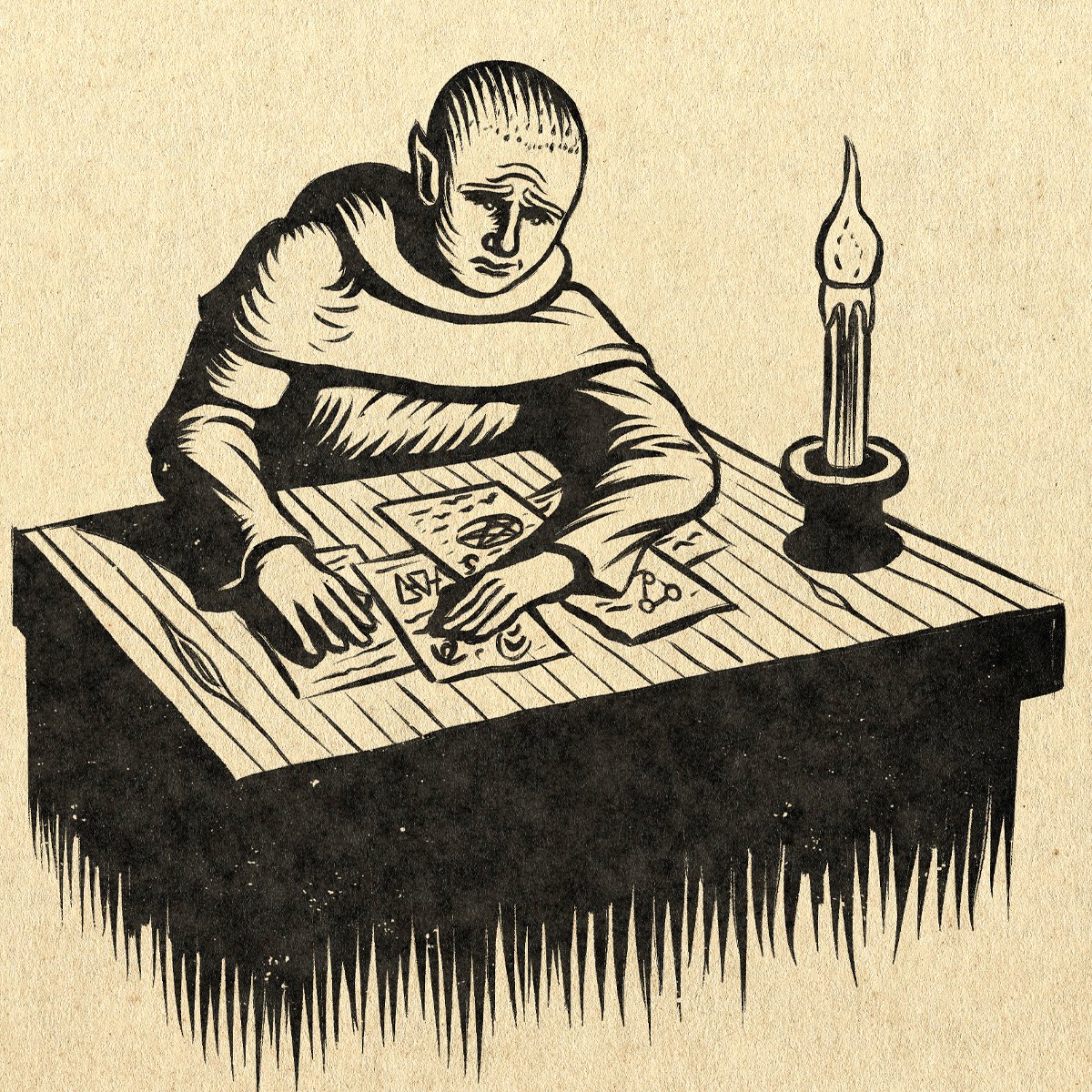
With uneasy huffs and muttered curses, the sexton set his shovel aside, wiped his hands at the basin, then brought a candle to the table and lifted the corpse’s hand up to the flame’s spectral glow.
He gingerly pried at a hairline crack on the corpse’s right index finger, watching as the material crumbled to the floor, nail and all. Thirty-three years in the temple’s service, and he had no clue what to make of it.
The brickmaker’s body had arrived at the sexton’s two-room shed behind the temple just yesterday. The priestesses had told him about the man’s public fall in the town square, the stone he had been holding, raving about, when he died. Apart from that, there was nothing to tell. They’d received and blessed him and carted him here, where the sexton was to clean him, wrap him in a shroud and bury him.
But the sexton, pious and careful, couldn’t stomach sending the corpse into the earth with this strange affliction unsolved, with the hands still grey-edged and knobbly. He’d thought it might be dirt, caked beneath the keratin after a final hard day’s work. But it was on the nail, or part of it, brittle to the touch.
How could it be dirt, too, when it wasn’t only the nails?
The sexton brought the candle to the corpse’s mouth, winced as he parted blue lips to see the dark arrangement of teeth beneath. They looked the same. Like game pieces, like beads, they were coarse, rocky, their corners flaking down into the flaccid throat at the sexton’s gentle picking.
After receiving the body and trying a first clean, he’d notified the priestesses of the aberrance, then wasted the day’s best digging hours watching as the novitiates cast spells with glowing lights, rubbed salt into the enamel, brushed oil on the nails, and told him it should look better by nightfall.
But the body looked the same.
Unsettled, the sexton pulled his finger from the cold mouth and wiped it on his apron. Then, as he often did when stumped by a problem, or faced with hours yet of grueling digging, pruning, or window-wiping on the temple grounds, he prayed.
“Oh Desmorah, I pray this fellow into your comely hands and your comforting bosom.” In the temple’s statues, the goddess was ample-figured, a detail which subconsciously featured in the sexton’s private prayers. “And may his lot in your domain be fitting for the nature of his life here in Threehill.”
Arms feeling boneless from digging the grave, the sexton turned and picked up the suspect stone from the table—ordinary looking, the size and shape of a large potato, dark and cool to the touch, the brickmaker’s final fascination, as the priestesses had told it—to see it better by the body’s hands in the candlelight, to approach some hypothesis he could not yet name.
“I pray, too, that you’d help me figure out what in ash has happened to this poor fellow’s fingers and teeth, and that it not be some failure of my procedure or care, for I work so hard to ensure the glory of your…”
He stopped.
Meager light caught some facet of the rock, the materials of the fingertip, and the stone and nails both revealed faint flecks, mineral colorations so small, so uncertain, so similar, that they must be tricks of the candle’s glow as it mingled with the moon’s bleak white.
“Yrig,” he swore, then yawned. “Dear mother, I’ll try cleaning his hands again come morning. And the mouth, if I got a stomach for it.”
Weary from his labor, the sexton blew out the candle with a pious breath, removed his smock, and stripped down to his unders. As he was about to retire, though, he saw the stone again, the way it glinted in the light the moon cast on the table, and he brought it with him to his bed.
For some time, he meditated on its facets, turned it over and over again in his hands, rested it on his stomach to better feel the satisfying weight of it as he drifted into uneasy dreams of all the graves he’d ever dug, and the swelling, aching earth beneath them.
Over time, though, the dreams unsettled him, became more real, overwhelming him with the feeling that he was, indeed, buried, unable to move.
He tried to wake up, and realized in horror that he was already awake, had been for some time, with a strange, shaking stiffness in his muscle, with eyes that wouldn’t open, with limbs that resisted his command.
The sexton forced himself to move, heard the stone thud on the floor, and felt as unknown forces, some unfamiliar substance, cracked around and within him as he strained upward in the bed.
Agony.
Each movement seemed to snap a bone in two, to draw a warm, wet, rush from his arms, elbows, head, neck, the smell of iron filling the room.
Fearing that some coating had sealed him in his sleep, he shouted, then stood with an explosive effort as if to escape it, and the pain expounded, and he was unsure whether stillness or movement was the torturous source. He tried to cry for help, achieving only a scathing gargle.
He reached for his face, clung desperately to his own knobbly, crumbling flesh, and felt some of it come away in his hand and fall to the floor. Stumbling around with eyes glued shut, he was unsure whether he felt the shed’s walls or merely the chaos of his skin destroying itself.
Now upright, he realized he did not want to lie down, to stop, to be still again—the idea brought him a sudden, overwhelming terror. If he kept walking, surely he would exit his shed behind the temple, and a priestess would see him, find him, hear him. He unleashed an inhuman groan, slightly louder now that his jaw had broken loose, and stumbled on, out of the shed, into the wood beyond, unseeing, uncertain, praying to Desmorah with all his heart that someone would catch him, and take him into her bosom, and rub salt and oil on his wounds with magic lights.
Huddled in a candlelit room on the dormitory’s upper floor, Ollis squinted down at his list of declensions, one hand tucked behind a subtly pointed ear as he drowsily scanned the parchment.
It was the greater transmutation rituals giving him trouble. The root words of each spell had a horribly complicated suffix system: -aritiris for those drawing on the plane of air, -silock for those of Druidic origin, but only when the modifying word was also Druidic in origin, and in other cases the root would be suffixed by -garlus, then -aziphael for impermanent alperfected transmutations when performed in a terrestrial domain, -palurat for all transmutations related to cats—
Ollis propped his clean-shaven head upon his palm and sighed. He wanted nothing more than to go down to the dormitory’s common room for a bit of hot rootmead—to savor its creamy, slightly bitter taste as his friends came down for an early breakfast. To chit-chat as the sun rose over Capplewait, maybe make plans to see his favorite team’s big match in town this afternoon…
But, yrig, Ollis couldn’t make it. After today’s notoriously long examination, he was due for a chat with Idris Jorhan. And that chat, he would not miss for the world.
If all went well, it would be when his teacher confirmed his promotion from a novitiate to adept. From a boy to a true Waithen.
Reminded of his duty, he steeled himself and whispered in the candle’s glow:
“-aritiris, -melirin, -incatim, -bas, -illirisat, -soris, -silock, -garlus, -acinate, -avident, -relock…”
Hours later, he emerged, his eyes sore, his mind numb and emptied of everything but the rhythmic sound of those syllables. The wool of his brown robe, subtly patterned and thick, warmed his tired limbs against the cool morning’s breeze as he walked, catching glimpses of the lake through the city’s side streets. Beside him, others walked for work, perhaps leisure, a few maybe even students like himself—hard to tell who’s who with everyone in this town, at this hour, at least, wearing the same tunic, the same wool robe, and that gleaming, hairless dome of head. Everyone, Waithen.
Maneuvering the city’s labyrinthine old quarter, Ollis arrived at the school’s offices, tall, dark, unpredictable hardwood structures whose rooms jutted from many facades. He crossed the building’s threshold and felt a tickle in his ears, signaling the structure’s magical charms for the detection of weapons, the shutting of windows, the preservation of centuries-old wood.
Ollis climbed tight stairs up to the fourth floor, declensions a flurry in his head, scurrying towards the Idris’s office at the end of a slightly tilted hall. But, just before grabbing the door’s familiar metal handle, he stopped.
“-incatim, -bas, -illirisat, -soris, -silock,” he whispered. “No, wait—” he shook his head. “-incatim, -bas, -illirisat, -soris, -garlus—all of Vindac, what am I saying?” he sighed. “-incatim, -bas, -soris, -silock, -garlus.” He’d had it right the first time. If he kept working the words over in his head, he’d start second-guessing everything he’d worked so hard to retain over three sleepless nights. He’d lose his cool during the examination, make a fool of himself…
Addled, Ollis took a few deep breaths, raised his palm to his nose, and with a delicate flourish of his first and third fingers, uttered, “pistenderis olfa.”
He heartily inhaled the scent of rootmead that rose from his hand. Nutty, creamy, with a hint of toasted bitterness on the end. In a flash, he remembered warm blankets, the sounds of his aunt telling him adventure stories as winter snow melted against warped glass windows. A memory like an ache.
As his shoulders finally relaxed, he breathed again, reached for the door handle, and gently swung it open.
Inside, Jorhan sat at his desk, his notably large frame—for he had a bit of giant in him—still as stone. His eyes were milky white, clouded over by the magic of the innerweave, probably in the middle of a communication spell of some sort. As Ollis sat, Jorhan twitched his head and blinked his eyes back to their usual, sage form.
“Ah, Ollis.” The teacher’s syrupy bass filled the small office. “The last of your Lower Examinations.”
“Yes sir.”
“You’re early.”
“Yes, I know,” Ollis anxiously stifled a yawn. “I hope it is no inconvenience.”
Through the open window behind Jorhan’s desk, misty sunrise fell over the city of Capplewait—all its jagged towers, bright windows.
“It is unexpected,” Jorhan replied with a hint of reprimand. “We had said the third hour. I was in the middle of a chat with a Magis, you know. Didn’t your other Idri tell you it was bad form to interrupt a spell?”
“Sorry, sir.” Ollis’s cheeks flushed.
“No matter, no matter.” Jorhan chuckled and scratched at a fleshy neck of greying stubble. “Are you prepared?”
“Yes, Idris Jorhan.”
“Do you think you’ll pass?”
“I, well—”
“Ollis, just tell me whether you think you’ll pass.”
“It’s hard to say, I think…I’ve heard some claim that the exam was harder than they thought, others that it was easier, and I believe I have a handle on the concepts, at least, but the rituals can be quite difficult, and I can never tell if—”
“Ollis.” At the master’s tone, the boy stilled. “If I were to, say, take this quill,” Jorhan said, plucking the feather from his inkpot, “and reconstitute the bird from which it came, I believe I’d need saltpeter, silopane root as a channeling herb, hardwood sap, and a five-planed arrangement in the ritual room. Yes?”
At the suggestion of this impossibly risky and complex task—even the most skilled of the Waithen Order wouldn’t entertain the idea without extensive preparation—Ollis’s brow furrowed. Still, the materials were theoretically correct, so he nodded.
“Then,” Jorhan said, looking wistfully to the ceiling, “I might chant something like: Aelagesis nentoriam bic pilforis,” he cocked his neck and squinted, “for nim glasserac tirenuum, and…” with one end of the quill, he tickled his chin, searching for the last piece, then said, “iagesis bic mentuum. Then, into which of the aforementioned materials would I dip the quill, before moving to the next phase of the ritual?”
“The saltpeter.”
Jorhan’s eyebrows rose. “Oh?”
“That would be the answer,” Ollis replied, “if you’d not neglected a key piece of your incantation: Aelagesis nentoriam bic pilforis for nac glasserac tirenuum, iagesis bic mentuum. Nim glasserac is conjugated for the procession of area, not the procession of receptacle. Nac glasserac, then, is the only way to ensure the reconstituted bird doesn’t start growing inside the feather, rather than around it, which I can imagine would be extraordinarily inefficient.”
Jorhan leaned back in his chair, still tickling the stubble on his chin. “Another question for you, Ollis.”
The boy sat straight, ready to begin the exam in earnest.
“Do you know how many Yaelfand students out of a hundred, whether in their first year or their sixth, would have caught a mistake that obscure, in a spell that preposterous?”
Ollis blinked, suddenly unsure how to meet the master’s gaze.
“One,” Jorhan said heavily, deep brown eyes steady and daunting. “I will ask again. Do you think you’ll pass?”
Ollis turned the problem over in his mind again and again. What did his teacher mean? Was this some sort of test, before the test? Perhaps if he said ‘no,’ he would get this preamble over with, but that didn’t feel quite honest. If he said ‘yes,’ perhaps he’d have failed some test of pride—was that what Jorhan intended?
Try as he might, Ollis could find no solution other than to answer in earnest.
“Yes,” he said, the word falling from his mouth like an unproven hatchling. “I’ll pass.”
Jorhan leaned over the surface of his desk. “So it is,” he replied. With the quill still in-hand, he scribbled his mark on the bottom of some ornate sheet. It took a moment for Ollis to recognize the certificate.
“But, Idris Jorhan—”
“Ollis Hilgerave, Adresil,” the teacher responded, extending the certificate across the desk. “Congratulations.”
Through the window behind the teacher, Capplewait faded in: the chittering of dawnbirds just above the fumbling of chore-busy townsfolk, sounds flavored by the scent of freshly baked bread. Jorhan’s silhouette wiggled the certificate, beckoning. The pupil leaned and took it.
Ollis greedily eyed its scripted flourishes, its illuminated edge, the gaps where Jorhan had filled in their names, the date.
Ollis Hilgerave hereby advances from Nirisil of the Fourth Rank to Adresil of the First Rank, as certified by Idris Jorhan, instructor at Yaelfand College, on this, the Twelfth day of Polir, in the Eight Hundred and Seventy Fourth year of the Second Age.
Holding it, his fingers trembled.
“Thank you, sir,” Ollis said, still uncertain.
“I ought to thank you, master Ollis. I knew you’d pass. You knew you’d pass. The exam would have us in here till the sixth hour and is one of the most tedious in our repertoire. If you’d performed any more poorly this year, I’d have you take it, just to be sure. But at this rate, it’s just a formality. I’m sure already. The only question was, were you?”
As to this last question, Ollis still felt unmoored. His mind and nerves were prepared for hours of questions, recitations, categorizations and written response, those transmutation declensions not least of all. But Jorhan showed no signs of humor, no hints of sarcasm.
“With that out of the way,” Jorhan said, “we have other things to discuss.”
“What’s there to discuss?” Ollis ventured cautiously, unable to handle another surprise this morning.
Rather than answer, Jorhan leaned back and sniffed. “Is that bread I smell?” The teacher looked over his shoulder and out the window.
“Yes sir, I think so.”
“Tandra must be back on it! She hasn’t baked all month. I’ve been waiting for that—don’t let me forget to make my way down as soon as we’re done with our chat.”
“Of course, sir, I—”
“An apprenticeship.”
Ollis’s hands nearly crushed the precious certificate. He couldn’t be serious.
“Listen. An Exploratory Party is heading down to Threehill soon, Idris Harkital among them. Something about an old stone popping up in a brickmaker’s yard. You know Harkital?”
Ollis shook his head no.
“Well he’s a twat. Knows nothing about history, even less about enchantment—two of your strongest subjects. But, to be frank with you, boy, I think you need a bit of twat in your life. The Waithen Order isn’t all ink and salt, you know.” The master leaned over his desk and scribbled something down.
“With all due respect, sir,” Ollis said, “I thought it’d be years before—I mean, I’ve certainly not got the skill and—well, the grit—to make it all the way to, wherever—”
“Well, then I suppose you’ll just die on the way then, won’t you?” Jorhan said, returning to his parchment. Ollis swallowed. “There’s no business in you hoping to work at the Archive—as I know you wish to,” certainly, Ollis did, “without knowing how artifacts are collected and processed. An opportunity like this might not be around in a few years. So, unless you really are unsure…”
He locked his brown, probing eyes on the boy again. Ollis, still getting over the shock of his promotion, could barely process the idea of an early apprenticeship, the sort of thing his peers might kill for. He wanted to think about it, to pause, to consider—but Jorhan’s quill hung over another scrap of parchment, waiting, again, for Ollis’s fateful word.
He nodded.
“Excellent.” Jorhan handed the next slip of parchment to Ollis. “First, give that to Master…what dormitory are you in again?”
“Baligrade, upper floor. Overseen by Master Yur.”
“Give that to Master Yur—it’s your dischargement. He’ll get you squared away. Then, gather your things and head to Kelt’s Keep in town, that general goods spot in Dawnbird’s Corner—”
“The one that always smells like fish?”
“No, that’s Girrigan-Ell’s. Kelt’s is the one with the yellow door, no fish, just junk. And tell him you need to make it to Timp. Not Threehill, but Timp.”
“But Timp’s hardly a day away, isn’t—”
“That way, when he successfully upsells you on everything, you’ll have exactly what you need, rather than a surplus.”
Ollis nodded once more.
“Ollis, you look about as bewildered as a cock in a cathouse.”
“Sorry sir—Idris, I—”
“Do you understand what’s happening?” Jorhan said, stepping out from behind the desk, approaching Ollis as he often would in class after all the other students had failed at some question that was, for him, rudimentary. “Do you understand what you’ve been given here?”
“Yes—well no.”
Jorhan cocked an eyebrow.
“I thought I was here to take a test, sir, and suddenly…suddenly I’m set for an apprenticeship? I don’t mean to misspeak, I am thrilled, but surprised. And I…why? Why me? Why now?”
The teacher nodded, then turned toward the window behind him, letting the morning sun catch the outline of his face.
“I mean it, when I say that one student out of a hundred has your aptitude for Waithen learning. You know that as well as anybody,” his voice lowered again with reprimand. “But, Ollis, if you stayed here another term, your head would get so big it wouldn’t fit through that door.”
Unsure whether Jorhan was referring to an increase of knowledge or an increase of ego, all Ollis could do was nod.
“You don’t need more classes. You need experience, now, before my fellow Idri and the Courts mold you into the cloying bureaucrat I turned out to be. It is a little early, but…” he let loose a sly grin. “I thought you and Harkital might get along nicely, too.”
Still in his hands, the certificate caught a sunbeam, and Ollis saw the last five years of schooling, his countless hours in the libraries, his ceaseless questions in class, his hands aching from the practiced gestures, gleaming there in its filigree. All of it, confirmed.
“Thank you, sir.”
“Alright, then,” Jorhan sat back down at his desk with a huff. “See if you can catch Kelt while he’s still hungover. Might earn you a better deal.”
“Thank you, Idris,” Ollis said. He turned and made his way out of the room, but just before the door shut behind him, caught it, swung it open a crack and called through the gap: “Oh, and don’t forget to go get some bread from Tandra—”
From within, the voice boomed. “M’thanks, Ollis.”
Ollis nearly stumbled as he came back down the office’s thin, crooked stairway, then crossed the building’s threshold into the open street. Each step replaced his uncertainty, his bewilderment, with purer, brighter glee.
He walked, grinning and breathless, in the opposite direction of his dormitory, zig-zagging through alleys before he finally found a proper spot on the bank of Elbroke Lake. A promenade of trees ran along the gentle expanse of blue, their leaves burnt with autumn, their dry, wooded fragrance melding with the dull, clean tones of the water. Right there, out in the open, he got down on his knees, bowed his head, and locked his hands around the back of his neck in the position of Waithen prayer. In the Old Tongue, he began to recite, from the corners of his mind, the Orison of New Beginnings:
Thank you, oh Vindac, whose dominion includes this grace of mine, for the blessing of obedience along a new-made route of destiny…
He would be an apprentice.
…may your mighty hand dwell sacred in the cool waters, to guide the current of our life and will in oceans of your powerful design…
He would be an Archivist.
…bless you, oh Vindac, for your provision—may we honor and recall it in our hearts forever…
He would know the world, and learn its histories, and serve Vindac well.
Three mornings later, outside the city gate, the newly fledged Adresil again had his hands on his neck, head bowed and praying, which Harkital found amusing.
No one said their orisons like that anymore.
Outside of the classroom, the Courts, and the chapels where celibates brewed shit beer to pass the time, Harkital couldn’t name a Waithen who said orisons on the regular in the first place.
Then again, he’d never been a keeper of the most pious company, had he?
“Boy,” Harkital said, shielding his eyes from the sun as it took its damn time rising over Capplewait’s high southern wall.
Northwatchmen chatted by the buttresses. A cart rolled creekily behind them. A bird shat on the road. The boy still prayed.
“Boy,” he raised his voice.
The prayer looked up, a stupid look on his face, and Harkital realized that he was a boy indeed, hardly even a young man, features still soft with a child’s fat, his pale blue eyes, beneath blond brows, wide and frightened-looking.
“Are you the Adresil that Jorhan mentioned?” Harkital asked, hoping he’d gotten their meeting place wrong.
The boy straightened and blinked, stammered a little and finally spat out, “Yes, Idris, sir. I’m Ollis. You’re Idris Harkital, no?” He extended a small hand, fingers round and feather-haired like a pig’s skin, which Harkital didn’t shake.
He wasn’t sure how to answer that question. Didn’t feel much like a teacher these days, not since he’d gotten himself into this mess. And all over that damn powder.
“Yes, I am,” Harkital said, then nodded at the rucksack by the boy’s kneeling spot. “Grab your bag, we’ve got ground to cover.”
“Of course, yes, Idris,” the boy replied.
“How old are you?”
“I have sixteen years, sir.”
“Sixteen?” That was young. He looked even younger. “Did you pay Jorhan for a promotion, then?”
“Maybe fifteen,” the boy replied.
“Maybe? Wh—you don’t know?”
“My father left when I was young, and my mother died not long after. An aunt raised me, but not related by blood—never did learn my exact age, unfortunately. That’s her estimate.” Ollis slung the pack over his shoulder, which nearly sent him tumbling.
Harkital squinted. “Your father was the elf, then?”
The boy nervously raised a hand to cover one of his tell-tale ears. “How’d you know?” he asked, but Harkital kept him wondering. If insults like these kept him quiet, the road would be all the easier.
“Come on then. Keep pace.” Harkital turned to the open road west, not looking to ensure the boy fell in behind, and for a while thought they might make it all the way past the municipal stables in silence. Then the boy piped up again.
“So what do you teach, Idris?”
Harkital’s nose twitched.
“Jorhan only said it wasn’t history. Perhaps alchemy? And I haven’t seen your name in any of the class rosters at Yaelfand—are you a visiting professor?”
Harkital pulled his flask from his cloak and drank its cheap, tasteless, but potent brew, suddenly feeling anxious that it might not last the trip. “Jorhan gossiping about his fellow Idri, eh? Bad form.”
“No,” the boy said, blushing again. “He only mentioned you in passing. I was just, I wondered—”
“I teach. Not here. That’s that.”
“I see,” Ollis said as they crossed a muddy rut. “Well, logistically speaking, I do have all I’ll need for Threehill. Kelt gave me food for three days’ journey, which Jorhan wisely advised me to acquire through a bit of deception. And I also have some parchment, a quill, and some charcoal, though I did learn how to fashion quills myself from common fowl in Scribery last term, plus a thin outer cloak, wax-lined, for rain and the cold when we make camp, and a few other sundries, and a pocket edition of Cardikep’s Histories. I know what you’re thinking—some find the abridgment a little too limiting. But I thought having some light informative reading would be better than none at all. Does all that sound alright?”
Harkital breathed deeply. This would be his first Exploratory Party in what, four? Six years? He was already anxious about seeing the others again. Had they heard? Were they ashamed of him?
Then there was, of course, the artifact they were heading to retrieve, the ever-present, dependably terrible unknown of it—it could be a trinket. Could be a relic. Could be a curse.
And on top of all of it, this boy. Nipping at his heels.
“Perfect,” he replied with great effort.
“No other materials to cover, then?”
“We’ll discuss the rest on the road.”
“Good,” Ollis replied. “I’m sure anything we’ll need for our artifact recovery can be procured at the town, or has already been sourced, so I won’t ask you just yet what else we need. Unless you’d like to discuss it before we get there? A preliminary list of materials? Perhaps a quick overview of the proper recovery procedures would help pass the time? I could assume we’ll need alchemical ingredients, necessary reference texts,” he chuckled, “not to mention our wits, of course—”
“Oi, drunt,” Harkital said, the bitter slur a sterner choice of word than he’d perhaps intended. “Though you may perceive otherwise, your talk isn’t making the time pass faster. If I were you, I’d keep your head down, take care not to trip on my heels, and walk.” The farms were passing behind them now, the forest looming ahead. “Practice your prayers, if you must.”
That night, deep in the forest off the road heading west, Ollis dreamt of the Archive.
He knew so little about the Archive itself, but also knew it intimately—it was his greatest desire, and a secret of secrets. It was an institution that safeguarded the Waithens’ knowledge of the world, open only to the highest echelons of Waithen authority, to the greatest and most trustworthy of Vindac’s servants. The one thing he knew for certain, for this was what any layman who knew of the Archive could actually know, was that the Archive also facilitated the protection and exploration of further knowledge through Expeditions. Like this one.
In waking life, he had somehow made it that far, had become an apprentice on one such excursion. But in his dream, on this night, there in the western forest, he made it even farther.
In his unconsciousness, great halls of knowledge formed, high rooms of oak and stone where he could pull from any book on the shelf and begin reading adventurous tales that began where all the books at Yaelfand so confusingly ended. He found a wide, expansive room full of quiet readers poring over their favorite texts, solving mysteries with each hushed turn of the page. Approaching a shelf, Ollis picked out a volume that had been missing from a collection of alchemical anecdotes he’d requested at Yaelfand last term. A volume the librarian had told him, in hushed, apologetic tones, could only be found here, in the holy, secret place. He pulled it from the shelf, reveling in the gold leaf on its solid spine, and sat at a desk near a crackling hearth, heroes and monsters carved into its mantle, to read freely, ravenously, unencumbered by—
Drunt.
He heard the stern word, looked around for whatever librarian chastized him now. But he was at the Archive. He was an Archivist here. There would be no secrets for him, no limits to his knowledge. Were even his dreams unsafe from—
“Wake up, drunt.”
Ollis’s eyes opened to the gravelly voice and the sparkle of a blade drawn in moonlight. All else was dark.
“Don’t move a muscle,” Harkital whispered again. The voice was his, not some librarians, not some bandit’s. “It’s coming close, but keep your trap shut and your body down and it’ll pass us by.”
The Idris was slumped against the trunk of the grand willow tree they’d camped beneath, his thin but slovenly body slouching, his bulbous nose and thick beard tacked like fungus onto his bald-headed face, a knife at the ready in his sinewy hand.
Around them both, the branches of the willow fell in cascading hairs, a waterfall of steely thread barely visible in the gloom. Ollis scanned the area, keeping still.
Then, beyond the blue bladed leaves, an unfamiliar shadow materialized.
A dark figure moved slowly around the tree. A creature’s frame, bipedal and crooked. A ghost’s silhouette.
Ollis gasped. Harkital shot an evil look toward the sound, then their eyes were back on the figure, watching for sudden movement, for danger. The creature, whatever it was, came directly before them, on the other side of the willow’s thickly bladed, sagging branches. Ollis’s ears tingled with a sudden fervor, heat, a sickening sense of motion—he felt dizzy, and heavy somehow, close to the earth, or death, or entombment.
A breeze came, gently pushing the leafy fabric along in an invisible swell, framing terrible glimpses of it.
Clothes, but tattered—it looked like it was, or had once been, a man. Yet its motion was impossible, its limbs unbending, and the amount of blood that stained its frame, unsurvivable. Dark, chunk-ridden fluid was caked around and beneath its limbs, its neck, as if seeping from hidden wounds. The features that should have defined its grey face were smashed into a folded mess, or missing entirely. Its nose was crushed, its lips carved, its eyes dull and ungleaming in the night. And Ollis was certain it was missing an ear entirely.
The dizziness behind Ollis’s own ears reached a climax, his stomach churning with the need to speak, to vomit, to scream and run—but he stayed still.
Facing some other corner of the wood, the creature continued on, a noiseless shadow just beyond the curtain, distancing itself from the swaying leaves. After a few minutes of quiet shuffling, it was gone.
“Lesser undead, you think? Necromancer’s pet project gone wrong?”
Was Harkital making jokes?
“No. I think Gorderak,” the Idris mumbled after some time. “Most likely.”
Ollis barely dared to speak—when he did, it sounded more like a croak. “What…is a Gorderak?”
Harkital frowned. “They don’t teach you much of use at Yaelfand these days, do they? All spellcasting and theory, the sods,” Harkital grunted. “Gorderaks are abandoned thralls. Conjured by a lesser deity or priest or what have you. Uncommon, but they can show up practically anywhere, when you do run into them.” Harkital fumbled his dagger back into a sheath on the belt around his robe. “They’re aimless, prone to wander far from home, keeping themselves alive for whenever their master shows up again.”
“But…it was wearing clothes. It looked like a man. Only his face was…wrong. Missing pieces.” It hadn’t felt like a thrall. It had looked terrible, but there’d been something all too human about it. “Are you sure it wasn’t—”
“Gorderaks look all sorts of ways, but they’re no more a man than a teenager would be,” Harkital said, pulling his flask from his pocket and taking a bit more than a nip. “Speaking of, might be good of you to build some experience keeping the rest of the watch tonight, don’t you think?”
Ollis sat up, “Until morning? How long will that be?”
“Beats me.”
“Wha—” Ollis stuttered, “What if it comes back?”
“Just wake me up. Or don’t. Either way, you’ll probably be fine.”
Ollis shifted his back against the trunk and waited for the nauseating feeling behind his ears to subside. He reached a hand back to stroke that spot, just behind and a little above his earlobe, applying a little bit of pressure. That seemed to help.
Other students had a similar sensitivity, he knew, after so much time in the enchanter’s rooms, but as with most magical things, it was never in the same spot, never with quite the same touch. And that had been no test enchantment. That had been something older, more powerful than he’d ever experienced before. And he’d hardly even seen the thing. He shuddered to think how it would have felt if it had come any closer.
And what could he have done?
He looked around to ensure they were alone, listened again for Harkital’s dull snore, then brought his hand up, and with a relaxed extension of his pinky and a crook of his thumb, meekly muttered: “igaris cantis.”
A flame like a lantern’s ignited above the bent knuckles of his inner three fingers, blooming before snuffing itself out. He looked to Harkital for an open eye, but the man merely snored.
It was dangerous to make any light in this darkness, with such a beast still in the shadows, but the flame reminded him of what he could do. Little, to be sure, as he was hardly a true adept, but maybe enough. Someday he’d be able to complete a cantrip like that inaudibly, through mental oration alone, but that would be a while.
Then, he’d be ready for more difficult spells, in higher level classes, and could learn more complex rituals, perhaps take another pilgrimage to Vindac’s Grace as a wiser, better Waithen. Then he could take his Higher Examinations—actually take them—and with his apprenticeship completed so early, he’d be free and clear to apply for some menial position at the Archive.
His heart warmed a little at the thought. At the idea of the Archive’s crackling hearth, the high-stretching shelves, the well-kept knowledge of the world.
But these things were years beyond him yet. For now, all he could do was keep an eye on the wood and practice his spells. He could comfort himself with his declensions, the sight of the flickering flame, and the scent of rootmead, until the sun graced the forest with its soft glow.
Ollis’s eyes were bloodshot when Harkital finally woke with a snort.
The sun animated the morning fog with light, producing a pleasantly damp haze. The willow’s leaves glistened with dewy specks. Beyond the tree’s curtain, aelbud leaves of red, orange, yellow, green, and pale purple formed a fresh bouquet.
Ollis watched the waking Idris gargle up a plug of mucus, spit it onto the earth, and wipe his lips, smearing a bit of the spit into his nest of facial hair. “Any more of our patronless friend?”
“No,” Ollis said.
“Excellent. Pack your things and let’s hoof it,” he said, standing and gathering his own satchel and rucksack from the base of the tree.
“No breakfast?”
“I’ve decided to starve you.”
Ollis balked.
“No, drunt, we’ll take breakfast, just a little down the road. Want to get out of this wood first.”
Ollis was pretty sure ‘drunt’ had originated as a derogatory term for unfriendly halflings, which halflings themselves considered highly offensive. Harkital knew Ollis was half-elven, but figured it wasn’t worth the trouble to correct him.
They gathered their things, slung the bags across their tired shoulders, and made their way through damp, ankle-high emerald grass.
The dirt road heading west was the same as always, green hills crested with trees and cut through by the pale dirt road. It was certainly its most pleasant in the morning, Ollis found, a tad chillier, but their motion warmed them up after an hour or so of walking, and it was a welcome cool when compared to the heat of the afternoon and the incessant drilling of evening bugs.
Birds crossed overhead, small and high, like flecks of dirt against the soft light of the early day. A breeze came in silken gusts, the scent on the air clean and simple, quite unlike the overwhelming complexity of Capplewait, where breads and fish and ovens and herbs and Elbroke Lake all combined at once. The simplicity here was comforting, in a way.
But in his heart, Ollis wished for the feeling of the Yaelfand dining hall, for the welcoming murmur of his cohort as he approached their table in the morning, where already they were quipping about some Idris or another, or discussing the fighting season and whether Ollis’s favorite team, the Lour Collective, would wave their bright blue upon the champion’s podium that year, theorizing about fighters over their healthy servings of rootmead, and sunwheat biscuits, and eggs, and millen…
“Idris Harkital,” Ollis said after they’d been on the road for the better part of an hour, “might I ask how much time we have left?”
Harkital gave a dirty look. “Before Threehill? Same as I told you yesterday. Once we pass the road to Taslow Manor, we’ve another night and another morn.” The Idris adjusted his bag. “Have we passed the road to Taslow Manor yet? No? Then it’s a little more than that.”
Ollis had actually meant how long it’d be until breakfast. But he didn’t push the subject. After another minute or two, without comment, Harkital reached in his pocket to pull out a ball of oat, which he proceeded to munch on while walking.
Resigned, Ollis had no choice but to pull his rucksack across his chest and reach in through his blanket, parchment, and that pouch of dried beans, to find one of the misshapen balls of oat Kelt had sold him, pressed together with a bit of honey, meal, and salt, though it somehow also included the slightest taste of sharp onion, which he did not enjoy.
So they walked and ate, trekking uphill and down, through narrow, hilled stretches and painfully flat expanses, watching the low green country roll by, pockmarked by settlements in the distance.
The sun was much higher in the sky when Ollis finally garnered the courage to ask another question. He knew it wouldn’t go well. But he just couldn’t help himself.
“Idris Harkital?” he said.
The man stayed quiet.
“What all do we know about the object?”
Harkital showed only the side of his eye.
“As in,” Ollis continued, “do we know its origin? How it was found? Roughly its size, shape, material?”
“Well,” Harkital said. “What did Jorhan tell you?”
That was a decent start.
“All he told me was that an old stone showed up in the yard of a brickmaker. Now, I wasn’t sure whether he meant a yard near the brickmaker’s house, or some sort of spot where the brickmaker harvested clay. But I deduced that the latter might have another name, which I know Jorhan probably would’ve specified or referred to as a common place belonging to the town, rather than the brickmaker, so I’m quite certain he meant on the personal property of the brickmaker himself, rather than the land he works on.”
Harkital rubbed his face, making Ollis wonder if he’d deduced that incorrectly. “Well,” the Idris groaned, “you know more than I do, then, don’t you?”
“You don’t know anything else about the artifact?” Ollis asked, stepping gingerly some horse’s old droppings. “Nothing about its composition, or—”
“He said it was a stone, right?”
“Well—”
“So I suppose it’s made of rock—Vindac help me!”
“But, Idris, you said we’d discuss the details on the road, remember?”
“I don’t have any details.”
“Surely an Exploratory Party ought to be more prepared?”
“Know all there is to know about Exploratory Parties, do you?”
“Only what I’ve heard in class. The writings are always so vague.”
“So, not so much?” Harkital snapped at him. “Curious. Surely, an Exploratory Party member as astute as yourself would be more prepared. Drop the questions, it’ll be better for you.”
“But Idris, what if the stone is dangerous? What if it’s valuable? Perhaps it could be cursed, even.”
“I swear upon the devourer himself, you have no clue what you’re talking about. You—”
“And if we can deduce more of its mineral contents, we could even discuss the most potent magical effects for its alchemical structure—”
“Boy—”
“And all we really need to know for that, though I don’t need to be telling an Idris, is whether the rock is igneous, or laminated in structure, or perhaps—”
Harkital turned sharply, facing him.
“If you keep asking your bloody questions, you wet-nosed drunt of a half-elf, the second we find that stone I’ll be liable to smack your face with it. Then, I could look at the little indentations it made in your head, and that’ll tell me exactly what kind of stone it is. Perhaps it’s a dark rock! Perhaps it’s a light rock! Perhaps it’s an ashen ruby! I don’t give a damn,” he exhaled, turned, and plodded on down the road, his voice lowering to belligerent mumble.
“And, in fact, I was doing plenty fine on my own doing just that—not giving a damn—before Jorhan almighty figured it was time I learned a lesson, and stuck me with you a full year before you were ready, just to make my job infinitely more miserable. That’s what I know about our little walk to the quaint fart of a town they call Threehill.”
Ollis had stopped walking, a lump hardening in his throat.
He looked down at his feet and tried his best not to cry. It was decided. He hated it here. He wasn’t sure he’d last the whole journey. He wasn’t sure he should be here at all. All these big ideas he’d had about climbing the echelons, proving himself, learning everything there was to learn—all of it was meaningless.
Wiping his eye of a tear that shouldn’t have made it through, Ollis saw to his left that a refined road led off into verdant hills, visible through a gap in the forest that walled the road in on either side. The land was covered in vines and wheat, and on the very edge of the horizon, a grand house on a hill marked the center of a lovely town.
“Idris Harkital?” the boy croaked, unable to help himself again.
“What!?” Harkital roared from down the road.
“Is that Taslow Manor?”
Harkital doubled back, furious, to look where Ollis pointed, apparently not having noticed the road either, and deflated, confirming without a word that Ollis was right and that they would have missed their one route marker if the boy hadn’t said anything.
Then, the Idris turned and continued along the path, swearing loudly to himself with the fervor of a Stormhand sailor.
Against his greatest yearnings, Ollis followed.
That night, at their camp in the hills—made much closer to the road than last night’s, but obscured only by a small patch of trees and scrub—their smooth heads gleamed with the firelight. Ollis was scooping warm beans into his mouth when Harkital, gazing into the flames between them, sighed. He looked up at Ollis, as if he might speak for the first time since they’d passed the manor.
The teacher had seemed sullen, almost guilty, for hours, ruminating like an old soldier on some past wound. Ollis had convinced himself the Idris meant to send him home early, or perhaps, oh hateful thing, recommend him for demotion. He braced himself.
“Do you love Vindac, Ollis?” Harkital asked, his expression inscrutable.
A bean fell from Ollis’s lips. He quickly picked it from the ground, used his cloak to brush the dirt off of it, and popped it back into his olive wood bowl.
“Of course. He is our Lord.”
“Why do you love him?” The Idris said, then downed a heavy gulp from his flask.
Ollis frowned. “How could I not?” Harkital didn’t say anything. Between them, the fire clicked, ticked, and crackled. “Because he is the creator, protector, and divine ruler of our world, devourer of corruption, safe-keeper of justice, and bestower of mercy.”
Harkital watched him, waited for more. Could his quotation, pulled directly from the Orison of Diet, really not be enough? Had Ollis missed something?
He looked into the fire, watched spindling flame and bright motes rise to meet the night. Orange gleamed from the battered flask in Harkital’s hand, from the sweat-filmed dome of the Idris’s head. Ollis opened his mouth to speak, second-guessed himself, and thought for a moment longer e. Then he said, “I love Vindac because he is the well-keeper of knowledge.”
It was not a conventional line in the churches, nor in the classrooms. Some theologians would even chastize him for such a statement, for not adhering perfectly to some obscure doctrine or another. But as he said it, Ollis knew it was a truth, one he actually held dear. And whether Harkital chastized him, whether he respected Ollis or not, Ollis knew his duty would always be truth in the eyes of Vindac, and none other.
Harkital took another sip, wiped his bearded lips, and looked at Ollis, still waiting.
“I hated growing up in my aunt and uncle’s homestead, outside of Folgrin,” the young man said, piety and awkwardness pulling the words from him in equal measure. “Especially after my aunt died, when my uncle was hardly ever home. It was boring. I tended animals, cleaned the house, and waited for the sun to set. Then someone gave my uncle a book he didn’t want, and he gave it to me, and I started reading. A Consolidated History, by Gissmina Delaine. It told about earliest peoples in this region of the continent, and about how over time, they united, and how the Lenrung River enabled agriculture, and how the Prophet—praise their name—”
“Praise it,” Harkital said with the typical Waithen instinctiveness.
“—gathered the Waithens in the north, and then the magical schools started in Capplewait, in Prae, and suddenly, it felt like my world was interesting. Suddenly I lived somewhere where something had happened, where something could be learned. And there, in that book, the writer mentioned the Archive.” Ollis’s brow furrowed. “It was only in passing, really. She didn’t think highly of the Waithens, or our wealth of knowledge. But how could knowledge be a bad thing? How could its collection not be worthy of praise?”
Harkital, slouching, either snorted or snored.
“So I read and asked more about the Waithens. The more I learned about the Order, and its knowledge, and its faith, the more I needed it. So when a few pilgrims stopped by my town on their way north, to Vindac’s Grace, to take the Rite, to join the Order—I tagged along.”
Harkital was either drunk, or half-asleep, or both, eyes weary and glimmering, flask half-buried in his thicket of beard. Ollis watched the fire, remembering his home, remembering that first, perfect taste of the holy waters of the north—
The Idris burped. “With an answer like that, Jorhan will have use for you yet,” he said with an unusually awkward chuckle. “So I best not cave your head in with the stone, eh?”
It took a moment for him to realize Harkital was joking. Or perhaps he wasn’t?
Looking again at Harkital’s eyes, he saw something more doleful than happy. Something tender in the way his eyebrows came together, the way his mouth was pulled in a soft smile.
“Are you…are you apologizing?’
Drunk Harkital averted Ollis’s gaze and looked at the fire again. “No,” he said, though Ollis wasn’t sure he believed it. “I’m just asking.”
“What do you love about Vindac, then?”
Harkital looked at him, smirked, and laid down, resting his head on his cot by the fire, as Ollis realized he’d once again be in charge of a long watch tonight.
The fire crackled on, dimming a little. Ollis would feed it soon, but for now was content to watch it withdraw, to think on the things he’d said, on the beauty of the Waithen life, on Vindac’s provision of this terrific opportunity to see an artifact, to help the Order, to serve the Archive. Sure that Harkital was asleep by now, he clasped his hands around the back of his neck and whispered, quietly, the Orison of Awesome Sight:
The spheres in their spectacle command your greatness, Oh deliverer of worlds, whose chasmous maw and perfect might devour and protect us, setting us aloft in heavenly waters, that we might come to drown within your glory—
Harkital stirred. “I love Vindac,” he said, eyes still closed to the flame, “because he gives second chances when he feels like it.”
Interrupted from his prayer, Ollis listened, waiting for Harkital to clarify himself.
“And that’s the long and short of it.”
One thought on “Transmutory Declensions — Echoes & Orisons Part One”