
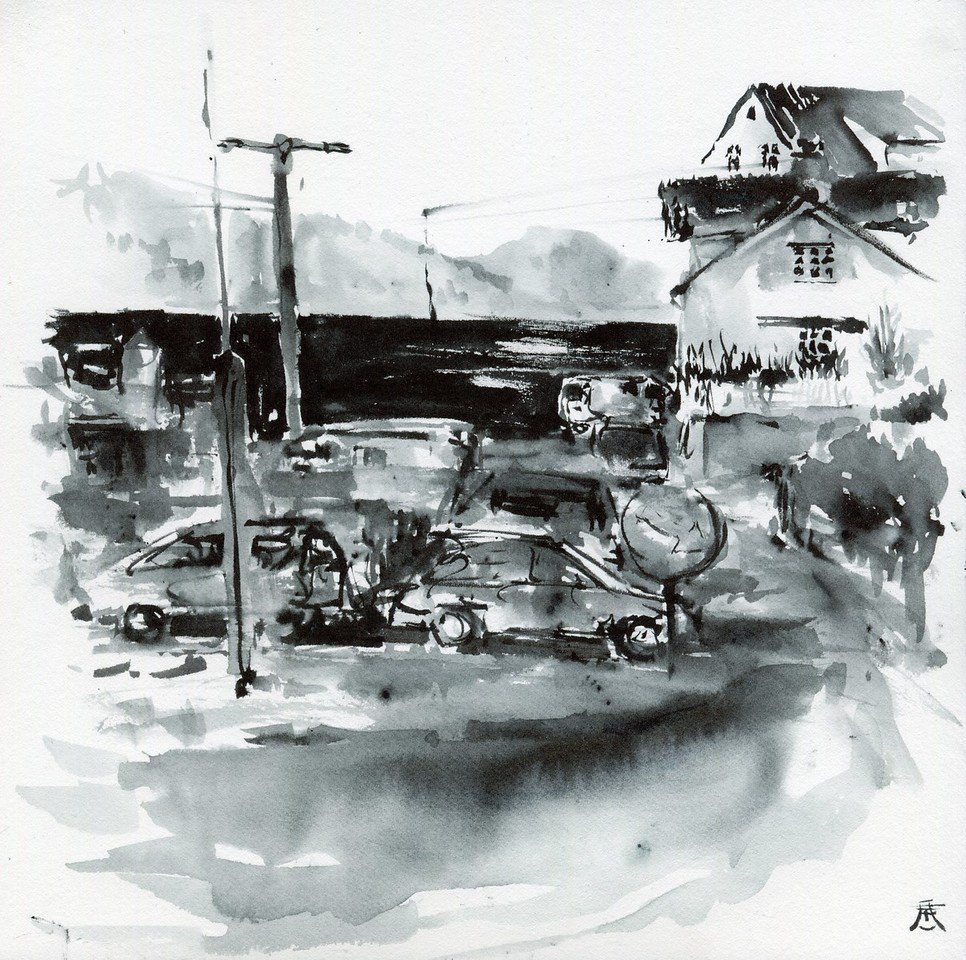
There was a girl named Angela. She lived on the fourth floor of a building that only went up to three.
One day, she came downstairs.
– The book of Dan and Angela, March, 1991
* * *
I’ve not seen the old building for, probably, thirty years. But here it is, almost exactly as it was the morning that my mom stood right there packing our car, with her puffy eyes and cracking voice trying her best, and failing miserably, to keep a lid on the pure fucking rage that she felt towards Dad.
Trying to make me feel safe.
“We’ll stop halfway for milkshakes and burgers,” she said, sniffling, “and you’ll love Durban, you can learn to surf.”
I never learned to surf.
But the building is the same, except for the spiked green palisade fencing with the razor wire.
Beige brick. Squat. Three floors.
Anglea lived on the fourth.
* * *
Yesterday, a box appeared just outside my front door. A shoebox, decorated with toilet paper, flowers, and leaves.
Inside was a small cupcake. It was a dark brown, baked close to black in some places. It had no icing, or any decoration at all except a small foxglove blossom sitting on top of it like a tiny gnome hat.
Alongside it, in an eerily familiar handwriting, was a note saying “eat” on one side, and the number 4 on the other.The cake was dry on the outside and bitter where burned, but moist and honey sweet inside. It left a gritty feeling on my teeth.
I texted my boss that I wouldn’t be in. He wrote back “OK D. Hope you’re okay after funeral, tnx for chkn in”
Then I turned back to the box to make sure I hadn’t missed anything, but it was only the cupcake, flower, and note. It was real. That much was certain. I know what not real feels like and that wasn’t it.
But how the hell was it real?
Surely, it could’ve only been Angela. And that was impossible. It wasn’t clear to me now, with distance and age, that anything about her could have been how I remembered it. But it couldn’t have been anyone else. Mom was the only person who knew about all that stuff, well, Mom and Dr Mendes. And neither Mom nor old Mendes were in the position to send me boxes or bake cupcakes. Not anymore.
So it had to be Angela.
I packed a small bag and drove through the night with no other plan than showing up where I’d last seen her.
* * *
I walk up to the intercom at the security gate and realise that I don’t actually know anyone in the building anymore and so I just start pressing buttons.
101 buzz 102 buzz 103 buzz click.
“Hello?” A gruff voice. Unsteady. Old.
“Hi, ja,” I reply, “My name is Daniel, Dan Calhoune, I used to live in this building.”
“What?”
“Dan Calhoune, I used to live in 301, back around 1991?” I say, practically shouting.
There’s a faint echo of my voice over the static of the open intercom line. I put my hand in my pocket and feel the note from the box. It’s still there. It’s real.
“I’m looking for someone who used to live here,” I say.
“Oh hell, if it’s a delivery just leave it in the foyer”
“It’s not a delivery. Do you know a girl … uh, woman named Angela?”
“If it’s money, bring it up.”
Click. Buzz.
I’m in.
* * *
Dan lived with his parents in the building. Dan had a computer with a black and green screen. He liked to play games and write stories, although he would have preferred to have a brother or sister. Angela had loads of sisters, but sometimes wished she didn’t. Her brother was her favourite.
– The book of Dan and Angela, March 1991
* * *
I was alone the afternoon I met her.
I’d had an old, mostly bald, tennis ball that I was knocking to myself against the wall on the third floor landing, singing… butchering, really… the chorus of Michael Jackson’s “who is it”—my favourite song at the time.
“What do you call this game?”
A voice from behind.
The feeling that I wasn’t alone was like slamming into a glass window you thought was open. That white-out pow of surprise and embarrassment.
“I’m sorry, I didn’t mean to scare you,” she said.
She stood against the wall of the stairwell near the lift, smiling at me with crooked teeth. She was about a year or so younger than me, I guessed, with ratty, ratty blonde hair that looked as if it had only ever heard rumors of a thing called a “brush”. An oversized plain white tee-shirt and purple shorts – the only thing I ever recall her wearing.
No shoes.
“It’s okay,” I said, my heart still trying to beat its way out of my chest. “I just thought I was alone.”
“I heard the sound of the ball, so I came down the stairs to see,” she said.
“Oh so you live on the fourth floor?” I said, joking, but in a sarcastic tone I regretted immediately.
Mom told me that if you want friends, you shouldn’t be an asshole to people. I wasn’t doing a good job.
“Yes, I do,” she said, shaking her head from left to right in a weirdly playful motion.
“Oh really,” I said, easing into the game, “so you’re the one banging around on my roof when I want to get to sleep?”
“My Dad—and everyone—is up there!” she said. “You look like my Dad, except he has horns.”
“Oh, weird.”
“Yes, but what is this game, please?”
“It’s called handball,” I said, “you keep hitting the ball back to you as long as you can, like this.”
I demonstrated, poorly, as the ball ricocheted back at an odd angle and came to rest near where Angela stood.
She picked up the ball, sniffed it, and then asked: “Can two people play handball?”
“Don’t you guys have handball upstairs?”
“No… but we have bladderballs, and we bounce them off our heads to each other sometimes, but that’s it.” She looked at her feet, almost bashful.
“Bladderballs, that’s gross, what about calling them… headerballs?”
“No, it’s bladderballs, head bouncing isn’t the only thing we do with them” she said, as if it were obvious “We put water in them, air for swimming underwater, floaties, use them for cooking…”
“Okay, I get it, bladderballs it is. Come, do you want to give this a try?”
She nodded, a grin curling into her sunblushed cheeks.
We knocked the ball back and forth for about an hour. She didn’t say very much more, concentrated as she was on smacking the ball back at me as hard as she could. For my part, I was so happy that I hadn’t chased her off, I would’ve endured anything—actually playing a game with another kid was more than I could’ve hoped for.
When I saw Mom’s car pull into the parking lot I said: “I have to go help my mom make supper.”
“Oh, okay.”
“What’s your name, I asked?”
“It’s Angela”
“I’m Dan”
“Dan.” She said my name as if it weren’t the most ordinary name in the world. “Okay Dan, I should go now too.”
“Back upstairs?” I liked this game.
“Yes. Up the stairs.”
“Say hi to everyone up there for me,” I said.
She laughed at that. I felt electric. I’d made another kid laugh, and not in a mean way.
“I will, that’ll make them happy. Do you want to play again tomorrow?”
* * *
The fourth floor is a garden. They have bladderballs, but they’re not as gross as they sound.
— The book of Dan and Angela, March 1991
* * *
The old building’s foyer has been completely refurbished. The rows of wooden post boxes that used to line the wall opposite the entrance have been replaced by a raft of these flimsy metal cubes with combination locks. No more lino floors either.
I remember my Dad standing here in the foyer, smoking. Just standing for hours, talking to himself, or pacing. This was before the smoking bans, I guess.
When I was a little older Mom told me that Dad had ended up in the hospital. He bounced around halfway houses up and down the country, disappearing for weeks, sometimes months, until he disappeared for good. When they ask you if you have a history of mental illness in your family, this is the kind of thing that they want to know about.
The foyer smells mostly the same. A weird mix of industrial cleaning products, some old lady cooking her lunch—soup, I guess—and a bitter afternote from the weeds that grow so thick in the no-man’s land between the back wall and the next building that it makes hiding there practically impossible.
The community board is still up though. Mostly just adverts for domestic workers and flats to let. And a faded poster with a picture of a cat named Oberon that disappeared a couple years ago. None of the posters’ little phone number tags have been torn off.
Poor Oberon.
* * *
The evening after I met Angela, I’m afraid I must’ve annoyed the living shit out of my mom. I followed her, yapping ceaselessly, as she walked room to room. “Angela says she lives on the fourth floor.”
Mom put down her purse and took off her shoes.
“We joked about the games they play up there.”
Mom got dinner ready.
“Angela didn’t know how to hit a ball, but now she’s better than me.”
Mom sat down for one moment of peace.
“Angela smells a little gnarly.”
No peace.
Eventually she held my face in her hands, and brought her own face right up to mine and said: “I know you’re happy Dan. I’m so glad you found a friend. But can you let your poor mom just have a second to breathe? I swear, I’ll listen to it all as soon as I’m relaxed.”
Then she kissed my forehead with big, soft lips.
“Okay ma.” I said.
“I’ve got an idea,” she said, the corner of her thin eyebrow arching high, “why don’t you write it all down on the computer? You can print it out for me and I’ll read it.”
I asked if she didn’t mind if I used the computer paper, since my dad used to get angry if I wasted it.
“Of course, I’ll tell Dad it’s okay, but he’s away for a bit anyway.”
Dad was gone again. He would drink and get angry and go off and in a few days mom would get a phone call from the police, or one of her friends, and would have to go fetch him and clean him up. So I was good to use the computer paper.
And I was off; the “Book of Dan and Angela” was a-go!
First entry: Bladderballs.
* * *
There is no school on the fourth floor. Dan says that sounds amazing. No school, no mean kids. Angela says kids up the stairs can be mean too, and are worse, since they have sharper teeth.
— The book of Dan and Angela, April, 1991
* * *
Most days I’d walk back from school to find Angela sitting cross legged in the passage just outside our flat waiting to play. Handball was the backup, but we each had our favourites. I’d make her play “space,” where we’d sit on the mezzanine landing pretending it was the StarShip Enterprise. Me as Picard, she as Data. She had no idea what was going on.Her game was “sticks and stones” where we’d gather twigs and rocks, put them in weird patterns at the bottom of the garden and dance around.
Through it all there were the fourth floor stories where we’d yap away about the world upstairs—about the animals, the royal family, the foods they ate up there.Honestly, it didn’t matter what we did; I would’ve done anything with Angela. I was someone’s friend. It was a heart opening revelation to me.
Angela was so much more than a salve for my loneliness. Having a friend was evidence, to me at least, that no matter what happened at home, or at school, no matter how much I hurt inside or out, I had proof that the world wasn’t just a machine built solely for crushing.
* * *
Water is its own kind of magic, says Angela. It’s been around before anyone else and it knows all our secrets. Dan says that it has seen him naked, so this is true.
— The book of Dan and Angela, April, 1991.
* * *
It was sometime near midsummer when we started writing notes. We swam on those afternoons where there was no chance of rain. That is to say that I’d swim, but the closest Angela got was dangling her feet in the water near the step.
“They don’t have pools on the fourth floor?” I asked.
“The rich ones have pools, but I can swim, my mom and aunts taught me to, by a pond near where we live.”
“Liar.”
“Really, I can,” she said, laughing, ”I’m not allowed to go under the water or I’ll get lost.” Another detail for the book.
“What happens if you go under water? Do you get a fish tale, like in Splash?”
“No, not that,” she giggled, “I’ll just get lost, that’s all, and my mom might not be able to find me. That’s what she says.”
“I think,” I swam up to her, “that you’re just afraid of getting your hair wet!” and splashed her.
She jumped up and ran a few paces back from the pool to near the fence.
“Dan! Mean!” she screamed, still laughing. “Oh,” she said, suddenly serious. “I almost forgot to tell you.”
“Ja?”
“I’m not allowed to play here for the next few days”
“Oh, that sucks, I guess…” I said, trying to camouflage my sudden sadness in a kind of flippant nonchalance. “Whatever will you do without me?”
“Oh, loads,” she said, a casual smile dancing across her face. Dagger through my heart. “It’s festival,” she continued, “and it’s an important one this year. I’m baking for the first time. I’m going to make cakes.”
“And that’s a big deal?”
“Oh, it’s a BIG deal.”.
“That’s cool then,” I replied, trying to drum up some enthusiasm for my friend, although I’m sure that some of my anxiety about being alone again must have seeped out because she looked hard at me for a long time before she spoke.
“Oh, I wish you could be there. You know, you could draw me a picture or write me a note, that would be nice.”
Until that point, I wasn’t sure Angela could read, given she never seemed to be at school.
“Ja, I can do that—where should I send it? ‘Weird girl, fourth floor, Heathwood, Northcliff?’”
“Hah, no, just put it in your post box, I’ll get my dad to deliver it.”
For the next two or so weeks, I didn’t see Angela. But she would leave small notes for me in my post box. Simple three or four word sentences scratched out in blunt pencil in a wild, looping cursive. Never written on blank or lined paper, but on scraps of newspaper, or old utility bills, or tissue paper.
Dan, I miss you
See you soon Dan
Dan, smile!
And for my part I spent my mostly lonely breaks at school writing her letters. About what was happening with the kids in my classes, or what I’d been daydreaming about on the bus ride to school. Messages about how I hoped my mom could get a new job, that we could get a pet, and about how I wished I wasn’t so stupid the whole time.
* * *
Festival is a very special time on the fourth floor. The boys all go out to hunt the white rabbit and the girls stay at home and bake cupcakes.
Angela’s cupcakes: Acorn Flour, honey, bat fat, bonemeal, foxglove blossom for decoration.
– The book of Dan and Angela, May 1991.
* * *
I take the stairs up to the third floor and make my way down the breezeway to our old flat. What’s so strange is how old fashioned everything seems. The window frames, the wrought iron security gate with its curlicues and little goblin face. I check to make sure nobody’s watching and look though the window.
Past the glass and the privacy netting is a lounge outfitted with leather couches, bookshelves, and a wide screen television. Whoever lives here now looks after their stuff. It’s so different from when Dad would sit here into the early morning on our brown corduroy couch, empties gathering on the side table as he watched CNN. American cable news was new to South Africa then, a kind of filler for when ordinary programming was done for the night, after the old national anthem. He would be completely absorbed by the lurid graphics, statistics and talking heads, getting drunker and louder and angrier. I didn’t understand how he could care so much about a war that we had nothing to do with.
I barely remember him as a person. Is that strange? Once Mom and I left, I saw him only once more. He’d managed to get down to Durban somehow. Hitchhiked, maybe. I was working just outside the city center so we arranged to meet at the Green Bean coffee stall. He came all dressed up, ready to give a big apology speech, fifteen years too late. All I can seem to recall is how much smaller he seemed to be sitting there across from me. He had delivered a rambling speech about he and I being the same and how, one day, he hoped I’d understand and see him for what he was. For why he was the way he was. I had nothing to say and I asked him to leave.
We didn’t touch.
But from back then, when we lived here in 301, I remember him mostly absent. And when he was around, he was distracted, consumed by something important only he seemed to know about. As if he weren’t really there at all. And there was no middle ground—either complete void or explosive rage.
I think of those angry moments, how enormous he seemed. This monster of a man, crashing through the house, my mom in tow explaining why things were the way they were. Beyond all that, I remember his hands. Their distinctive smell, a kind of savory steweyness.
Like they were carved from stone
* * *
How do you get to the fourth floor, asked Dan. Angela said that for big people the only way is through dreaming or dying. Dan said that sucks, but he’d rather do the dream. Angela said that they’re the same thing and he was being an idiot, since he could come whenever he wanted.
– The book of Dan and Angela, June 1991
* * *
The last time I spoke to Angela would have been a week or so before Mom and I left for Durban. Angela and I were playing near the small embankment at the back of the shared gardens, picking out sticks we could use to make bows and arrows.
“We use arrows the whole time for hunting,” she said, carefully examining a stick she’d pulled from one of the piles the gardeners had left last time they’d trimmed the trees.
She shook her head, “Also for fighting sometimes, but this one’s not a goodie.”
She threw the stick back on the pile.
“It could be a knobkerrie,” I said, “do you have those up on the fourth floor?”
“I don’t know what that is?”
“Oh, it’s like… a kind of… stick with a knob at the end that you use for hitting things.”
“What things?” she asked.
“Other people’s heads?”
“Oh, yes, we have those up the stairs too,” she laughed.
“Angela? For real now, which flat do you live in, my mom wants to know?”
“Why?” she asked, narrowing her eyes.
“I think she wants to know if you want to come have supper. She wants to meet you.”
That was a straight up lie, on my part. I’d practically begged Mom to let Angela come and have supper at our house. Nobody was really allowed to come over, but Dad was away again and I thought that it might be okay if he didn’t know.
I’d printed out a copy of the notes I was writing about our games for Angela and bound the paper with some string I found in my mom’s study drawer, a hand drawn picture of me and Angela standing outside our building as the front cover.
I knew that she wouldn’t be allowed to stay over, but just to have her in my house, have mom make us some cool drinks, maybe watch some TV together. That’s all I wanted. That, and to present her with our book.
“I don’t have a flat number, Dan,” she said, looking askance. “I live on the Fourth Floor, remember? Up the stairs.”
“That’s the game, no, you must tell me your flat number so Mom can ask your parents if you can come visit, since you’re a girl, you know? Mom wants them to know everything’s okay.”
She shrugged. I felt my face burn red with embarrassment, then anger.
“Why are you doing this?”
“What?”
“Just stop! Don’t you want to come over?”
“It sounds nice, but I can’t eat your mom’s food anyway—can’t we just play like normal?”
All the humiliation between home and school bore down on me, and it seemed as though the one person I thought was my friend had been making fun of me the whole time. I was embarrassed and hurt. I wanted to hide. I wanted to hurt back.
“I hate you,” I screamed. I was crying. My cheeks flushed, burning.
Angela stood stock still, looking utterly confused.
“I hate you, Angela. Hate.” I screamed again and ran back across the garden, up the stairs, and to my room where I cried into my pillow until it was wet with tears and spit.
After a little while I went to the lounge window that opened up onto the back garden. Angela was gone, and the sun had started setting.
That evening, after mom made me get ready for bed, I wrote Angela another letter. About a page and a half about how I thought that it was really mean that she would tease me about where she lived, and that if she didn’t want to come over she didn’t have to, that she didn’t have to lie to me. If she was going to hurt me for fun, she’s not a friend anyway. Just another one of all the rest.
The next morning I left the letter in my post-box. When I got home from school that afternoon, Angela wasn’t waiting for me, but she’d left a reply, written on the back of a phone bill.
I’m sorry Dan. I’m not being mean. I’m not lying. I am your friend.
* * *
The fourth floor is a big F-word-ing lie.
— The book of Dan, July 1991
* * *
The lift, unlike the rest of the foyer, looks pretty much like it did when I was a kid. A wooden door with a glass portal window near the top, so you can see when the carriage is on your floor.
I press the little black button with the up-arrow and there’s a whirring clanking sound as the machinery near the bottom of the shaft comes to life.
Through the portal window I can see the lift cables shift and move in the low light and then the carriage fills my view with its silver doors. It comes to a rocky stop and there’s a grating of metal on metal as the carriage doors slide open.
I open the outer door and step inside. The air is dusty and sweet and smells a little like old polished wood. A close, familiar smell.
* * *
After my meltdown with Angela, I’d get home from school and see her standing at the top of the stairs, looking down at me. She’d wave, wait a moment, and when it was clear I wasn’t ready to speak with her, she’d go off and play by herself while I holed myself up in our flat and waited for my mom to get home. I was so ashamed, but still angry, at myself, I guess, more than Angela.
And then one day, it was over.
Okay. I know that this is important. But this is not something I dwell on anymore, not really. And, as I said, my dad eventually made up for it, or apologized, at least.
How he explained it was that he had a bad day. Everything was out of joint, that he felt he was living a life that wasn’t his. He didn’t mention the drinking, he didn’t have to.
As if I didn’t know all these things back then?
That afternoon I’d said something. I mentioned I was bored, or wanted to watch some more television. Something trivial. He grabbed me by the arm, hard, and somewhere between him yelling and ragdolling me something snapped and popped in my forearm.
I don’t think he’d ever heard me make those particular kinds of sounds before. I was really hurt this time.He deflated immediately, all meek and apologetic. Wishing he could take it back.
“It’s okay isn’t it? That’s my boy. It happens sometimes when guys are just playing around.”
Mom was the one that took me to the clinic, though. The doctors x-rayed my arm, put it in a cast and sling, and sent me home with a baggie of panados.
After Mom put me to bed, she and Dad really got into it.No chance I was sleeping that night.
The next morning she took me for a drive to “get ciggies” while Dad slept in the lounge. She pulled over to the side of the road and burst out crying, telling me just how sorry she was and that she was finally going to do something about it. I’d never seen her like that. It was unsettling. I stroked her hair and held her hand and told her that we were going to be okay.
We waited till Dad left for work, then packed our bags, my video games and books into Mom’s red Toyota Corolla.
While she was on the phone with Ouma, asking if we could stay with her for a little while, I ran through the building and gardens looking for Angela.
When I couldn’t find her, I found a piece of paper and wrote her a note saying how sorry I was and that she was my friend and that here was my Ouma’s phone number and she could phone me if she wanted. I took my note and her copy of the “Book of Dan and Angela” and ran them up to my post-box. There was a part of me that expected to find a note inside of it asking me to stay.
* * *
And Dan moved away for a long time. And his Mom wouldn’t let him think of Dad, or Angela. And nobody believed him anyway. And he had a job and a wife and lost both. Then Ouma. Then Mom. Then there was a long sad time after which, he could finally go home.
— The Book of Dan and Angela – March, 2025
* * *
It’s funny what we remember and what we don’t. As I stand here I can swear that there was never a button for the fourth floor in the lift’s control panel. But here it is, clear as anything. One, two, three, four. I don’t know how I could’ve missed it?
I press the little black button and the lift whines into action. The digital display on the control panel changes from 1, to 2, from 2 to 3 and then shuts off. The lift just keeps climbing and, somehow, it feels like the most natural thing in the world.
And I think that I knew, even back then, that I’d eventually end up here, riding up to the fourth floor.
In leaving, things didn’t get any better, when we left, did they?
Did I even leave?
I’m not sure, it feels more like I’m waking up from a long dream.
A dream about dropping out of university followed by the string of jobs that lead nowhere. A dream about Dad showing up and then disappearing for good.
Ouma’s death.
Of hospitals and apple sauce.
A dream of a short, sad marriage I thought would save me, but didn’t.
Of Mom.
Of sickness.
Of more hospitals, then funerals.
Of a body burned to ash and teeth.
A dream of a long, long time of nothing at all. Quiet. Inert. Absolutely alone.
Silent and black.
And, of course there would be a box with a cupcake. Of course there would be a note. I’m as certain of that as I am of anything in this stupid little life. After what might be anywhere from half an hour to a week, the lift comes to a stop. The inner doors slide open to reveal a small, wood paneled room. There’s another door in the opposite wall, much older and ornate. There are no lightbulbs as far as I can tell, but when the lift’s doors close behind me, I notice that there’s a blue light that comes from nowhere in particular.
The floor is littered with scraps of paper, and there is what seems to be a makeshift bed of rags and plastic shopping packets, decades old, in the corner. Besides it is a pile of clothes and shoes. I rifle through it and find mens shirts, skirts, a pair of purple shorts. A ragged tennis ball. A sheaf of computer paper bound with string and covered in coloured pencil drawing of a building, squat, beige brick, and two crudely rendered figures on the cover, playing bladderball, she with wings and he with horns.
With horns! Why did I draw myself with horns?
I raise my hands to my forehead and to what now grows there.
Oh.
Oh, of course. How silly of me. It was always real. It was always here. And I knew, I knew, even then.
Sister, why didn’t you tell me? Why couldn’t you?
Glory! Glory!
I hope I’m not late for festival.
I take off my clothes and toss them on to the pile, then step to the older door.
There is no door knob or handle and so I push it. It swings open silently and effortlessly, revealing the bottom of a spiraling staircase made of dark stone. The same blue light permeates everything. I look up from the base of the stairs to see them spiral, seemingly endless, in a way that makes me feel lightheaded, like I’ve stood up too quickly, or lost too much blood.
“Angela,” I call, as loudly as I can, “I’m here!” I’m laughing freely, and I feel as though I’ve never laughed before.
There is no answer and no echo. But then, I think I hear something, perhaps feet shuffling on stone, much, much further above me. Maybe the whisper of a hand poised above strings, the moment before the music begins.
“Tell Dad, tell everybody. I’m here.”
There is the slightest breeze. Redolent of flowers and rain.
There’s no more reason to wait.
I put my foot on the first step and start to climb.