Back Old Sorcery on BackerKit for exclusive rewards!

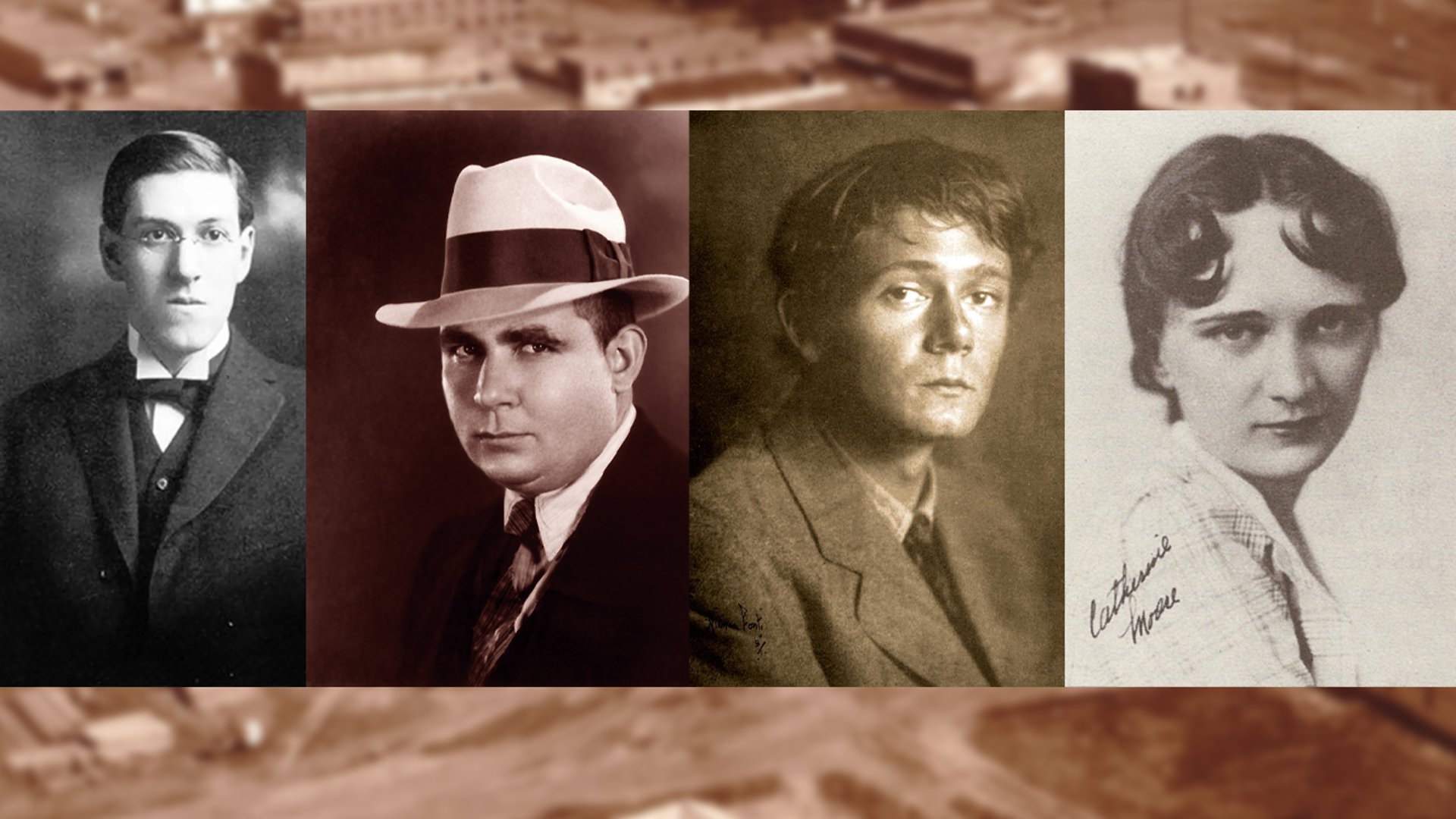
Forging New Nexuses: Gassing Up Genre Writers of the 1920s and 2020s
Iconic horror author, H.P. Lovecraft, kept correspondance with many of his contemporaries. It's believed that in time he'll be remembered more for his letters than his fiction. This article examines the exchange between authors of the 1920s and how they celebrated their successes and vented their insecurities, and what writers of today can learn from their examples.
BLOG POSTCREATIVE NON-FICTION
Phillip Royce Johnson
3/23/20269 min read
Citation abbreviation notes:
AMtF: A Means to Freedom: The Letters of H. P. Lovecraft and Robert E. Howard (Volume 1)
DSLH: Dawnward Spire, Lonely Hill: The Letters of H. P. Lovecraft and Clark Ashton Smith
CLM: Letters to C. L. Moore and Others
During the desperate economic precarity of the Great Depression, some of the most celebrated early writers of horror, weird, and sword & sorcery fiction found, via the highly resilient U.S. postal service, the voices of other aspirant wordsmiths. These exchanges of letters not only took place in relatively public venues, such as featured letters in magazines, but also private correspondences. H. P. Lovecraft found himself as a kind of epistolary super-nexus, writing thousands of pages to dozens of organizations and individuals, often laudably with a spirit of attentiveness, generosity, and earnestness. S. T. Joshi, a leading Lovecraft scholar, has provocatively remarked that in the future, Lovecraft might even become better known for his letters than his fiction.
And there certainly are recurrences and “episodes” of Lovecraft’s letters that contend with his lesser stories in terms of critical interest. But the intimacy of the letters themselves might also serve to inform how we modern genre writers could better comport ourselves in terms of the quality of our exchanges. Those of us who reach graspingly back through time to the golden age of genre fiction would do well to imitate the best examples of these, not only in terms of content, but of their sincerity, warmth, and preoccupation with fostering new talent.
Because of the survival of many of Lovecraft’s exchanges, we know that nicknames, inside jokes, friendly ribbing, and discussions on all manner of topics both frivolous and serious existed alongside professional advice and commentary-critiques on stories. As positive examples, then, I’d like to humbly highlight three correspondents in Lovecraft’s letters, all from just around a century ago:
1.) Robert E. Howard (REH hereafter)
REH of Conan the Barbarian fame enjoyed lively back-and-forths with Lovecraft about wide-ranging subjects, from “shop talk” about writing, publishing, and copyright issues, to linguistics, sports, politics, and their perennial debate on the relative value of civilization vs. frontiersmanship. And amid these discussions, a friendship was sparked between these vastly temperamentally different men, enriching both of them.
In addition to enthusing about REH’s work, Lovecraft found, to his great delight, that beyond the blood ‘n guts action stories, REH had a keen interest in and deep knowledge of the American southwest, particularly west Texas, describing to Lovecraft not only the rugged land, but its pioneer-spirited people as well. Ever interested in local color, Lovecraft probed REH on whether he had considered expanding his horizons and writing non-fiction about real-world Texan locales in addition to his genre fiction.
HPL to REH:
“Your mention of a new series of tales dealing with the ‘Hyborian Age’ arouses pleasant anticipations, and I also look forward to the tale of early Texas. My admiration is about evenly divided betwixt tales which are utterly cosmic and exotic, and those which grow realistically from the soil and possess all the atmosphere and colour of their locale.”
(AMtF vol. 1 p. 288)
Lovecraft also encouraged REH to consider using some of the anecdotes the latter shared as fiction-writing material:
“What you call a ‘quiet, humdrum youth’ would seem to an Easterner active and violent beyond all non-fictional conception! “Red”, the oil-field ‘bad man’, would be promising raw material for epic treatment.”
(AMtF vol. 1 p. 289)
Lovecraft also praised a tale taking place in a far-off land, where REH, although having scant knowledge or personal experience of the place, wrote convincingly:
“I enjoyed ‘Lord of Samarcand’ tremendously, and congratulate you on the vividness with which you mirrored the colour, pageantry, and feelings of the East.”
(AMtF vol. 1 p. 285)
When discussing the weather and topography of their respective homes, Lovecraft also made reference to another writer in their circle:
“Your sandstorms are something I can picture only through imagination, for they have no equivalent here… Their atmospheric attributes—red sun and red dust—must surely have much impressiveness. They remind me of what Wandrei writes of the curious sky-effects seen at rare intervals in Minnesota when that region receives the tail end of some sweeping prairie dust-storm. He will never forget one red, ominous sunset in St. Paul, when the earth seemed almost convulsively in the grasp of unknown forces from Outside.”
(AMtF vol. 1 p. 290)
REH was appreciative, and reciprocated Lovecraft’s lengthy, detailed letters with remarks of his own, likewise referring to other writers in their circle whose knowledge he tapped in service of verisimilitude in his stories…
REH to HPL:
“Glad you liked the Oriental story, and thank you very much for the kind things you said about it. Its [sic] always with misgivings that I submit an Eastern yarn to the magazine, for I never know how many glaring errors and mistakes I’ve made. My knowledge of the Orient is extremely sketchy, and I have to draw on my imagination to supply missing links which I cant [sic] learn in the scanty references at my command. Price and Miller, however, are a big help in the matter of Arabic names, grammar, etc.”
(AMtF vol. 1 p. 291)
…and shared resources and encouragement of his own, showing a spirit of reciprocity:
“I’ve recently joined the American Fiction Guild, which looks like a pretty good thing. If you are not already a member, and would care to look into it, I’ll have them send you some literature…”
(AMtF vol. 1 p. 302)
“...anything written uncommercially—from the pure self-expression motive—is a welcome rarity nowadays.”
(AMtF vol. 1 p. 307)
Even for innocuous-seeming comments, such as REH complaining of a lack of exercise, Lovecraft had offerings:
“Can’t you do more of your writing in the open, as I do? I’ve probably mentioned before that no fine summer afternoon ever finds me under a roof. Current work and reading all go into a black leatherette bag, and accompany me to whatever neighbouring woodland retreat I choose… when I am away—I always choose some picturesque park or other outdoor spot to do my reading and writing in.”
(AMtF vol. 1 p. 313)
Lovecraft and REH died within a year of each other, and although they never met in person, their extant letters alone now make up two volumes, each hundreds of pages. They left an indelible mark on each other, perhaps even more in terms of friendship and interest than on their respective fictions.
2.) Clark Ashton Smith (CAS)
CAS was the object of effusive, at times almost overbearing praise from Lovecraft, who often closed his letters to the former with jokey salutations and valedictions, including “To Klarkash-Ton, High-Priest of Tsathoggua,” “Yr most oblig’d & obt Servt.,” “E’ch-pi-el, Priest of Cthulhu,” and others. Like the correspondence to REH, their communication ran a broad gamut of topics, from compliments at CAS’s multi-talentedness in various artistic mediums to outlooks on literature and personal philosophies.
Lovecraft’s praise of CAS’s artistic skill was smirked at by weird fiction scholar S.T. Joshi for being a case of questionable taste, but it nonetheless oozed with earnestness, and specificity can be a great marker for sincere praise, as Lovecraft demonstrates here:
“You are a genius in conceiving & [graphically] rendering noxious, baleful, poisonous vegetation, & I veritably believe my descriptions were excited by some of your drawings…”
(DSLH p. 41)
The pair’s rapport was such that they felt comfortable exchanging their most cringe-worthy early works as well:
“Your favourable comments on my fictional efforts are, as usual, highly heartening & inspiring! I have several more [stories] which you shall see as soon as I have reduced them to legible & transmissible form. One will remind you in point of age of your own early authorship—for it was completed when I was 14½.”
(DSLH p. 44)
Finally, Lovecraft’s praise sometimes bordered on the deluvial. One thing’s for certain, though: he knew how to gas up a friend. Here are his remarks on a collection of Smith’s poetry:
“...my card sent from Salem last month attempted in a feeble way to express the delirious delight & unboundedly enthusiastic admiration which “Ebony & Crystal” aroused in me. It is truly titanic—it is a breath of divine and daemoniac beauty, horror, madness, & wonder which perfumed & pestilential night-winds have whirled through bat-throned abysms of infinity & elder time from dead cities… It is genius, if genius ever existed! As I have said before, there is no author but yourself who seems to have glimpsed fully those tenebrous wastes, immeasurable gulfs, grey topless pinnacles, crumbling corpses of forgotten cities… & alien, indefinable, antiquity-ridden gardens of strange decay, with which my own dreams have been crowded since earliest childhood. I have read your work as the record of the only other human eye which has seen things I have seen in far planets.”
(DSLH p. 46)
At times Lovecraft himself felt the occasional melancholy at his work, not only in terms of commercial success, but in stinging rejections and what he felt was flagging talent:
“…every now & then I have the feeling of the aging workman that perhaps my hand has lost what little cunning it ever possessed. When my stuff is done it always disappoints me… I plug along & do the feeble best I can.”
(DSLH p. 80)
“[Artistic/literary] Recognition seems to be largely a matter of chance, & the wise artist is he who permits his work to form its own reward—the joy of creation, & the sense of beauty nourished.”
(DSLH p. 96)
“I have no illusions left as to my status in remunerative fiction. I simply can’t do the damn stuff which editors want—I lack the cleverness to overcome my own repugnances.”
(DSLH p. 329)
“…markets seem to be developing a set of standardised conventional requirements in a direction definitely alien to any I can take…”
(DSLH p. 359)
CAS encouraged Lovecraft in turn, admiring his adherence to his own set of standards:
“It is utterly beyond me why you should be dampened in the least by the criticism of time-serving termites… Personally… I wouldn’t permit a thousand rejections to make me think that my own best tales are anything but first-rate… I am willing to gamble that you and your work will be known: perhaps not to a very large audience, but certainly to a select and faithful one.”
(DSLH, p. 407)
Almost comically, CAS, translator of decadent French poetry and author of phantasmagoric poems and fantasies, functioned as a sober (and accurate) perspective, correctly predicting Lovecraft’s enduring literary legacy, as well as lauding his endurance amid pressures to creative conformity.
3.) C. L. Moore (CLM)
CLM, at the age of 24, was contacted out of the blue by Lovecraft on behalf of Robert Barlow, who wanted permission to republish some of her stories. Moore’s exchanges with Lovecraft can serve as an example to us moderns about how to foster young talent and steer new writers away from low-quality pulp, encouraging what we hope will be a more enduring type of literature.
Lovecraft’s first letter to Moore was a type of analogous headhunting (in the HR sense): “Hence this otherwise unsolicited & apparently meddlesome bulletin of comment from a stranger—albeit a stranger admiringly familiar with all your published fantasies, & enthusiastic regarding the advent to the weird firmament of its first new major luminary since Clark Ashton Smith.”
Some praise! He goes on:
“The fact is, [Barlow] & his enterprise represent a level & quality of endeavour utterly removed from the sordid arena of tradesmanlike hack work typified by the wood-pulp magazines & their sickening standards. It is his design to choose those specimens of your fiction which are actually—not popularly or commercially or saleable—best, & to issue them in a dignified format & fashion suited to their quality—circulating them among readers of real discrimination, who would not be likely to take seriously such tawdry rags as Weird Tales & its fellow-news-stand pulps. He would thus be paving the way for the development of your genius along the right instead of wrong line—preparing you to follow the sincere, spontaneous, purely artistic course of real fantaisistes like Poe, Dunsany… instead of the mob-catering insidiously charlatanic course of the cheap-magazine idols who sacrifice sincerity & aesthetic quality to the arbitrary herd-motivated demands of the callous business men who control the popular periodical press. Of course, it may seem a bit impertinent in Barlow to fear that a first-rate genius ever could be permanently sidetracked in this way—but when you reflect on the number of splendid writers whom he has seen thus alienated from literature, you will probably be disposed to forgive him.”
(CLM p. 25)
Lovecraft goes on to list several promising writers whose genius and literary quality he felt were corrupted by cheap pulp standards, and with almost urgent ardor, asks that she not succumb to similar mire.
Moore responded:
“Your letter has impressed me tremendously. It’s awfully nice to be flattered… not until yesterday when I read your letter did it really occur to me that my “pulp”-published and extrav[ag]ant romances might actually, after all, contain a nucleus of worth which should be taken seriously…. When one of your standards and ability takes the trouble to write at all I think it behooves me to stand off and look at myself with some awe.
…I’m in no position to turn my back on profits… For what it’s worth, I can promise never to write anything I don’t enjoy writing… The points you outline in explaining the essentials of good weird fiction came as completely new ideas to me—the sort of things I somehow never learned in college or in any reading I’ve done. They give a new dignity to what I’d heretofore regarded as something akin to wild-west fiction—a lot of fun… but of no literary merit and with no connection to the world of Machen and Dunsany and the rest. If anything can save me from the abysses of hack-writing, I think it will be the ideas I have just absorbed from your letter… I’d like to thank you not only for being kind enough to write, but for opening my eyes to the possibilities of dignity in the type of writing I enjoy, and the possibilities of merit in my own work.”
(CLM p. 28-29)
That one encouraging letter can catalyze an eye-opening realization—that the recipient of a letter (or message) has a germ of genius—should be enough to spur the rest of us to do better amid the speed and callousness of the current genre literature milieu.
In summary, while these varied exchanges may not cure the ills specific to our 2026 modernity—notably the disintegration of close-knit community, the distractions of media, and the muck of AI pollutants—they may nonetheless serve as positive reminders of the importance of attention to detail and intimacy in our communications with fellow writers. These letters should in some sense be aspirational for those of us who want worthwhile genre literature to survive in a form meeting or exceeding that of the century-old golden age.

Art by Kim Holm
Logo by Anastasia Bereznikova
Contact: editors@thearcanist.net | business@thearcanist.net
Copyright © 2025 The Arcanist: Fantasy Publishing, LLC
ISSN: 3069-5163 (Print) 3069-518X (Online)