When the Waithens walked back through town with their quiet, awestruck shuffle, Harkital still had Vorik’s blood on his cloak. The Threehillers who saw them gawked and gasped, whispered and wondered where the fourth baldie had got to. For that question, Cynthea had only half an answer. Vorik had died, that was certain. But why? And what was left to be done?
The Waithens trudged through the square, unspeaking, past the stands selling produce and cloth and the old men ever-smoking on their stoop with leery eyes and the town’s ominous, unused gallows. The sun had crested the horizon, morning in full bloom, and the bits of Vorik’s body that had come off in the dell were drying and clumping on Harkital’s woolen garb.
There would be an audit, Cynthea knew, an interrogation at the Archive, or in some auxiliary room belonging to the courts. An accounting of everything she’d done up to the point when Vorik touched the stone and everything she did after. She’d contact them immediately, through the shack’s ritual room, to inform them, to request aid, but not before she told the town magistrate. Not before she communicated just what sort of hell had emerged in those hills.
She knocked on the heavy door at the northern end of the square, just past the scaffolds.
The same greengaurdsman as before answered, sleepier this time. “Oh, it’s you lot. Magistrate Elva’s rather busy today, so…”
Cynthea watched his eyes catch Harkital’s foul carapace, the hollow looks on their faces, the sorrow that drew their shoulders down.
“What—” he stuttered, frowned. “Where’s the dwarf?”
Cynthea walked past him.
“I, no, wait—” The guard tried to get in front of her, but was clearly too shocked by the blood-soaked cloak to try very hard. “The magistrate—what happened? Are you wounded?”
“No.” She proceeded down the hall and opened the door to Elva’s bureau. “Elva,” she said, barely registering the tall female stranger, dark-haired, skinned with the south’s tawny, freckled hues, with a dagger at her belt, who stood before the magistrate’s desk. The stranger and Elva turned as the other Waithens entered the room.
“Sweet mother,” the magistrate gasped at the sight of Harkital. “Is he hurt? Are you hurt?”
Harkital said nothing. By Cynthea’s count, the spell she’d cast to mollify him in the dell had worn off as they walked back into town, making his silence a deeper, darker sort.
“He’s fine,” she answered.
The magistrate squinted. “You’re one head short.”
The Waithens said nothing, and that was enough.
“I—” Elva started, then looked at the stranger standing across from her at the desk, then to her guard, who hovered anxiously in the doorway. “Kurt, get this poor man washed up, would you?” Then she turned to the stranger. “As for you, we’ll continue our discussion later.”
“Of course,” the stranger said, raspy-voiced, as she looked at Cynthea with something like condolence, though something else lurked beneath.
Frowning, Cynthea then nodded Ollis and Admar out of the room as well. The southern stranger was the last out, shutting the door behind her, leaving Cynthea and Elva alone with the weight of the world.
“What happened?” Elva asked.
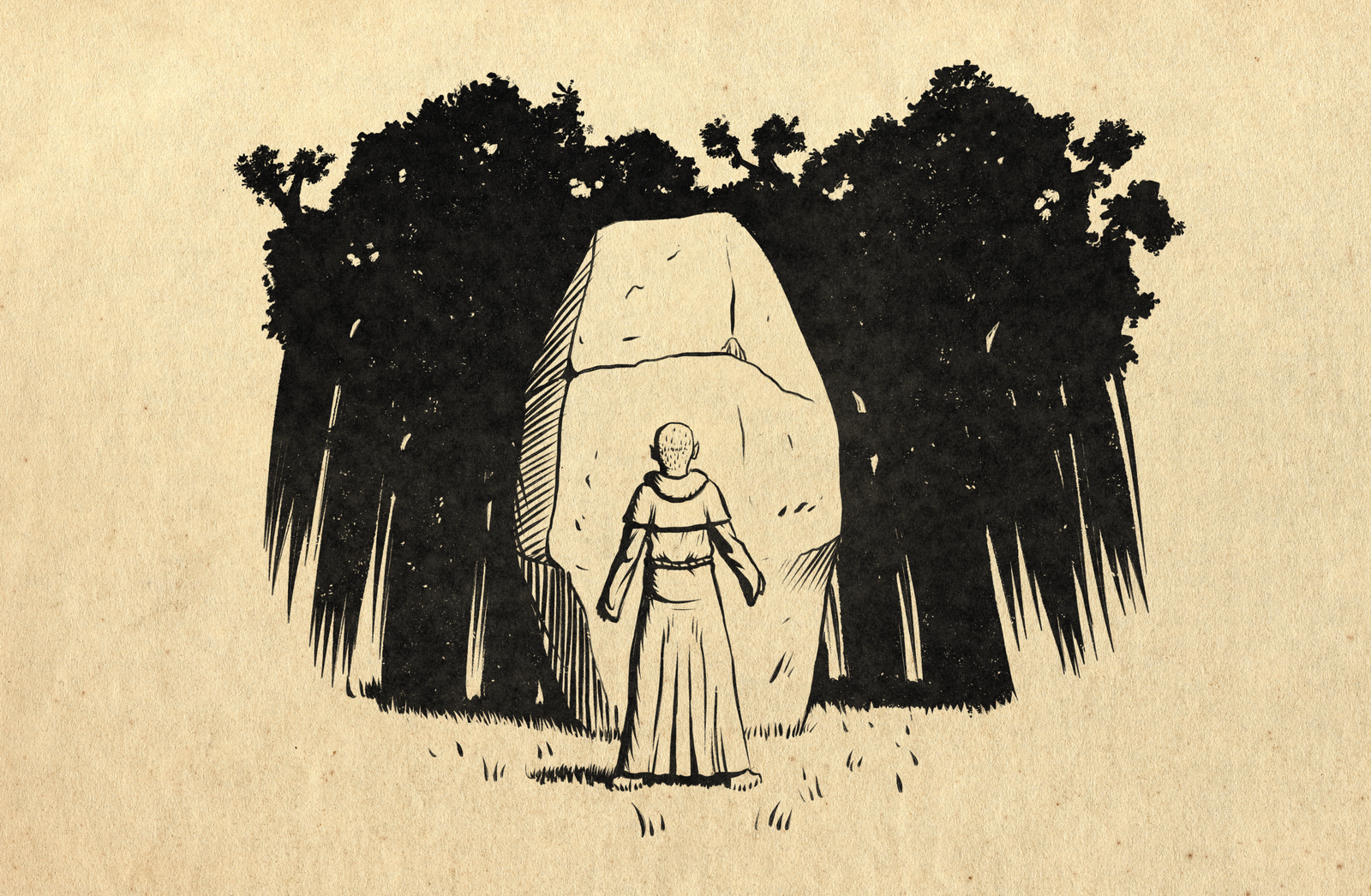
Cynthea told her about Admar’s illicit journey through the dark, about his discovery of the boulder in the dell, about how Ollis, so foolish, had followed behind. About Vorik’s attempt to allay her fears by touching it. About what happened to him. And about the energy, the pulse that the stone emanated, the sense that it was reaching some point of power they couldn’t dare ignore. And when she was done, Elva bore a blank stare, eyes lost in the imagination of what had happened the night before, and what awaited them now.
“We need to consider an evacuation,” Cynthea said.
“I—no, that’s madness.”
“I told you the boulder in the dell has more energy, a pulse, and there’s no telling what will happen when it reaches its zenith.”
Elva brought an anxious hand to her thick chin. “But how long until that happens?”
“There’s no telling that either. But I fear it will be sooner than we’d hope.”
“I believe you. But abandoning our homes, our farms, our temple, and for an unknown amount of time, for an unknown threat—”
“Elva—”
“It’s insanity.”
Cynthea had no reply. It was insanity, but reality, too. That’s what made it terrible.
“For now, all we must do is refrain from going up to the dell and touching the damn thing, yes?” Elva asked.
“For now.”
In these simple words, Cynthea sensed lives condemned. But the magistrate’s mind was made up. And beyond that, though Cynthea couldn’t be certain, there was a hint of suspicion in Elva’s eyes.
“I do have one more question for you,” Elva said, and Cynthea’s stomach turned in yet tighter knots.
“Speak.”
“In your story of last night’s events, you said it was the elf who came through town and found the stone.”
Cynthea’s face went dark. “Yes, that is the case.”
“Miranda says it was the boy.”
* * *
The three of them were now in the cells in the basement, their barred windows the only access to light. And to Cynthea’s fury. Ordinarily, none of them preferred such accommodations, of course. But Cynthea, wielding all her authority as a Magis, had been quite persuasive. She paced the basement’s hall, eyeing them in turn through the heavy doors: Ollis, whose nose and eyes barely peeked over his door’s window; Admar, whose haughty features were masked with stoic silence; last was the southerner, this Miranda, who bore something like a smirk on her lips, but who seemed anything but snide.
Harkital, for his part, sat on a stool in the nearby corner, massaging his hands. His Waithen clothes had been exchanged for a tunic and braies from the greenguardsmen’s storeroom.
“One of our number is dead,” Cynthea said, barely containing the black rage now roiling in her. “And at least one of you is lying about the events that brought this about. Elva has been kind enough to lend use of the town’s facilities to get to the bottom of it.”
“First,” she stopped at the stranger’s cell, “who are you?”
“Miranda Pelly,” the stranger replied. “I’m a trader, heading northeast from Passle with a shipment.”
“And what do you claim?”
Miranda’s eyes through the bars were dark, keen, framed by the freckled, ochre complexion of other climes. Her voice was thin and airy, riding a casual lilt.
“The boy wandered through town last night. I was drinking on the roof of Bartow’s with my traveling companion, Nosetip. I saw the boy heading north with something in his hand. The elf came after.”
“Tell me, did your traveling companion see this as well?” Cynthea asked.
“No, he turned in earlier than I did.”
“And why, I ask, were you so interested in these affairs? Why bring them to Elva?”
“I’ve only been in town a few days, miss, and everyone, from the butcher to the farmers to the farmers’ mothers, have talked about nothing but the baldies since I got in.” Her tone held a casual defiance. “Your affairs—especially those taken under cover of night—are of great public interest, it seems.”
Cynthea eyed her, trying and failing to discern what lurked beneath her cagey gaze.
“Pure-blooded altruism, then? What concerns the town, concerns you?”
The trader didn’t answer. For a moment, Cynthea toyed with the idea of reading her intent by deploying some spell of insight. But it was a tricky thing, delving into the minds of the unfamiliar, and caution prevailed.
Cynthea moved on to Admar. Standing before his door, she met his inscrutable gaze and waited. He set his face upon her, reminding her with a mere look of their years of history, of dark and hungry nights on the road, of hunting artifacts, of enchanted goblets and unseeing eyes. Eventually, he spoke.
“I’m unsure what motive this trader has to lie,” he said coolly, “or whether she truly believes she saw us in that order. I mean no insult, but she was mistaken.”
Cynthea let him talk.
“Please, Cynthea,” Admar leaned into the barred window and spoke quietly, “you know I wouldn’t permit the boy to wander off with the thing. What is she proposing? That I followed him through town for an hour? Why? I’m foolish enough to investigate things on my own. I’m not foolish enough to watch the boy put himself in danger.”
In his eyes were haughtiness and earnestness entwined. Admar was a proud bastard, but at least his pride was undisguised. She had not known him to lie in matters like this, in matters of the Archive, in matters where one of their party would no longer be coming home. But perhaps it was truer to say she had not known him to lie often. Perhaps even truer to say that she’d rarely caught him in it.
Across the bars, he seemed to beg for some affirmation, some release from her, but she would not provide it.
Silently, she moved on to Ollis’s cell door, last along the line, where she bent to see his face. “Ollis, this is very, very important. For the love of Vindac, and at the command of a Magis, please, I beg you, tell me the truth.”
The boy, eyes wet-edged and raw from many sleepless hours, still haunted by visions of Vorik’s death, stared at her.
“Did you find the boulder in the dell?” she asked.
Ollis broke her gaze, looking down at the dirt floor.
“Ollis?”
When he would not speak again, the southerner piped up from two doors down. “Why’d you stop at the one house?” Miranda asked. “Why’d you look through the window?”
At this, Admar seemed confused. For a few moments, the silence stretched, the elf and the boy saying nothing. Then the boy replied softly,“It was the brickmaker’s. On our first day, in the inn, Vorik told us that the brickmaker had been staring at some pan on his wall. As I was coming through town, the path took me to his house, to that very wall where a pan hung. But the force continued on, pulling me through it, past it, out of town altogether. I suppose the brickmaker couldn’t feel where the stone was really drawing him.”
It didn’t take long for Cynthea to test these words for truth. She’d heard enough. Taking the clutch of dangling keys Elva had given her, she opened the cell door. Ollis looked at her fleetingly, then sulked over to Harkital in the corner, who barely acknowledged him.
Cynthea returned to Miranda at the other end of the hall. “I’m not sure what motive you have to lie about this, but Admar has a point. Neither am I sure why you’d tell the truth.”
“You locked me in a cell, miss, and looked like you might cast a spell on me just for looking at you funny.” Miranda shrugged. “Lying didn’t seem too smart.”
Cynthea unlocked her door and Miranda exited, leaning against the hall’s back wall, aloof and curious, seemingly unphased by this strange captivity. Cynthea again noticed the dagger on her belt, then the agile sway of her walk. Some trader.
Lastly, the Magis stepped in front of Admar’s door and met his storied eyes, cold, strong, and patient.
“Admar. For endangering yourself, the boy, and your party, for obstructing an artifact retrieval, and for lying to me,” she took a deep and solemn breath, “you will be censured.”
At the last word, what little air was in the basement vanished. Ollis made some pitiful sound. Even as it left her lips, Cynthea could hardly believe she said it, could hardly believe it had come to this. There would be more than an interrogation now. There would be a review before the courts. There would be reprimands, revocations, reassignments—perhaps, even, demotion. The gem-like color of Admar’s eyes seemed to fade in an instant, to crumple into helpless grey.
The Magis unlocked his door. “But for now, I need all the help I can get to stop this thing. To help these people. And you will be a part of that.”
Admar, whose place in the chapels, whose station and prospects had all just been reduced to rubble, stood quietly in his cell, waiting and watching as Cynthea and the others climbed the stairs and left.
Exiting the offices and entering the mid-morning light of the square—Admar still somewhere behind her, Harkital and Ollis wandering off ahead—the sun was a little higher now, the square busier with Threehill’s walkers, talkers, and hawkers. Again, Cynthea caught the old men on the stoop glaring and nearly told them off, her patience worn thin with Waithens’ lies, with the skeptical interest of strangers, with the craggy doom awaiting them in the hills to the north.
“Hey,” a voice beside her said as she passed the town square’s gallows. This Miranda again.
“Thank you for your help,” Cynthea said, failing to add the now please leave us alone that she intended to.
“Sure.” The trader matched her tired, ambling gait. “Now, if it’s an evacuation you want, I may be able to lend some expertise. Forgive me for eavesdropping on you and Elva earlier, couldn’t help myself.”
Cynthea cocked an eyebrow. “Expertise?”
“Of the logistical variety,” the trader replied, then approached one of the farmer’s stands, where flour, grains, even bunches of grapes were piled in woven baskets for purchase. As the stand’s seller talked with a neighboring cheesemonger, Miranda lithely plucked a grape from its bunch, popped it into her mouth, and chewed, talking quietly, “My traveling partner and I could, oh, say, map out the town a bit. Start getting word out about the danger. Check the best routes, good places to group folks if the need arises. That sort of thing.”
“You think that’d be worth your time?” Cynthea asked. “Can’t imagine your clients would welcome a late shipment.”
“It’s ore, miss, not like it goes bad. And what’s a few more days for altruism’s sake?” Miranda swallowed her fruit and plucked another. “Plus, if this stone or boulder thing is as dangerous as you say it is, helping you might just be a way of saving my own skin.”
If Cynthea was honest with herself, they would need that sort of help if Elva remained so reluctant. The Waithens wouldn’t have the time to scout things on their own, not between babysitting Ollis and Harkital, keeping Admar in check, communicating with the Archive about the latest events, and—though the prospect made her want to peel her skin—investigating the boulder further. She had no choice but to accept.
“Thank you,” she said. “For your help in finding the truth today.”
“Obliged.”
“If you wish to help, I won’t stop you. We’re at the alchemist’s shack, on the southwestern road, if you need us.”
“I’ll be sure to stop by.”
With an awkward nod, Cynthea turned to leave her, then stopped herself. “Miranda?”
The trader had a handful of grapes now, somehow still uncaught by the unwitting stall owner.
“You and this companion of yours,” Cynthea asked, “why are you stopped here again?”
She popped another grape into her mouth. “Oh, we took a tumble with bandits on the road here. Needed time to heal up, rest the horses.”
“Bandits, you say?”
Miranda nodded. Behind her, Cynthea saw the stall owner appraising his stock of grapes, sure that they’d looked fuller when he last checked on them. “Well, I’m glad you made it out unscathed.”
“That makes two of us.”
With a polite, if not a little coy, nod, Cynthea left the southerner at the square and turned south for the shack.
Miranda was lying, that much was obvious. About what, and why, she could not guess. But Cynthea was still satisfied that this new acquaintance had brought to light a weighty truth today—for now, perhaps things cancelled out.
With a quiet wind coming in, the wheatfield before them swayed like a banner, rolling and furling for some country that bore no name. Beyond it, the road out of Threehill headed east, back home, to the Waithen lands. Harkital sat atop a fence now, looking out at that field and the road that curled through it. Ollis, as meekly as he could, climbed onto the fence beside him.
For a while they just watched, saying nothing about dead Vorik, or Admar’s deception, or Cynthea’s dominion. Ollis thought of plenty of things to say, questions to ask, ways to broach the topic of Harkital’s clear, consuming grief. But on the road from home to here, he’d learned his lesson. He knew this teacher, and he stayed quiet. Perhaps that would be enough.
Eventually, as the wheat yet waved, and the sun sat bright and placid above them, the boy’s patience paid off.
“I work at Ilekirke, in Stormhand, when I’m not on expeditions. Smaller school than Yaelfand, to be sure. Bitter cold, though later in spring the warm wind comes in like this, all pretty.”
Ollis looked out on the field’s sunny surface as it rolled.
“I was helping with some course in alchemy. Can’t even remember the name of it. Teacher needed an assistant to watch them, so I stepped in, helped facilitate experiments. I was hungover, I think. When you drink as much as I do, it gets hard to tell.”
As if that were a reminder, Harkital pulled his flask from the waistband of his braies and tipped it back.
“We were outside, the wind coming in like this, and we were mixing avrium and birds’ bones, making some sedative or other. One of the students ran out of avrium, so I headed inside, grabbed a jar.”
A flock of small birds flew in eddies over the land before them.
“It wasn’t until the boy started screaming that we realized I’d grabbed whitegoss instead. Have you heard of it?”
Ollis shook his head no.
“I hadn’t either. They look the same, a greyish, sparkling powder. The wind came in, quiet, just like this, and threw the smallest, faintest dust all upon him.” Harkital took another sip, then giggled in a humorless, sickly way. “And he started running around, screaming his head off, as if it would have helped. Then he asphyxiated, head started swelling and purpling, and his hands, and his arms. Looked like a bruised tomato. We got the healer out there, but it was too late, you know.”
The breeze brushed the stray hairs of his beard as Harkital’s smiling cheek caught a wayward tear.
“You students are too young.” He turned to Ollis then, looking at him with raw and welling eyes, breath hot with liquor. “You aren’t ready for things like that. For men like me.”
Ollis felt the instinct to reject this, but of course, it was all too true.
“But we get you started early. Ready for a life in the Order. Plenty of schooling. The promise of promotion. And you do it all so that someday, when you’ve finally found a brother who helps you keep your head on your shoulders, you can watch him die.”
Harkital took another greedy gulp. “For Vindac’s sake.” He coughed the words out, almost as if they were poison.
Before them, the wheat paused its motion, and the birds above swirled out of sight.
“Yes,” Ollis said, wielding a small defiance. “For Vindac’s sake. For the truth, power, justice, safety, and blessing that he brings.”
Harkital chuckled dryly, voice now lowered to a mutter. “Truth, justice, sure,” he agreed. “Not forgiveness.”
Beside Ollis, there on the fence, Harkital’s eyes were already drying, clouded over by the winded haze of heady liquor, nearly as dull and ungleaming as a stone-faced wanderer’s.
The Waithens returned to the Alchemist’s shack, Ollis and Harkital delayed by their detour to the fields at the edge of town, and Admar the very last of them, walking in slowly.
Cynthea looked as weary and sleepless as she could be, and Harkital, having freshly dredged his transgressions, promptly retired to the shack’s lone bedroom. Admar ambled about, first in the kitchen, then to the bedroom where Harkital slept, then outside, always eerily quiet and unwilling to meet eyes with Ollis.
A death like Vorik’s must affect everyone differently, Ollis figured. For Admar, it made him wander.
But in his own case, it inspired a miserable guilt. Ollis had spent every spare moment on this terrible day replaying the painting-like scene of Vorik as he approached the stone, imagining how things would have been different if he’d just said something about what he’d found, what the yegstone had done to him, how the pulse had been growing. He didn’t know whether to hate Admar or himself for what had happened, but the latter option seemed more reasonable, and Harkital was doing a good job of showing him how it was done, besides.
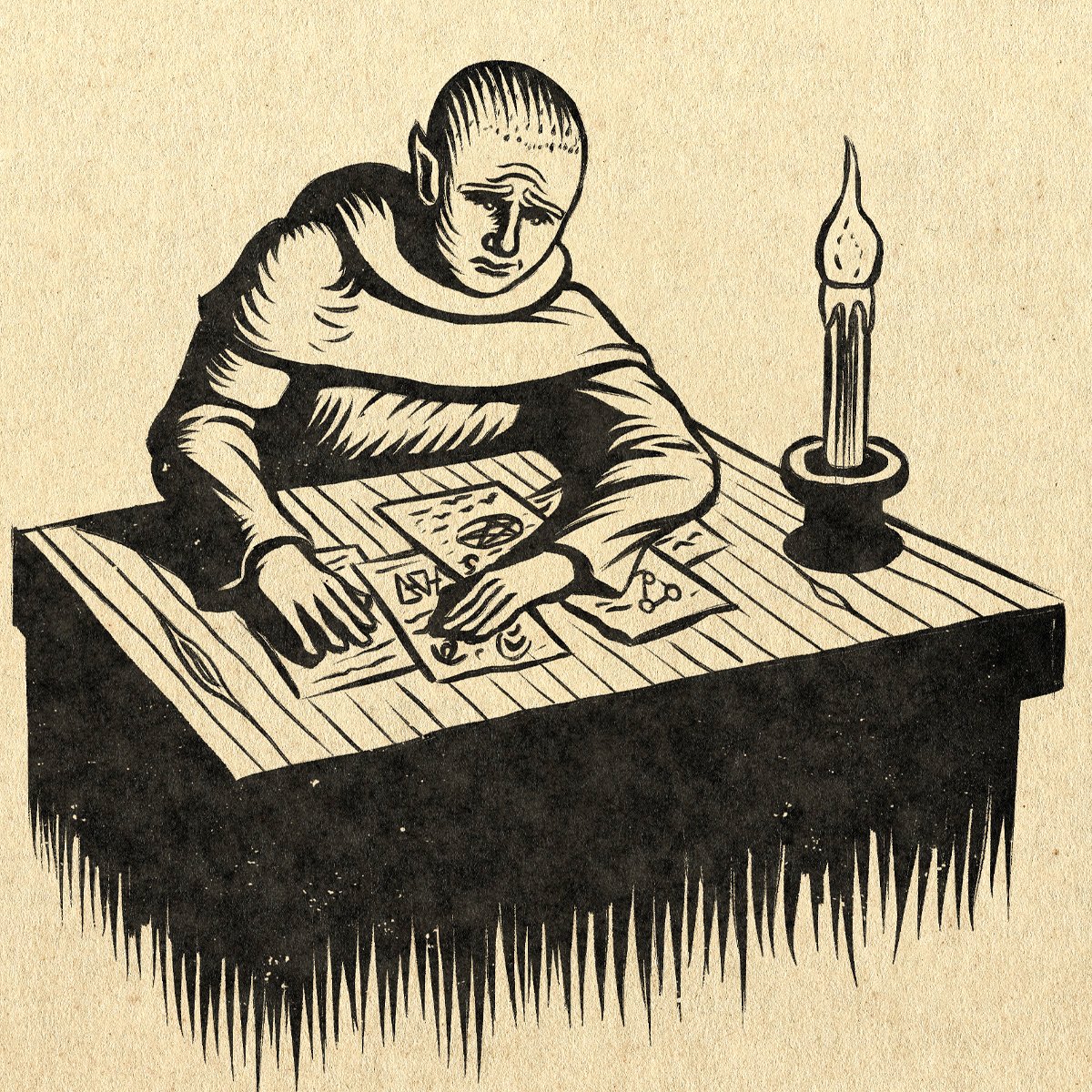
Cynthea had her legs crossed on the floor of the main room again, organic shapes drawn out before her in thinly dispersed lines of salt. Three bowls were arranged where the lines intersected and bent: one full of feather, one of ambiguous flesh, and one of small lead granules with a faint orange glow.
She’d sat there for a few hours now, speaking across the innerweave with various officials at Nalreach and an Archivist at Estaith—that conversation, Ollis listened to intently, though it was very cryptic, spoken entirely in the Old Tongue, and he didn’t gain much meaning from it. Now she spoke to a professor at Yaelfand, someone in the Evocation school whom Ollis had not heard of. He stood by the cupboards, watching. Harkital was likely still in the bedroom, sleeping off his grief. Admar sat outside now, facing the wall of forest that stretched out beyond the shack, leaving Ollis and Cynthea alone as she spoke, desperately, to people who might be able to help them. Without luck.
“It is not a divining orb, Ulder, I’m telling you, the boulder is taller than I am…”
There was a long pause between each statement. Cynthea’s eyes were milky white all through, her voice topped by an unusual airiness. Ollis had never performed a spell like this before and deciphering its details was a welcome distraction from the dagger of Vorik’s frozen frame, from the crushing sludge of time’s continuous passage, from thoughts of trembling stone.
“As we left,” Cynthea continued, “myself and an Adresil felt the signal growing faster. Our feet began to ache, even. It seemed to be the same effect we had experienced holding the shard, but it was amplifying, spreading…”
A minute or two passed.
“…But I already told you, touching the thing is exactly what killed Vorik,” she said in a hushed voice. “On any other day I would identify or neutralize it, but it has been so volatile, so powerful, so concentrated, I hope not to trigger it…”
Another minute went by.
“…So be it. I’ll get in touch with them, I suppose…issirit.”
With that final word—the Old Tongue goodbye—her eyes suddenly returned to her, lucid and pure in their brown color, though the skin around them was still weighed with sleepless angst. She looked up at Ollis.
“I fear the worst, Ollis. Nalreach has no word of advice or procedure, though I knew they wouldn’t. Farlit, at the Archive, said he could look into the matter, but that it would take time. Too much time, I fear. Idris Ulder was about as helpful as Kiri was for the Regimens last season, and we’re back at square one, I suppose.”
When Cynthea offered no more insights, Ollis sat down beside her and chanced his first question in hours. “Are you a fan of the Regimens, then?” He yearned to fly to the scents and sounds of the Capplewait arena, the taste of its trademark sausage and herbal drinks, the roar of the crowd.
Cynthea smiled. “Make way for the Regiment,” she chanted half-heartedly, “all your men and wenches—hurrah,” adding the traditional flourish of the wrist at the end. “I had tickets for every match of the season last year, all of which that bastard Kiri bungled.”
“Wasn’t she the one that died from a hit to the temple? Sometime around match seven?”
“No, you’re thinking of Ivvy, she was with Everfestal, though that was a match against us. Kiri got a few too many ribs cracked and bled out, I believe. Match twelve. Damn shame—she was brilliant with that bow two seasons back, should’ve left on a high note.”
“Wish I’d seen it,” Ollis said. “Really, I wish I’d seen more matches in general, now that I can’t this year.” When that thought came out, he realized how pitifully sad it sounded and added, “I’m a Lour Collective fan myself—bleed the bright and blue.”
“You’ll have the chance to see more matches soon, Ollis. I’ll make sure of it.”
He looked down at where his legs were crossed on the shack’s wooden floor. “What I wouldn’t give to be back there now.”
“Tell you what, once we’re back, I’ll take you to a regular season match of your choosing. My treat, plus a cup of mint gillis for the both of us. Extra foamy.”
“Oh, Magis, I couldn’t—” Ollis said, though the offer was too tantalizing to deny.
“But I won’t wear that ‘holier-than-thouer’ blue. I can assure you of that.”
He smirked. “Well what would I have to do, then? To get you to wear Lour blue?”
Cynthea thought for a moment, then said, “Truth be told, I’d love to see you develop more confidence in yourself.”
His smirk vanished.
“You’re putting yourself out there. You’re doing the right thing. But don’t let Harkital or Admar or V—” She stopped herself, nearly forgetting. “Don’t let anyone put you down. Keep asking questions. Keep studying. Rest in the fact that you’ve come farther out here in the field than any Waithen your age—at least that I know of. That you’ve done more. That you’ve done very well. And you have the potential to be quite an extraordinary Waithen. Maybe even an archivist like myself, someday. You must know this.”
Ollis was silent again. Part of him wanted to thank her for her flattery, and part of him wanted to run out of the room. The last time he’d put himself out there, as she said, he’d wandered through town in the dark. Look where that had gotten them.
“I…” he stopped himself.
“Go on.”
“I just…feel like it’s too much, maybe.”
“This?” Cynthea said, gesturing broadly.
“Yes. The Exploratory Party. All of it. I hoped I was ready, but I’m just…not sure.”
“Of course you weren’t ready. That’s the point of it. That’s what makes how you’ve handled yourself all the better. You investigated the shard, found the boulder, put up with Admar’s lies, and you’re still up and kicking. You’re sitting here right now just to listen to me cast my rituals, eavesdropping on my conversation with Farlit,” she cocked her head knowingly. “You’re here to learn, and you’ve done that much. No, you weren’t ready, but you weren’t supposed to be. Although,” she added, “before he even sent you over to us, Jorhan said you’d be a fine addition to our little group.”
“Jorhan?” Suddenly it clicked. Perhaps that’s who the teacher had been talking to when he came in for his examinations, all those days ago: Cynthea.
And here Ollis recalled the other mystery of Jorhan that had been revealed to him—the story of Rittenhour—Jorhan, of all people, present in that tale, with a mysterious place in Waithen history. Ollis had so many questions to ask when he returned.
“Sure, he said you were a little green. But also that you were more than a little capable in spellcraft. And I can vouch for that too. Your spell, the one that you used to reverse the effect?” Cynthea spoke gingerly, clearly aware of what images it might conjure. “It worked. It was an excellent choice, not one I would’ve thought of.”
He almost smiled at her assurances. Instead, Ollis frowned. “But…I could have said something.” He rubbed his hands together anxiously. “It’s one thing to be a little green. It’s another altogether to get someone killed.”
“Ollis—”
“I could have said something, Cynthea—I mean, I knew that the stone had affected me, and I felt—I thought I could feel the pulse of the thing growing greater and, but Admar said I couldn’t say—I wasn’t, I’m not ready for this—”
“Ollis,” she stopped him, holding up her hand. “You came between Admar and a potential discovery. And promotion. It is not your fault that he lied. Even then, none of us knew what the stone was capable of. None of us knew that it would…” she sighed. “But now we do. And had Admar not done what he did, intimidated you as he had, we may be in a different place now. You wandered, but he lied. And for that, he will be censured.”
Ollis blanched.
“And don’t go wallowing over his punishment, either,” she said, reading his mind, and he could tell by her look that his self-abasement was beginning to grate. “That is his, Ollis, and his alone. Something I’m sure he recognizes.”
Ollis straightened his back a little.
“I know him,” she continued. “I know how he values the Order, how he respects its law.” At that, her face grew dark. “Sometimes too much.” Cynthea let out a heaving sigh. “All of Vindac, I think if I were stuck with these two fools alone, I’d be out of luck.”
“And what of Harkital?” Ollis cast a cautious look toward the bedroom where he still slept. “Is he…do you think he’ll be alright?”
“He—”
“If you two are done gossipping,” a low voice cut through the room, “I’d like to make a suggestion.”
They turned to see Admar standing in the doorway that led to the side yard and the road to town. Cynthea stood, and Ollis joined her.
“Of course. What would you suggest?” she asked plainly.
“That I return to the dell.”
Ollis looked back and forth between her and Admar, both their expressions chiseled by old, earned pride. “What for?” she asked.
“To divine the object’s meaning.”
“Through spellcraft?”
“How else?”
She shook her head. “Until we know more, any magical interfacing with that boulder is too dangerous. I applied whatever investigatory skills I have at my disposal when we first encountered it, and—”
“But you may have missed something.”
“Indeed. And what do you think that might be?”
“With all due respect,” Admar said coolly, encroaching further on the shack’s creaking floor, “I don’t believe that divination is your strong suit, as it is mine.” He seemed to revel in this claim. She did not deny it. “You may have sensed its various properties, to be sure, but were you listening for the music of energies beyond the transmutory or alchemical? For the voices of the gods? For the sounds of the Alegreon, or the Orandreon, their forebears? In the church,” he added, “you could barely name them.”
She thought for a moment. “Perhaps that’s true, Admar. But even so. A proper divinatory analysis will have you in just the same contact with the thing as an identification spell. You will die. Others may die as well. It’s getting stronger. And we’ve suffered enough already. I will not have it.”
Admar’s silhouette in the doorway straightened, his frame like a soldier’s, his face unrevealing. “You will not have it?” he asked, voice steady, inquisitive, pure.
“No.”
For a while, he stood there silently. Then, with the same measured voice, he said, “How surprising.” He turned and walked back out.
Cynthea followed, a new weight on her brow, and a strange severity in her step. Ollis went after her.
Standing on the porch, the warm afternoon light was harsh upon their eyes, sun hanging silent and watchful above the forest to their left. The elf had stepped down from the stoop into the grass and continued in a straight line, his strides pointing him past the garden and through the field, resolutely north, toward town. Toward the thing that lay beyond it.
“Admar?” Cynthea called. He did not answer. “What are you doing?”
“What you will not have,” he called back, still walking.
“By my authority as a Magis,” she said, pulling down her collar to reveal the stilor again, the holy water pinned against her chest, “I command you to stop.”
Admar continued on, not bothering to look. Cynthea raised her hand.
“Admar, you’ll kill yourself, or others,” she implored him.
He walked on.
Ollis watched as the look of concern upon her face transfigured into something harder, something unyielding, and his heart began to race. “Last warning,” she called. Cynthea’s outstretched hand curled and flexed into fifth position, and the space before it filled with small, stable globules of white-hot light, connected by fine, illuminated mesh. A vibration at Ollis’s ears built, responding to this magic, and his shallow breaths quietly quickened.
Admar took another step, and the globules suddenly shot from Cynthea’s hand in three direct beams, straighter and truer and faster than anything Ollis had seen in Introductory Arcane Defense. They reached the elf in less than a second.
With blinding speed, Admar flung his right hand backward, a gust of yellow-white wind flying behind him in an arc, spraying the darts wildly into the grass. He had not even turned around. Then, the elf stopped and faced them, his teeth bared, his knuckles clenched with rage and indignation.
“Seven years I had waited for promotion, Cynthea. Seven years of Exploratory Parties, invitations to court, pilgrimages to holy Vindac’s Grace, only to watch you waltz into Capplewait and reach Magis for a damned enchanted goblet. So know this—I will not have you hinder me from claiming what you have denied me at every expedition since Harbinger’s Hollow. I will not have you standing in my way from boons and glories and work that I have earned.
“The courts may spurn me,” he growled. “But you will not.”
Cynthea kept her hand raised, her other hand still exposing the glass stilor, the waters of the Bay within it. “If you go to that stone, you will not find the glory you seek. Even if you do uncover something and happen to live, I will make sure your name falls to mud in all the Waithen world.”
“Ha!” Admar shouted, stepping forward. “There! There! You admit it, that you only seek glory for yourself, that you would hold me back from an opportunity to learn the truth—to save this Biluranian backwater—for your own, ill-gotten hubris!”
“Stand down,” she commanded.
“Stand down? Stand down?” Admar said, mocking and incredulous. Then, with his eyes narrowed into blades, his brow heavy as a storm, he thundered: “I will not have it.”
From Admar’s hand, many yards off, a yellow-white orb of fire collected in the air and hurtled toward them. It arrived quickly—Cynthea ducked and Ollis jumped back, the orb striking the roof of the shack with a thudding detonation.
Before Ollis could react, Cynthea turned and raised her arms once more. Now both of them were clasped together, pointed outward, forefingers extended. Her lips moved in a small, contained whisper, and from her fingers a small, thin thread of cool light shot out, weaving around itself in bends as it sailed. With its unpredictable trajectory, it caught him, wrapping quickly around Admar’s left forearm, and Cynthea grabbed the other end of this long thread and pulled. As she did, a trail of arcing blue energy coursed up the wire until smoke plumed where it touched the elf’s flesh. He howled in pain as Cynthea jumped from the shack’s porch and approached him, holding the zapping cord all along the way.
Then, the hot smell of smoke—not that of Admar’s flesh out in the yard, but of burning wood. The roof of the shack was ablaze where Admar’s orb had hit it, a gaping hole in the structure, a rapidly growing flame, a mess of splinters and char. By instinct, words flew through Ollis’s head.
Gedrigar aqellit…Gedrigar eqillorum…Gedrigar…Gedrigar iqidiriq—
The next word stopped before him, as if selected from the slips of parchment ever crowding his dormitory desk.
“Gedrigar oquellire.” Ollis pointed his hand with fingers fanned out toward the blaze. Cool, fluid, invisible energy flowed from his palm along his knuckles and upward toward the fire. The flame subsided into tufts of smoke, its red tongues smothered.
Another shout rang from across the yard.
The white-hot tangle still wrapped around his left arm, Admar wailed as Cynthea pulled herself within a dozen feet of him. She lifted her free hand, the other still holding the blue-lit thread, and sent a thick blast of arcane energy toward him. Even so restrained, Admar deflected the blow, but Cynthea followed up, leaping forward after the blast to seize him.
But Admar was too quick. The elf grabbed Cynthea’s wrist just as she reached to strike a definitive blow with a glowing palm. Yellow-white light spread where he touched her, and her entire frame went rigid. She fell, limp and heavy, to the earth. Smoke bloomed from the elf’s seared forearm. Releasing Cynthea, he grasped the shocking thread with his free hand, cried out, then began to unwind it. He grimaced, animal sounds leaking through his locked teeth, tears streaking his anguished face, but he seemed no closer to yielding than a feral boar.
Terror filled Ollis as he considered the novice darts, little more than flickering lights, he might employ against him. Looking up from his still-smoking limb, finally freed, Admar met Ollis’s eyes with a face tightened and ravenous. Ollis leapt back through the door of the shack, knocking a putrid pile of jars that shattered against the floor as he stumbled into Harkital’s room.
“Harkital!” Ollis shouted, his voice cracking under its own volume. “Admar’s attacking us, we have to leave! Wake up! Wake up!”
Yet the mass in its bed did not stir.
“Harkital, wake up!” he cried, ripping the blanket from him and reaching down to shake him.
Then, Ollis saw Harkital’s face, frozen, eyes wide open. With trembling hands, with breath he struggled to keep down, he felt his Idris’s neck for a pulse. There, he felt it, slow and still as the earthen tide.
Ollis quickly pressed his ear against Harkital’s chest, confirming his fear. Harkital, too, was paralyzed, just as Ollis had been last night, just as Cynthea was now, out there in the grass. Admar had been ready for this, ready to abandon them for his own aims. Horror filled him. He sought the word to reverse such a charm, but nothing came. Roots and suffixes flew through his head at an unwieldy pace, but none leapt out, none arranged themselves from the chaos on the desk.
It wasn’t words that stopped a paralysis spell at all, he suddenly remembered. It was something simpler, substantive, like salt, or yeast, or wine, but he could not name it. Was the ingredient here, in the shack behind him? Would he have time to find it before Admar—
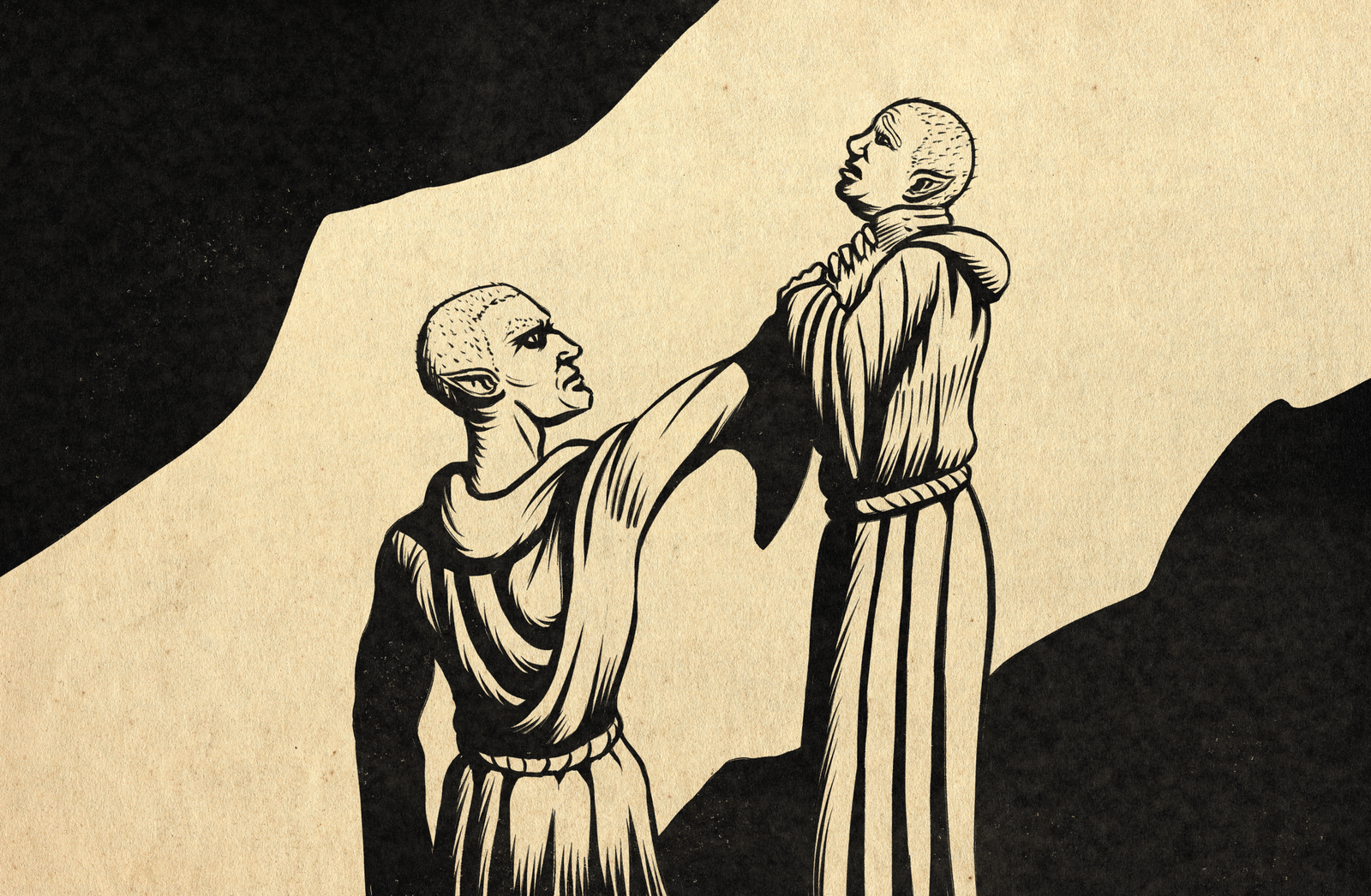
From the threshold of Harkital’s room, a hand reached in and clasped Ollis’s neck, its grip rigid and tight, the fine skin of its palm slick with sweat. The elf’s glassine eyes found him again, the profound and hideous stench of the burnt arm filling Ollis’s nose as Admar reached a hand under his shoulder and pushed him up against the wall.
“An Adresil, before your puny little balls have even dropped,” the elf laughed—or wept—through a clenched jaw. Ollis’s head began pounding for lack of air from his grip, then the pain compounded, as warm, sickly magical energy emanated from Admar’s hand and into his neck and jaw. “That took me nine years, you know. You weasel, you little drunt—ah!”
Admar screamed as Ollis dug his nails deep into Admar’s left forearm, carving into the wet, burgundy lines still fresh on the skin. Ollis broke from the elf’s grip and fell to the ground, wheezing, then lurched through the shack’s door and scrambled over the edge of the porch, into the grass, his lungs needling with lack of air.
“I’ll kill you boy!” Ollis heard behind him as he broke into a run. Cynthea was up ahead, an unmoving form in the grass. He could reach her, mere steps away. Surely he could, he thought, and he glanced backward just in time to see Admar’s form disappear from the porch in a puff of mist.
Then, another puff, and Admar was mere feet behind him, hands reaching forward madly and grabbing him by the edge of his cloak. With a lurch, Admar clasped Ollis’s shaven head. Before he could grab the elf’s raw skin again, or cast a spell, or even think, the crushing grip on his skull swelled with powerful, evil magic that stopped him cold. Admar’s lips did not move, his wet, weary, even sorrowful eyes twinkling and hateful as Ollis’s vision faded at the edges, blotted out by a dark green haze. His body went completely limp as the energy surged through it, and everything grew darker, the torment behind his eyes explosive and sublime—
Suddenly, the rhythmic whir of metal through the air. A razor tearing through cloth, the sound of fleshy impact. Admar released Ollis with another wail, letting the boy fall into the grass, and into the arms of the death he’d cast upon him.
Necrotic energy buzzed from the top of Ollis’s head to his outer limbs, its call alluring and complete. He could hear his own pulse, arhythmic, sporadic, faltering. His stomach filled with bile. Images flashed in his mind of executions, of stillborn children, of abattoirs, of the swirling clays so far below, of mountains unseen beneath the waves. Every part of him that was flesh cried to be burnt, severed, excised, reduced with salt and lye to nothing. Every part of him that was not flesh cried out for evacuation, to be pulled from his being, and as it slowly left him, every space that it departed filled instantly with some nameless bruised waste. His skull echoed as if it were a bell that could not be unrung, and he realized, suddenly and perfectly, that the only way out of this agony—the agony, the agony—was sleep.
With terrible urgency, Ollis exhaled what breath remained in him as if it were a poison, and he settled into the stillness left behind as best he could. Whatever was happening to him now would not happen for much longer, and that was alright. In fact, that was the best he could hope for. Behind him, barely perceived, there was another puff of air, the sound of mist. Then, dozens of yards out, through the haze of Ollis’s blotting, fading vision, the figure of Admar reemerged amid the grass, clutching his right shoulder, hobbling forward, vaulting the stone wall that demarcated the property. Heading north. Disappearing.
Hands grasped Ollis, turned him around.
He saw upward, somewhere in the darkening green, the face of the southerner, Miranda, her eyes bright with intensity. Soon the face of a beardless dwarf appeared. They were saying something, moving him around, murmuring. The southerner looked over toward where Cynthea was, and left Ollis with the strange dwarf, whose eyes were brighter than Vorik’s, though just as kind. In the distance, he heard sounds, a flask opened, more voices and words. A desperate gasp.
As his consciousness reduced itself to the smallest, thinnest scraps, and the peace of nonbeing finally welcomed him, the southerner’s face returned overhead. Cynthea’s as well, weary and bruised. Her soft hands clasped Ollis’s temples, holding the empty space between them. Warm, dull light began to shine within his eyes. His pulse began to stabilize, to beat in time to magic that filled his ears like the sound of holy music.
Soon, his mind slipped away.
There, at the Bridge again.
Wind whipped over Ollis’s face, his naked body, like great sheets of fabric pulled around him. The salt of the air stung his eyes and mouth and he smelled it, rich and sharp in his nostrils. His ears were full of the hollow, curvaceous sound of the battering waves, the taxing wind, the fuming sea, and endless, boundless magic.
Somewhere, invisible mountains.
He was standing near the edge, so that he could look down and over the lip to see the sea and its fathoms below. The height was incomprehensible. He turned from it to face the Bridge’s length again, only to find Admar standing there. The elf’s arm was still burnt, his smile wide with vicious mockery, his head bruised, his woolen cloak and tunic torn at the left arm, the right shoulder.
“Go on,” the elf said. Though only a whisper carried on the wind, Ollis somehow heard the voice, silver and destructive. “Like Rittenhour.”
Above them both, the sky sat, heavy as stone, dark and impenetrable. Ollis’s feet were bare. He could not, would not run.
Suddenly, Admar was closer. A hand clasped around the dome of Ollis’s head again, lifting him by it with a claw-like grasp, walking toward the edge of the Bridge.
“Go on,” Admar said, Ollis’s feet now dangling freely above that impossible height. “Echo.”
And somehow beneath him, clear and strong—from mountains he could not see—Ollis felt echoes.