Follow The Literary Fantasy Magazine 2026 on BackerKit.

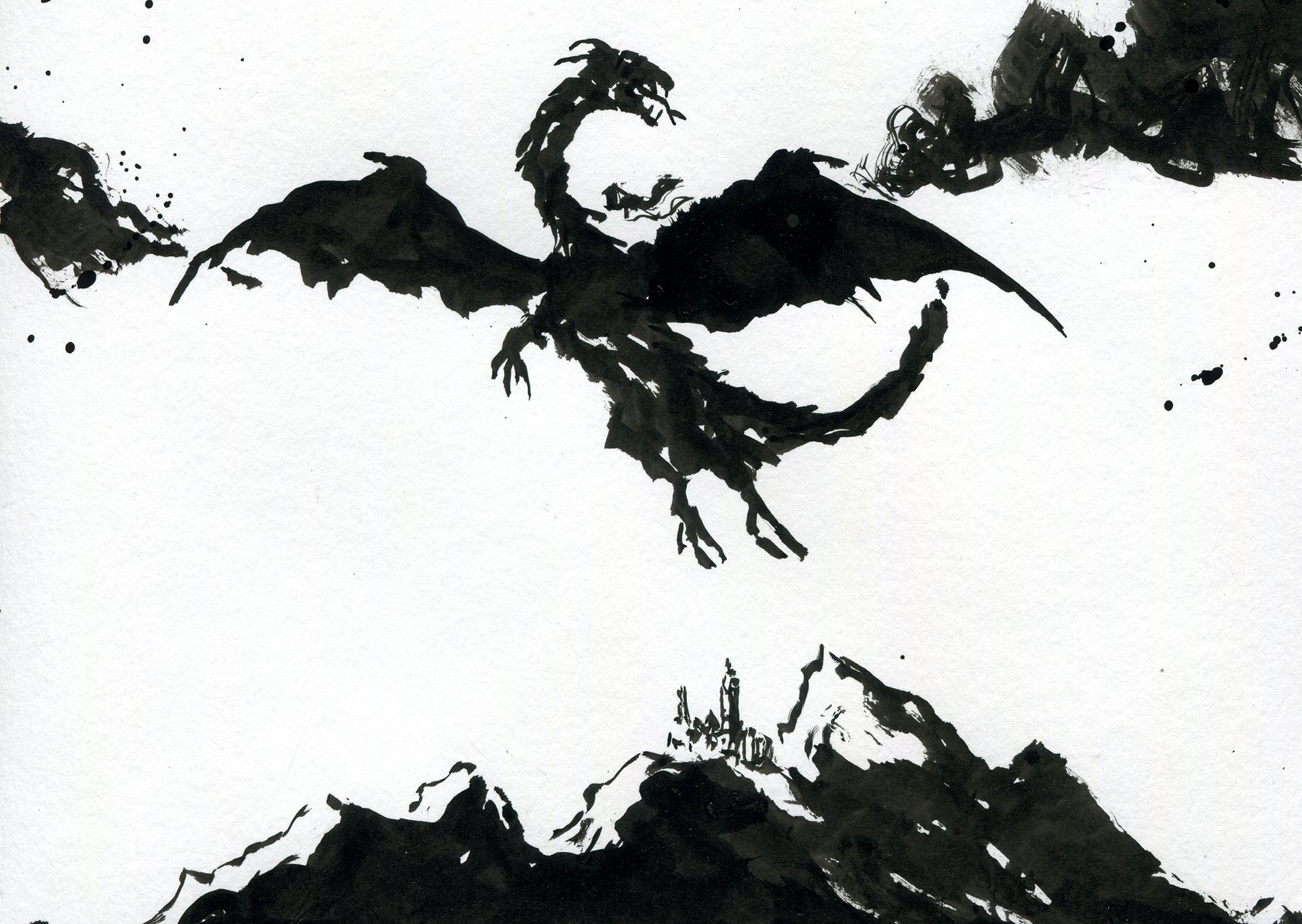
The Dragon and the Deep Kingdom
The deep dragon, Argooul, utters poisonous words which have leveled kingdoms. When King Thornblade Mikteshfis learns these words have spread to her domain, she delves into the Deep to slay the slanderous dragon. Nothing could have prepared her for what she discovers in the depths.
SHORT FICTIONHEROIC FANTASY
SM Reine
2/6/202619 min read
In those days, the Kingdom of First Knuckle still stood at the heart of a deep-lake, where the mists were a perfume of spores and the wind smelled like velvet shank. There was no reaching the castle at its center without taking a gonleden up the locks to the channels. To set upon the lake itself was to die in the jaws of the leviathan; to take the channels without the King’s blessing was to die by her arrow.
King Thornblade surveyed her kingdom from the highest chamber, reminding herself of legacy. It was Mikteshfis gold studding the walls, Mikteshfis thralls who cut the brick, Mikteshfis bodies honored in the mortuary. The Dwarrow commoners who worked the shoreline village owed everything to the Mikteshfis lineage.
She was gazing over her kingdom, sadly contemplating duty, when a bard brought the news.
“Our world changes,” said the flautist. “A new darkness creeps from commoner hovels to consume noble flesh. Moats flow with noble blood, and it is not noble blade that spills it.”
Thornblade was chilled by the thought, clutching her wrists to hold her veins closed. “What is this darkness made from?”
“Evil wearing the mask of populist philosophy. A dragon’s prophecy spurring treachery.”
“Where is this dragon?”
He was called Argooul, and he was said to lie deeper than the Deep. He spewed golden magma and enchanting words that poisoned every mind who heard him.
His words had first reached the Kingdom of Fistred Shy, so they had been the first to fall. In the depth of night, when winter clutched the Abovelands, village workers had swarmed the castle the way that clusterpedes swarmed tarask cadavers. “Commoners demanded all the wealth of Fistred,” said the bard. “The ore from the mines, the fruit from the fields. When King Blunderheel denied them, he was rent limb from limb.”
“But he was their finest warrior!”
“The dragon poisoned thousands. Even a great warrior cannot stand against such numbers.” Blunderheel’s son had marched against Argooul, accompanied by reinforcements from the allied Kingdom of Lesser Citrine.
Those reinforcements had been poisoned by the dragon, too.
Lesser Citrine was no more.
No Kingdom was safe from such coercion. Citizen uprisings overwhelmed the Mountainhomes, and the commoners all demanded the same selfish things.
“I shall slay this dragon Argooul before he comes to my Kingdom,” said King Mikteshfis.
She donned her armor and took up the Mikteshfis standard.
The King rode forth with her most trusted knights: Kolkor the Bewitched, Yvin Shieldmaid, Bordandolar the Fierce. These knights were followed by a clutch of squires, footmen, maids, and hostlers. They took armored ibexes trained for war wearing shoes like hammers and horn-sheaths like knives. Wagons filled with food commoners had harvested followed.
The Dwarrow rode away from the glimmering waterfalls. Reflections faded from their armor. The Mikteshfis banner undulated into shadow.
* * *
No Dwarf lived in the Deep. The uncivilized frontier knew no gods.
Titles meant nothing in such a lightless place. The wilderness knew no difference between Dwarf King and heathen Gnome. Even within a metal carapace, Dwarf flesh was only meat to the beasts who hunted them.
In the shallows these beasts were spidren, wearing faces like Gnomes and bodies like spiders. For this, Thornblade had brought Bordandolar, whose adamantine axe cleaved heads from every spidren it met. Where fell pieces of spidren, the maids were quick to gather. Blood was ink and dye was wealth.
Bordandolar’s squire marked her master’s path by burning stands of succulents, ensuring Thornblade never need ride into true darkness; Bordandolar’s work meant only cadavers greeted them.
They rode until ibex tired, then camped to rest them.
Bordandolar boasted of his skill with the axe. “Honed against lazy smiths!” His father owned the forge where everything short of adamantine was turned to tools and armor. “And perfected against Jawchaw!”
The party roared agreement, lifting pints of ale in memory of battles won.
A Vekichenden bard bandied songs while they rode, making a long journey joyful. He wrote new songs of King Thornblade’s bravery and sang those too.
Thornblade would crush the dragon, he said, and take Argooul’s head to mount atop her castle.
“I wager Argooul is no dragon,” said Thornblade. “The Old Kingdoms killed all such and none remain. He will be a hermit, an exile—a radical—and easily slain.”
The bard promised he would sing her praise regardless. “Your legacy will join your ancestors’ as a dragon slayer.”
Thornblade was sobered by the thought. She often feared what her descendants would think of her, wondering why she must live up to a legacy she would never know. She imagined her entire life diminished to a single tale of dragonslaying which might be a lie, and she felt sad again.
The party made quick time to the Ancient Mines where Dwarrow had found their first ores. Ragged, cramped tunnels were foremother to the wealth that empowered the Kings of modernity. They had been long since taken by shadow.
Now the dead would not stay dead within the Ancient Mines.
Skeletons rose to set upon the party.
One ibex was struck down, then arose to attack his rider.
A maid was slaughtered by the spidren remains she carried. Then the maid’s corpse rounded upon Thornblade, who dismembered her.
Yvin Shieldmaiden held a single narrow passage against the onslaught of skeletons. Her escutcheon bore the Mikteshfis standard, so she punched the icon of tower-and-Skygill into chattering skulls.
Kolkor the Bewitched drew fire in the air with his fingers; his squire shot that flame upon the graves.
With magick the dead were laid to rest.
Eventually, everything rested again.
The Ancient Mines fell quiet.
King Mikteshfis went deeper into the Deep, and her party crushed the wilderness that would have stopped them.
* * *
Where King Mikteshfis expected to find the dragon, she found a hovel. It was built of mushroom wood against the craggy rear wall of a cavern, elevated above the lapping edge of the swamp. Kolkor had poisoned a hundred clusterpedes for them to reach the hovel safely.
“This is the place?” asked King Mikteshfis doubtfully.
“Surely,” said a bard, “as sure as you are King.”
Thornblade commanded her party to camp outside the hovel. “I will return with the head of the dragon.”
At last, she proceeded alone.
Inside the hovel sat a Gnome, his back stooped, his eyes colorless. Like all Gnomes, his pointed ears were long and drooping. His frail body was wrapped in tattered wool scraps. He rested upon a crude stool beside a cold hearth. “Who seeks wisdom at the edge of the Underdeep?” asked the Hermit.
“I am King Thornblade, bearer of the Mikteshfis legacy, ruler of First Knuckle,” said she. “I come to slay the dragon Argooul who poisons Dwarrow with lies. Are you he?”
He contemplated her question while stroking his chin with spindly Gnome fingers. “All is one, and one is all,” said the Hermit. “What harms the dragon harms me, and you, and all who stand between us—the thresh in the caves, the skittering spidren, and the Gnoll they devour.”
Thornblade believed this to be a confession; she took his head with a swing of her sword. Gnome blood spilled a sickly pale orange.
She lifted his head by the ear and tied it to her belt using his hair.
The darkness in the rear of the hovel rumbled and echoed. Flame flared. Heat and light swelled into life.
Where Thornblade had presumed a wall to stand, there was more cave—much more of it. A short hallway opened into a cavern as large as her home’s. The Hermit’s head thumped her knee as she progressed forward, sword raised.
Therein lie a monster.
He was the size of a castle, hunched atop a hill of glimmering golden mushrooms. His legs were pebbled as the village roads. Glimmering scales protected a body like a muscled wyvern. A sweep of his wings made flame gutter and stole Thornblade’s breath.
Angrily he roared, spattering her armor with slime. His tongue could have licked up every ibex in the Kingdom with one swipe. His smallest tooth was taller than Thornblade.
“Monster!” she shouted, dauntless. “I am King Thornblade, bearer of the Mikteshfis legacy, ruler of First Knuckle! I come to slay the dragon Argooul who poisons Dwarrow with lies! Are you he?”
“All is one and one is all!” the dragon shouted back.
She could hardly stand against his breath, though she dug in her boots and shielded her face with both arms. He gusted heat from his belly that seared her armor until she scorched within.
When he inhaled, Thornblade rushed forward, escutcheon lifted. She made his nearest foot her enemy. Her sword could penetrate neither hide nor claw. A third thrust wedged the point between the two, and Argooul cried out.
Golden blood erupted from the wound. It sprayed hot over the mushrooms, which shriveled at the touch.
He drew his foot away and retreated. Every step was a shiverquake. The King was brought to her knees by the tremors.
“Why did you kill the Hermit?” asked Argooul, serpent neck twisted away, brow-fans flaring with rage and horror.
“I must bring justice to the Dwarf Kingdoms! Your words have destroyed the legacies of generations!” She leaped to her feet to pursue him. “Devour me so I may gut you from your innards!”
Yet he still retreated. “You cannot kill until there is peace,” said Argooul. “What harms the Hermit harms me, and you, and all that stands above and below: our All-Mother, her bastard brother, and the lives transformed from her tears. I would kill you no more than I would kill myself.”
His voice had softened so it no longer bore upon her like a hammer.
His words were daggers to her breast instead.
“You speak lies as though they are philosophy.” Thornblade hardened her resolve. “Your poison will not take me!”
Argooul easily danced away from each swing of her sword. He watched from above with growing puzzlement. “You believe in the value of one above all, but you stand against me, who could deliver certain death to the body you operate.”
“I am bearer of legacy unbroken, and I will not be the Mikteshfis who fails our clan!”
“You are brave,” said the dragon. “No, I would not kill you. You have already killed yourself a thousand times.”
Again and again, Thornblade tried to make Argooul fight, but he would not.
She swung until she wore all the strength from her muscles. Her armor became too heavy for her to stand, her sword too heavy to clutch.
The King collapsed within the hovel.
Argooul rested his head on the other side of the hallway, gazing in at her with glittering eyes. He did not breathe flame. He watched in puzzlement as she threw her sword a final time and it clattered to the ground in front of his nose. He denied Thornblade honorable, certain death.
With the last shreds of energy, she dragged herself to the door of the hovel.
She pushed it open to find her party dead.
* * *
A tarask had smelled the knights as soon as they left the Kingdom of First Knuckle. She was in her nesting season, midway through migration, and the stench of axe-spilled blood drifted through the caverns.
At first, the tarasks’s instinct had craved the ibex. She had turned from her usual path to pursue. Flames gushed from every footstep and dripped from her mouth where other beasts drooled.
She came across succulent mounds that had already burned—and not with tarask fire. The Dwarrow had started small, cool fires that extinguished quickly. She could not nest with the remaining fuel. Her eggs would not incubate without real heat.
Her body changed at the growing smell of blood without the taste of flesh.
Insensate, without action marriable to instinct, the tarask hunted beyond migration grounds. She gorged herself upon the bloodless shreds of spidren carapace. She chewed the twice-fallen skeletons of the restless dead, which made her thirstier, and lapped up the waste left by ibex and Dwarf.
When the tarask caught up with the King and her knights, she was full of filth, yet hungrier than she had ever been, and swollen by over-developed eggs that she could not lay. Her flames were guttering. She knew only distress.
Bordandolar faced her with a well-blooded axe.
Yvin joined him with a spear.
Kolkor with magicked flame.
But they could not rally the remainder of their party; a roar of the tarask immobilized them where they stood.
She consumed the hostlers and the ibexes. They were not enough to sate her.
She was attacked by the knights, who penetrated her hide and spilled her flaming blood.
She ate the maids and the squires. Injured by the knights, they were also not enough to sate her.
The bard tried to flee between her legs. She ate him too.
Bordandolar and Yvin punctured her belly in an attempt to free the others. They lost their weapons to her thrashing, then lost their lives to her claws.
Kolkor rallied the squires, but the tarask fell upon all of them, and they were crushed under her flaming flesh. In the wake of battle, she was too weak to crawl away. Kolkor, at least, would have lived if she moved; he was uniquely capable of surviving flames. He smothered to death over the course of minutes instead of burning to char like the others.
In this way, Thornblade’s entire party died far from home, and so did the tarask.
* * *
Caught between the tarask flames that engulfed her camp, and the head of Argooul, Thornblade could only lie with the body of the Hermit she had killed. She curled around his head and dozed with wounds she had inflicted upon herself by fighting a dragon who would not fight back.
She was a pathetic little thing, thought Argooul. She sweated in her sleep and moaned quietly from nightmares of past sins.
The mushroom wood couldn’t burn in the dead tarask’s flame, but it left one side of the hovel overheated. Argooul cooled his breath to make Thornblade comfortable. Her slumber remained restless, albeit less sweaty.
When he sang the nursery songs of the Dwarrow, her fits finally settled. She was able to rest for hours.
Thornblade awoke angry. “How do you know the songs of my people?”
“I listen,” he said.
“How can you hear from the Deep?”
“I have walked among the Dwarrow as I have walked among the Gnomes. At times I have been Halfing or Àlvare. I am all of you.”
“A spirit of evil,” she said. “Deceiver.”
He pitied her for the hostility. Argooul continued to sing in a low, rumbling voice, using no words that she could argue with. He sang the songs she would have heard in childhood.
When she fell asleep again, Argooul gathered mushrooms from his cave and nudged them into the hovel. They contained enough water and nutrients to sustain her—at least for now.
Thornblade ate them reluctantly, resentfully. “You may as well kill me,” she said. “I will slay you when I am strong.”
“All is one and one is all,” he replied.
This enraged her.
She took up her sword to attack him again.
Argooul did not allow the tiny Dwarf to injure his body, but he admired her ferocity, her stubbornness, the cleverness of strategy. He could tell that she had been grown in battle. She found projectiles to dislodge stalactites that might fall upon Argooul. She attempted to trip him so she could reach his head. She nearly climbed his tail to his spine.
She ran out of energy again, eventually.
While she sagged against the hovel, panting, Thornblade surveyed him with eyes which no longer hated. He could see respect growing out of her resentment. “I will need more mushrooms before I can kill you,” Thornblade said.
Argooul was pleased to provide them.
Thornblade ate. “You may feign kindness, but you destroyed several kingdoms already.”
“I did,” said Argooul, “in a way.”
“I know it was your thralls who did the killing in Fistred Shy—”
“There was nearly no killing,” he said.
“My bards told me everything.”
“Nearly everything,” said Argooul.
He told Thornblade the fullness of truth, and it was this:
The Kingdom of Fistred Shy was a cruel place where King Blunderheel exploited all resources for war. He had planned to strike against the allied Kingdom of Lesser Citrine. Such fighting between Kingdoms was a regular occurrence. Most commoners had lived through several such wars, lost their children to providing for it, and were still haunted by a grief which could never heal.
Argooul had taken counsel with many of Fistred Shy’s miners, who dreaded more fighting to come.
The dragon reminded them that they vastly outnumbered the noble family. Argooul had turned their hearts with his words: All is one, one is all. You cannot kill your way to peace. He convinced them to rise against King Blunderheel with numbers alone, eschewing weapons, and they did.
“The Kingdom fell because it will no longer be ruled by a King,” said Argooul. “Society continues. The miners and farmers and craftsdwarrow will find another way.”
“But Lesser Citrine is gone,” said Thornblade.
Argooul became very sad. “Yes.”
King Blunderheel and his family had been confined in a gaol where they could harm no others. Blunderheel’s son, Folgolggin, lied about his intent to respect the commoners. He betrayed them as soon as he was free.
Folgolggin had fled to Lesser Citrine to gather allies.
They had journeyed to the Deep to fight Argooul, but Argooul was unkillable, and they had no choice but to hear his words. He had turned the hearts of of Folggolgin’s party to the truth:
All is one, one is all. You cannot kill your way to peace.
Only Folggolgin could not be turned. He returned to Lesser Citrine filled with rage.
The casualties were many. Nobility fought commoner, and commoner turned against commoner.
“I could smell the blood from here,” said Argooul. “I only wanted to help.”
“Will you stop now that you have failed and hurt so many?” asked Thornblade.
“I cannot. Many of Folggogin’s party fled to other Kingdoms, and they take my words with them. The other Kingdoms will fall. Kingdoms must always fall. I pray they fall without blood because—”
“All is one and one is all.” Thornblade knew the story now. “What hurts the Kingdoms hurts you, and me, and the farmers and miners and craftsdwarrow, and everyone between us.”
In the wake of this tale, Thornblade’s desire to battle was gone. She slumped to the floor, dazed.
She thought for a long time.
“What are Dwarrow without Kingdoms?” she asked.
Argooul could provide no such answer. “It will not be a land of dragons. It must be a land of Dwarrow with Dwarrow on equal standing.”
“From whence did this wisdom arise?”
“I have been the kings. I have been the commoners. A great sadness grips them all. I incubated within All-Mother’s flesh, distant from biological need, isolated as an amniote, alone with my thoughts, considering this great sadness. There is only one solution.”
“No path to peace by killing,” said Thornblade. “But you are wrong. I am not gripped by sadness. I am lifted by responsibility and compassion and the wisdom of ancestors, eager to take my place in history.”
“Is that so?” asked Argooul.
She did not reply to that question.
“I am afraid to lose my Kingdom,” said Thornblade instead. “It was built by my forebears. I fail their legacy if I do not protect it.”
“Did your forebears build it, or did their thralls?” asked Argooul.
She did not reply again.
Eventually, the tarask stopped burning.
After eating and sleeping, King Thornblade left the hovel to perform funereal rights. There was nobody to bury: everyone had been eaten, crushed under the corpse of the mighty tarask, or burned to cinder.
She could not linger to pray either. Clusterpedes feasted upon the tarask’s hide and would just as gladly turn upon her. Digging the Mikteshfis standard out of a pile of tents drew their attention. She rushed the flag into the hovel under her arm and returned to the dragon’s cave.
“Can you take me home?” she asked.
Argooul happily agreed.
He diminished himself until he was hardly any larger than the largest dire ibex had been. In this form, he was like a wyvern with four legs, and he invited Thornblade to ride him.
“You are a powerful magick,” said Thornblade.
“So are you,” said Argooul. “So are we all.”
* * *
The dragon’s words reached the Kingdom of First Knuckle before the dragon himself could arrive with the King on his back.
After Thornblade and her knights left, the commoners had been poisoned. In past seasons, traders had spread lungrot with their coughs, but now their words spread the stories of Fistred Shy and Lesser Citrine.
The King was absent, her family was distracted, and her advisors were counting their money, so there was nobody to prevent a pandemic of treason.
The commoners shared ale in the taverns and spoke of their woes.
Whatever food farmers grew was taken by lords who owned the fields. In exchange, they received a pittance to feed themselves; that food had to be purchased from the very farms where they worked. To build homes, the miners needed to pay the dukes who claimed to own the mines, though the dukes had never lifted pickaxes their own. Likewise, the craftsdwarrow were punished severely if they thought to use the goods they crafted without buying them first.
It was a sad loss every commoner suffered. Members of different guilds were more alike than different in this pain.
There were thousands of these workers in the Kingdom of First Knuckle.
There were only dozens of nobles—and a singular King.
A miner said: “The Kingdom of Fistred Shy stopped treating their nobles as nobles, stopped obeying the laws, and took what they created under their own control.”
“Lesser Citrine died for it,” observed a farmer.
“Then we will have to protect each other and ourselves,” said a craftsdwarf.
They went to the locks and climbed the canals. With escutcheons fashioned from tables and doors, they advanced upon the castle at the heart of the mists.
The nobles cowered behind knights, who drew their swords to face the shields. “Leave them living,” said an advisor, who understood that slaying the commoners meant there would be nobody to work.
And so a battle unfolded under the Skygills, commoner against knight, on the outer walls of the castle, and this was what Thornblade saw when she arrived.
* * *
Thornblade stood on the edge of First Knuckle and overlooked chaos. It was night in the Abovelands, so the waterfalls were dim, and the Skygills were in the midst of midnight sporefall. Through the mist, she could could not make out individual Dwarrow, but she could tell positions based upon the pinpricks of glowcaps. The commoners carried them in bags to confront guards who bore torches.
The village had emptied to swarm the castle.
She feared that Mikteshfis legacy had already become the same as Lesser Citrine. “Take me to them,” said Thornblade, turning back to Argooul.
But he was already gone.
She was abandoned to scramble down the cavern wall alone.
Her armor was too heavy to maneuver. She had not planned in climbing without an ibex. Reluctantly, Thornblade shed her carapace of metal piece by piece: the helm gifted by her mother, the breastplate taken from her great-grandfather’s grave, and even the boots and gloves Kolkor had enchanted.
Thornblade tried to keep the standard. She lashed it to her back with her belt across her shoulders. But it slipped free when she was midway down, and a hand thrown out could not catch it before it tumbled into the lake.
The shadowy form of the leviathan surged underwater. Its mouth opened, took the flag, and closed again. The beast was gone with barely a ripple.
Naked of anything that could distinguish her as King, Thornblade arrived at the village as a scuffed, dirty Dwarrow.
Long had it been since Thornblade walked the village which sustained her. The commoners lived in hollows dug out of the cavern wall. No wild mushrooms flushed along streets where once they flourished. The forges had not been rebuilt in generations and looked on the brink of collapse. Thornblade twisted an ankle trying to walk the neglected roads.
The Kingdom she knew only emerged when she approached the locks, where the rear of the conflict now stood. Commoners were treating the wounded with any supplies they could find: makeshift bandages, spit poultices, and liquor.
Few glanced at Thornblade as she passed, and she did not attempt to summon attention.
She climbed the ladders outside the locks. She walked along the glimmering canals that had been dried so no boats could move.
Knights fought commoners with the hilts and flats of their swords, while commoners slowly advanced. Dwarrow with broken bones moaned on the ground. The knights were unharmed within the safety of their armor.
Sir Galuggin Mikteshfis tried to stop Thornblade when she approached a skirmish. The knight shouted and moved to arrest her. His gauntlet closed around her arm, bare but for a thin wool undershirt.
“Do not touch me,” the King said, meeting her cousin’s eye.
He recognized her and dropped his sword. “Your majesty.” He bowed deeply. “At last! We are saved!”
Word of her arrival rippled through the knights. A path was cleared.
“We are saved! King Mikteshfis has come home!”
She entered a castle that commoners had penetrated. Individual rooms were held by knights to protect the nobles within, but the numbers of those defending the Kingdom were few compared to the commoners.
Joyful looting rocked the hallways. Miners pried valuable metals and gems from the walls using their knives, reclaiming what they had worked to retrieve. Others went to the kitchens to devour fine foods. Still others broke into unoccupied bedrooms, stripped the wadrobes of gowns, and flung them into the arms of their excited friends.
“You can make them stop,” said Galuggin. “Focus the knights’ efforts on purging this castle!”
When Thornblade reached her throne room, she was greeted with relieved sobbing by the rest of her family. She was numb as they embraced her.
“You can protect our family’s legacy,” said Galuggin.
But Thornblade pushed aside the guards and opened the doors to her throne room. “Over here!” she cried to the commoners.
They were swarmed.
The nobles were cornered—and astounded. “The dragon,” they said. “The dragon poisoned her!”
“I have felt the weight of legacy and its hollow sadness,” said Thornblade. “We must do what is right for all those who live in this land, not only the ones who control the coffers.”
“Are you commanding us to surrender to anarchy?” asked Galuggin, raising his sword again.
“I can command nothing,” said Thornblade, “for my command means nothing more than the command of my neighbor, or his neighbor.”
“This is betrayal! Usurpation! You would take all our wealth for yourself!”
Ferociously angry, the nobles spoke of replacing her as king. But the commoners were so much more numerous, they could pry weapons from the hands of those who would oppress them. They flooded the room and overcame those who resisted.
Thornblade, still unrecognized by commoners she had never met, melted into the fracas. She allowed the tide of bodies to overtake everything that she had spent her life protecting.
Her peers could not arrest her. A new King could not be appointed.
The revolution proceeded apace.
* * *
The transition did not come easily; few nobles cooperated. Thornblade left the castle for the village and thought very little about it.
There was work to be done.
She joined the farmers in the fields to ensure there would be another mushroom harvest when the chaos ended. She was strong from her time as a warrior-king, well-suited to tilling the soil, and she took instructions from the more experienced farmers.
Once the fields were inoculated, Thornblade joined the healers to tend the wounded. She washed blood gently off bodies using lake water and rag. She gave them food that they had not purchased. Thornblade unlocked a storage room when nobody was looking and shared plaster so they could fashion casts for broken bones.
Thornblade also helped rebuild shacks. She was encouraged to claim an empty one. She lie upon its roof to sleep during the nights, watching the sporefall from a position where she had never before lain.
In all her life, she had looked down upon a cave that she owned. Now she gazed up at a cave where she lived.
Over the months, skirmishes continued, but so did reconstruction. News of other Kingdoms in revolution reached them. She cheered with the others in true joy.
Thornblade forgot what it was to feel that deep sadness.
One day, deep into the process of relearning how to be a society, Argooul reappeared.
He was small again. He settled beside Thornblade on the roof, scales and limbs falling together with a hushed scraping, and he rested his head upon her knee.
“You abandoned me,” said Thornblade.
“I could not do such a thing,” Argooul said.
“Because all is one and one is all?”
He did not have a mouth like a Dwarf, but he clearly smiled. “We are always together, all of us, even when we forget it.”
Thornblade stroked his brow. “Things are changing.”
“Everything always changes.”
“Some people did not survive,” Thornblade said. “The knights felled a hundred Dwarrow who rushed the castle.”
“That is a tragic thing for the knights to do,” Argooul said.
“I took the side of the common Dwarrow.”
“I thought you would. Abandoning a Kingdom that served you is very brave.”
“I’m not sure anyone here knows I used to be King.” She showed him the dirt under her fingernails. “For two seasons now, I have been a farmer. The pins have emerged. Soon we will harvest; I will eat something I helped grow.”
“A miracle.” Argooul nudged her hand to move where she was rubbing. “Scratch there.”
She obliged. “It is a dangerous time. Some say we will need new leaders, if not a King. Other Kingdoms will try to invade to seize control. We must defend what we’re trying to make.”
“You will,” he said. “I will help.”
Thornblade was not certain if he meant that he would help with the work, or if his perceived unity of existence meant “he” would “help” with the work. She found his reassurance pleasing anyway. It was hard to feel glum while petting a dragon.
The next day, a former King helped harvest mushrooms.
Many Dwarrow joined at the town hall to discuss how they might form a new government immune to kings. A few who came used to be knights, and they helped too. There were many terrible ideas and a few good ones. But they were decisions the Dwarrow tried to make together.
In this way—piece by piece, year by year—the Dwarrow Kingdoms fell, and the era came to an end.

Art by Kim Holm
Logo by Anastasia Bereznikova
Contact: editors@thearcanist.net | business@thearcanist.net
Copyright © 2025 The Arcanist: Fantasy Publishing, LLC
ISSN: 3069-5163 (Print) 3069-518X (Online)