Follow The Literary Fantasy Magazine 2026 on BackerKit.

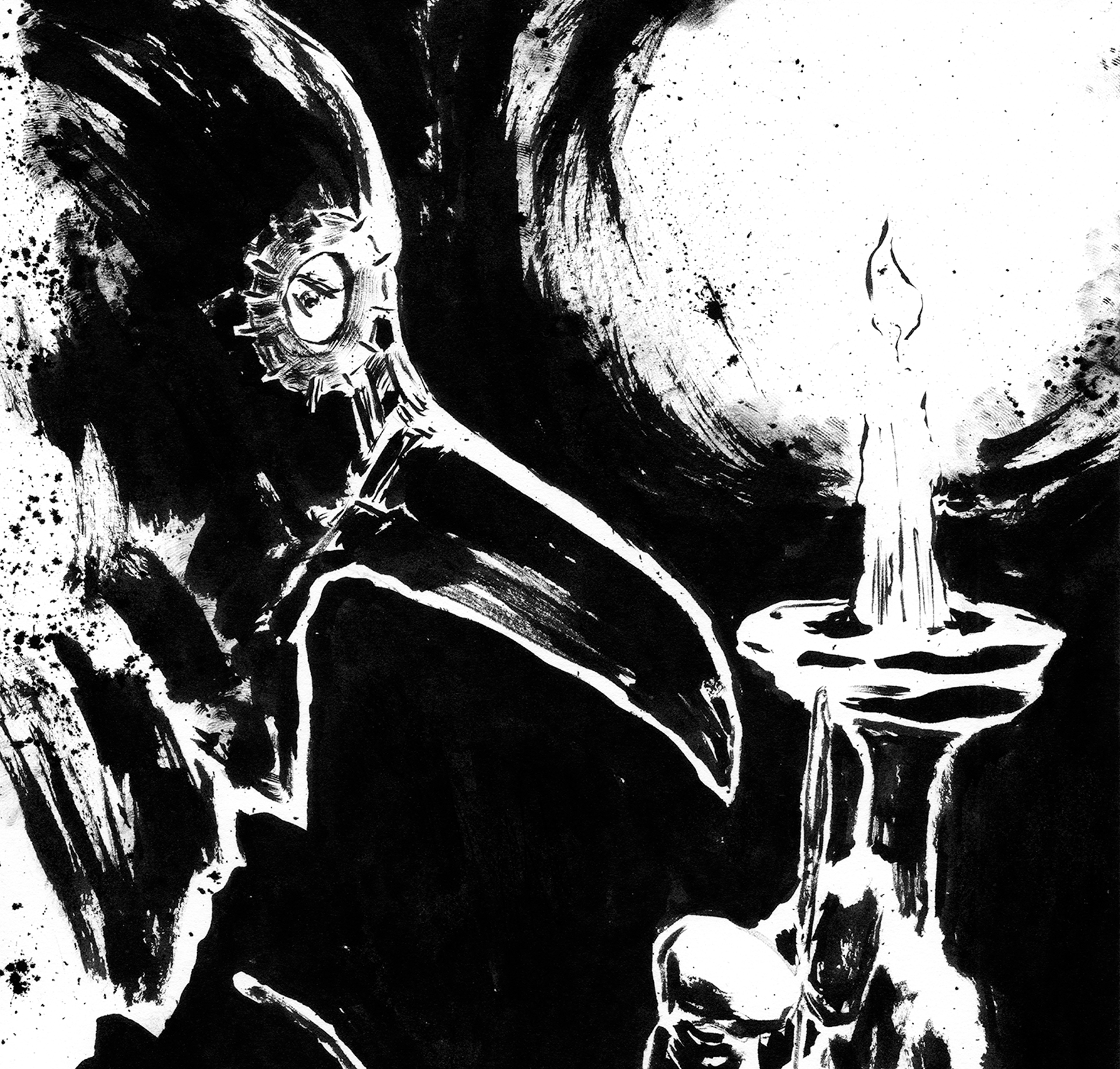
The Talekeeper
A cursed scholar wanders the land, searching for tales that will fill his tome. Passing through a desolate town stricken by plague, the wisdom he's collected upsets the local authorities.
SHORT FICTIONDARK FANTASY
Gareth Marks
5/15/202611 min read
The weight of old words, pages unread. I carried it with me in those days. Close to my breast I clutched it under my cloak as if holding myself together. I was filthy-faced and rough-bearded, seldom speaking to another living soul. Carriages steered in wide arcs around me on the road; lanterns dimmed in windowsills when I passed. If I came across a group of children they would scatter upon seeing me. When I left a town, tales sometimes spread of a witch’s thrall shambling by night or a bogeyman carrying a sack of bone and gristle on his back. I knew them all. I carried them too.
I came to Arcuna in a time of pestilence. Men pushed deadcarts in the streets, and behind them the air was thick with incense from the swinging censers. An uncanny quiet hung in the air. It was as if the town was not quite real but merely some great lifeless sculpture. In many of the houses an X was chiselled into the front door, telling that the occupants had succumbed. I could not say why I was compelled to go there—I never could. The first man who spoke to me was a vagrant, gaunt and sallow-skinned, slouching against a half-collapsed wall.
“Vayth’s bones,” he called to me, “An’ here comes one now. Ye scholars. Men of learning. Come to tell how we deserve our lot, I reckon.” I held my satchel closer against my chest. The man was on his feet now, stumbling after me. “Well, come then, man of learning! Tell us why we ought to freeze in the streets, watch our children wither… tell us how rotten we all are… come and tell us, come and tell us all…” The man trailed off, and when I looked back he had collapsed against the house with his head in his hands. There was nothing I could give him. No words could be of use.
A temple stood in the centre of the town. The lower walls were made of dark magmatic stone, buttressed by great pillars that held up a pediment at the structure’s front. Terracotta gods and heroes posed within, smoothed over with age. I stood a moment wondering how long this stone giant might stand. Rain began to fall; I raised my hood. Just then, I felt a hand upon my shoulder.
“Stranger,” came a man’s voice behind me, deep and harsh. “This town is closed to travellers, by order of the Praetor. You violate the law in coming here.” I turned. The man before me was a haruspex, clad in the long black habit and iron diviner’s mask hiding all but the irises. Two bare-faced novitiates stood behind him. Beside them was another, a hairless old man wearing not the robes of the priesthood but the red-striped tunic of the core cities. A scholar.
“Forgive me,” I said. “I did not know. I am a poor man, and I live alone in the countryside.”
“A poor man,” said the haruspex. “Well. Tell me, poor man. Has your poverty ruined your eyes?”
“No,” I said.
“Then you saw the empty streets and the deathsigns carved into the doors. What of your hearing, poor man? Intact?”
“Aye,” I said.
“Then you would have heard the preachings of the crier, and noticed the silence of the temple bell. And your sense of smell? Have you that as well?”
“I have,” I said.
“Then that is worst of all, for not only would you have smelled the reek of death that lingers here, but its root as well. The wickedness that invited in the sickness.” He looked to the novitiates. “Recall the parable of the blind man. Vaetha grants prudence to the virtuous, and curses the vicious with folly.”
“We remember, master,” said the younger.
The haruspex turned back to me. “So you are thrice guilty, poor man. It was not ignorance but wickedness that brought you here, like a moth to a flame, and unless you do your penance you’ll carry it away with you as well.” He gestured to the novitiates, and they moved around me. I held out my arms. I knew well what they were planning to do with me.
“Wait,” said the scholar in a raspy voice. “His cloak.” He stepped towards me and took hold of my sleeve.
“What of it?” asked the haruspex.
“It is not of our time,” said the scholar. “Leatherworking in this style has not been done for centuries. It’s from at least the Antecaean period, maybe older.”
“So the profligate found an old robe,” said the haruspex, seizing me by the wrist. “This is no time for a history lesson.”
The scholar looked into my eyes. “No—there is more,” he said. “Show me your hand.” I held up my left hand, revealing a coin-sized black symbol: an eye inscribed in a five-pointed star. “Ah,” said the scholar. “Remarkable.”
“What is it?” asked the haruspex, loosening his grip on my wrist.
“He is Accursed,” said the scholar. The novitiates stepped back, whispering to one another, but the haruspex remained unmoved.
“How can you be sure?” he asked.
“He bears the mark,” said the scholar.
“It could be mere imitation.” He glared at me. “Is this some trick?”
“No,” I said. “It is the true mark.”
“Do not be rash,” said the scholar. “He is beyond even your jurisdiction.”
The haruspex let out a deep breath. “Very well,” he said. Then, with one swift jerk of the arm, he threw me to my knees. “Stay out of my sight,” he said, walking away. I lost my grip on my satchel and it fell open, a handful of pages spilling out into a muddy puddle. And then the pain came. Fire in my veins, daggers in my bones. I scrambled to save the pages but my hands quivered from the pain and I couldn’t keep my grip. Ink bled forth; the water ran dark. Then a man appeared at my shoulder. In one motion he fished out all the pages, and the pain began to recede.
“Thank you,” I said.
“Aye,” said the man. “I saw what happened. I’m no friend of the haruspex myself.” He looked over the sopping pages. “Though I fear these are ruined. I hope they weren’t important.”
I sat up. “They are,” I said. “But they’ll heal.”
The man shrugged. “If you say so. Have you a bed for the night, stranger?”
“Don’t you fear the sickness?”
“I’ve had it. A bed, then?”
I stood. “I thank you. Have you a name?”
“Amnos,” said the man. He was tall and lean, and wore a short chestnut-coloured beard.
“Amnos. Well, lead me on, Amnos.”
#
We walked to his home in silence. I always needed some time to recover after the pain took me, and Amnos was a quiet man himself. It was a small house, with just three rooms and a roof that had clumps of thatch falling out. A square slot had been cut out of the door and was now crudely patched over with a section of cloth.
“You’ve had the deathsign,” I said.
He nodded, opening the door for me. “My sons and I had the sickness all. Sores, pustules, the lot. I still have the pockmarks.”
“But you lived. It is a rare thing, I understand.”
Amnos sat at the small table in the centre of the house, staring blankly into space. “Aye. I was lucky, as was my elder son. My youngest… Turanos was not.”
“I’m sorry,” I said.
“Pah. Many have suffered worse of late. And I forget myself.” He looked to the room on the left, furnished with two sturdy bunks. “Calun!” he called. “We have a guest.”
A thin, pale-faced boy of perhaps twelve emerged. “Pleased to meet you, sir,” he said.
“Give him some gruel, ah?” said Amnos.
“You mentioned you were no friend of the haruspex,” I said. “Is there a reason for that?” Calun returned, setting a wooden bowl down before me. I thanked him.
“You go on outside, now,” Amnos said. “Fetch us some well water.” The boy looked confused, for the cook-pot was still full, but he left without saying a word. When the door was shut, Amnos turned back to me, speaking in a low voice. “Aye. I’m afraid there is a reason. The haruspex didn’t like that we survived the deathsign. I suppose it embarrassed him, having to saw it out. Challenged his authority or the like. He told us the sickness was Vaetha’s punishment, and that since we survived we’d have to do penance. Or that Calun would, at least.”
My eyes widened. I knew the haruspex to be a cruel man, but even for him this was low. “He’d make a penitent of the boy?”
“Aye. You get better treatment in the debtors’ prisons, from what I hear.”
“Does he know?” I asked.
“Not yet. I begged the haruspex to give me some time, so I could tell him myself. I’ve yet to find the words.” He let out a deep breath. “I’ll have to, soon enough. They’ll come for him at the end of the week.”
“I’m sorry, once again.”
“There’s naught you can do. Forgive me, friend. I haven’t asked your name.”
“Ah. I’m called the Talekeeper,” I said.
“That’s a title, not a name.”
I placed my left hand flat on the table, revealing the mark to Amnos. “There are many things I have lost. My name is among them.”
Amnos’ mouth hung open a moment. “The mark of Mirvaen. It’s real, then?”
“Aye. It’s real.”
“I always thought it was an old wives’ tale. Pray, how did you wind up with that?”
I took my hand from the table. “Many years ago I was a scribe. I was careless then, and sloppy in my work. A library burned on my watch.”
“The Praetors razed whole cities in the wars. There must be more to it than that.”
“This was no ordinary library. At the time, it was the centre of all learning in the known world. It might have stood for millennia as a window into ages past but for a tipped oil lamp. Mirvaen, among other things, is the god of knowledge, and the library had been consecrated in his honour. Its destruction enraged him.”
“So you were cursed for leaving a lamp unattended,” Amnos said, crossing his arms. “While thugs and killers rule.”
“I am cursed only to replace what I took.” I set my satchel on the table. “Mirvaen placed every scrap of learning that burned in here. My penance is to wander until all have been restored.”
“What, you keep a whole library in that bag?”
“And more besides. It is no ordinary bag.”
Amnos’ eyes widened. “I suppose not,” he said. A discomfort crept over me in the silence that followed. I didn’t like talking about my past. “I reckon you won’t stay long, then?” he continued. It was true. Already I could feel the mark urging me on. “I’m only a carpenter, after all. Can’t help you any in your mission.”
“Only a night, if you’ll have me.”
He nodded. “Take the lower bunk; Calun will sleep on top. It’s all we can do to treat each other well in such times.”
That night I didn’t fall asleep until the early hours of morning. I sat hunched on the bunk, reading old tales from my satchel in the window’s dim moonlight.
* * *
I awoke to a pounding on the front door. Calun shot down from the top bunk before I’d even sat up. Amnos was first to the door, and by the time I rose he’d opened it. I heard only faint voices at first.
“You told me you’d give me more time,” said Amnos.
“Father, what are they doing here?” said his son. I stumbled out towards them, still half-asleep. The haruspex stood at the door. A small congregation of novitiates and lesser diviners were gathered behind him, some wearing masks of various shapes, some carrying torches. The baldheaded scholar stood near the back. From behind the table, I watched. So often I merely watched.
“Have you not told him?” asked the haruspex. “That was imprudent. And we all know whence imprudence comes.”
Amnos kneeled, taking his son by the hand. “I’m sorry. I didn’t know they’d come so soon. I just—I hoped we could have some time together.”
The boy moved backwards, staring wide-eyed at the masked men. “Where will they take me?” he asked.
The haruspex stepped forward. “The sickness came down on you, boy. Your father also. It is Vaetha’s punishment, and afflicts none but the wicked. You will be made one of the temple penitents, that you and your house might be purified.”
“Please,” said Amnos. “He’s only a child. Take me instead.”
The haruspex didn’t even look at Amnos. Instead, he turned to the assembly at his rear, raising his arms in the manner of an orator. “Recall the parable of the lepers. Two men, one faithful and the other wicked, were condemned to spend a month in a leper’s colony. At the end of the month, the flesh was falling from the wicked man’s bones, but Vaetha’s faithful was unharmed. And why? Because Vaetha is the lady of justice, and rewards virtue with health. So, this is a boy: it means only that he will have longer to spread his vice, left uncorrected.” I remembered something then. I started rustling through my satchel, looking for the right words.
One of the other diviners came forward with a pair of manacles. “It is time,” he said. Amnos was down on one knee, whispering something to his son. Yet what could he say?
“Enough of this,” said the haruspex, grabbing Calun by the arm. Just as he was pulling him across the threshold, I found what I was looking for.
“Wait!” I called out. The haruspex stopped. He turned to me, but didn’t release his grip. “That is not the true parable.”
“Accursed,” said the haruspex. “I told you to stay out of my sight. What are you babbling about?”
I held up two yellowed pages, speaking to the group behind him. “I hold two documents in my hand. The first is an original manuscript detailing the parable of the lepers.”
“That is impossible,” said the haruspex. “The original copies of Vaetha’s parables are lost.”
“Not to me. In the original, there was only the virtuous man. He taught the lepers Vaetha’s wisdom, and by the month’s end all were cured. The tale showed Vaetha’s mercy, not her judgement.”
“Blasphemy! I should have you hanged.” But already there was whispering among the diviners.
“The second is a decree of Voltumnos, a High Praetor of the late Antecaean. When the sickness began to spread, it was by his writ that the parables were altered, that they might not encourage aiding the afflicted. The temples were ordered to burn the decree after they received it.”
“Babble, more babble!” cried the haruspex. “These are forgeries, at best.”
The scholar came towards me, squeezing between the crowded diviners. “Let me see it,” he said. “I’ve read many an Antecaean scroll in my day. I can spot a forgery in my sleep.” I handed him the pages. Long minutes passed while he read them over. None said a word. Even the haruspex was silent, shuffling back and forth on his feet. Calun’s arm was bone-white where he gripped it.
At last the scholar spoke. “I can scarcely believe it,” he said, “but they are authentic.” At once a murmuring broke out among the diviners.
The haruspex, trying in vain to restore order, let go of Calun. “Friends! Students! Do not be deceived by this, this—spreader of confusion! Yes, that’s all he has in that bag of his, confusion and lies!” He grew more frenzied with each word, drawing the others to bewildered silence. Once all eyes were upon him, he turned to the diviner with the manacles. “Well, go on then—shackle him!”
There was a brief silence. Then, the diviner said: “I took my oath to Vaetha. Not to you.” There came a roar of assent from the others. I cannot say all that happened in the confusion that followed. Calun ran to his father, who held him closely. There was talk of emergency elections in the Arcunan temple. At first the haruspex raved frantically, but when it became clear that no one was listening, he stormed towards the doorway.
“Fine, then. You can all drown in your wickedness.” Before he left, he threw his mask to the ground. I saw his face just long enough to notice that it was covered in pockmarks.
The other diviners gave their apologies to Amnos and his son. Now that the haruspex was safely deposed, it seemed everyone had a story of how they knew he was mad with power from the start. I gave the pages to the scholar, along with what other parables I could find. The diviners left soon after. I felt the mark’s heat on my skin, beckoning me away as well.
“I cannot thank you enough,” said Amnos. “We cannot.”
“It is as you said. All we can do is treat each other well, in such times.”
Amnos nodded. “Would that I had more to give you. Some bread for the road, at least.”
“You’ve given enough,” I said.
The sun had risen when I set out. Near the town’s edge I passed the vagrant who’d approached me the day prior, curled up asleep beneath a canvas awning. I left the bread that Amnos insisted on giving me beside him. It would be the last time I set foot in Arcuna for decades. There was warmth in the air as I walked, a lightness in my joints, the feeling of which I’d nearly forgotten. I still bore the mark and the satchel, and would bear them for many years to come, but on that morning the burden felt a little lighter.

Art by Kim Holm
Logo by Anastasia Bereznikova
Contact: editors@thearcanist.net | business@thearcanist.net
Copyright © 2025 The Arcanist: Fantasy Publishing, LLC
ISSN: 3069-5163 (Print) 3069-518X (Online)