Follow The Literary Fantasy Magazine 2026 on BackerKit.

The Value of Horns
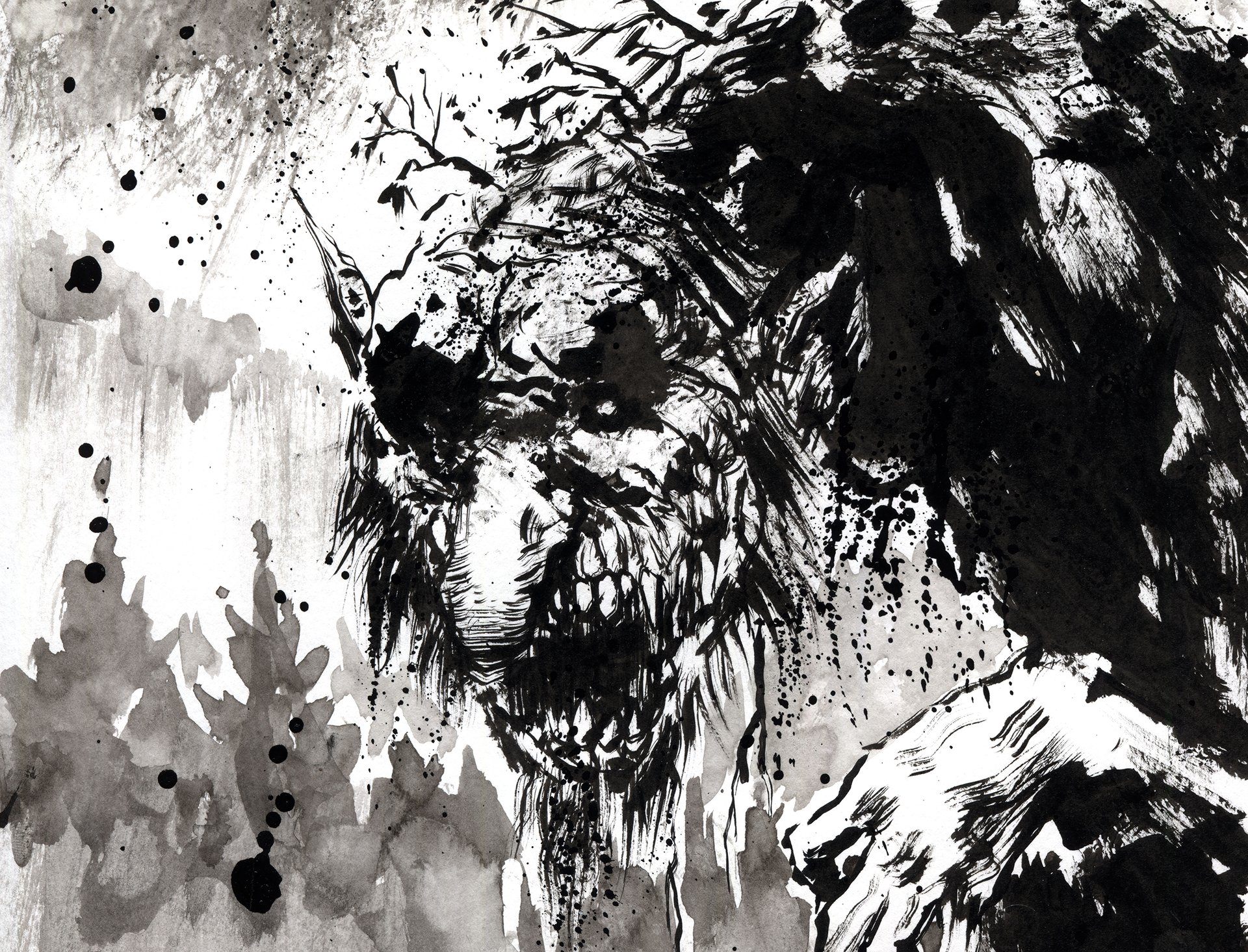
What does it mean to be a troll? Gromby wonders this every day of his hornless life. Can he live up to his heritage with his smooth pate? And what lengths would he go to claim the birthright denied him?
SHORT FICTIONADVENTURE
James Callan
12/12/20258 min read
This story was first published in The Literary Fantasy Magazine: Winter 2025. James Callan is author of four books and the upcoming absurdist epic, Old Sorcery.
When it comes to trolls, horns are paramount to one’s identity. More than a badge of status, they transcend mere ornamentation. For trolls, size matters—the bigger the better—especially when it comes to their horns. Although, the shape, curve, twist, and hue are no less important than the length and girth. Troll horns are versatile, multifaceted in their purpose. They are used for combat, for attracting mates, for intimidation and glamour. Horns are at the center of troll fashion and, in some tribes, even of great spiritual significance. For trolls, be they of the cave or forest or mountain clans, horns are everything. And so, it begs the question: what is a troll without horns?
Is he truly a troll at all?
Gromby asks himself this question each day. What am I? Am I truly a troll? He rubs at his hornless head and feels a smooth scalp beneath coarse, tousled hair. It is a habit he developed, a constant reminder of his dire lack. Without the slightest of nubs to suggest that maybe, just maybe, his horns might be coming in, he mourns for the missing hallmarks of a troll. And so, when going about Trollgate, Gromby has taken to wearing a cap.
Grimdolyn, widely known among the clans as the most beautiful troll of all, possesses ashen horns, slender, and deadly-sharp. Rising from the edges of her dragon-bone tiara, keratin spires sprout out of her gray-gold hair. They shine in the sun, shimmer in the moon, and dance with amber light in the evening bonfires and troll-hall hearths. Grimdolyn is the envy of many a maiden troll, and the center of many a man-troll’s lust.
From afar—or near, if he is lucky—Gromby admires Grimdolyn’s prodigious nose, how it slopes upward between her crimson eyes to meet at the roots of her celestial horns, as lovely and grand as twin ivory towers.
Borgoth the Mighty, who is rough around the edges and wide around the waist, is famed for his slaying of the dreaded undead dragon, Skullhorn, a feat of extraordinary heroics accomplished in his youth. Well-seasoned, if not yet old, Borgoth is no longer the warrior he once was. Even so, his name carries weight, his past deeds, clout, and is respected throughout the clans, by warrior, layman, and priest. His horns are thick and curved, spiraling inward at his temples, hard and heavy as anvils. He has split the skull of many a ram, risking his own in provoking their furious, headlong charges.
At the center of Trollgate, in the town square, Borgoth’s burly visage is etched into the conical monument that stands as tall as any ogre; the single horn of Skullhorn, which has since been dubbed Skysplitter.
Now gazing up at Skysplitter from beneath the cap that covers his hornless head, Gromby considers, not for the first time, how discriminating the gods can be with the gifts they bestow, and to whom they are given. He rubs at his unadorned pate, staring into the graven eyes of Borgoth the Mighty. Someone sighs in admiration, a swoon of sorts, and Gromby rolls his eyes, annoyed to discover Grimdolyn standing nearby while gazing longingly up at the hero’s monument. Despite his irritation, his outright jealousy for Borgoth, Gromby withers when Grimdolyn lowers her gaze to meet his own, dismantled by her disarming beauty.
“Is he not the bravest, most dashing, most noble of trolls in all of Trollgate, nay, in all the clans, to the furthest reaches of the world?” Grimdolyn muses as she twirls a lock of hair around a finger no less fair.
Gromby is enchanted by the scarlet sparkle in Grimdolyn’s eyes, by her charm, which is rendered intoxicating by the love she feels for the famed troll Gromby himself wishes he could be. He would do anything to appease Grimdolyn. Sighing, he lowers his head. “It is as you say, Lady Grimdolyn. There is no doubting it: Borgoth the Mighty is the finest troll among us, across mountain, forest, and cave.”
Grimdolyn titters, a coy eruption. “And such big horns…”
Gromby reaches under his cap to rub his head. “Yes.” He swallows his pride. “Such very big horns.”
When Borgoth the Mighty was wedded to Grimdolyn the Fair, Gromby the Hornless reflected, not for the last time, how discriminating the gods can be with the gifts they bestow, and to whom. With enough bitterness to fill the hollow of Skysplitter, Gromby considered the harsh truth of it all: unless a troll is uncommonly privileged, one would waste much time awaiting the capricious goodwill of the gods. And so, not wishing to play the luckless fool any longer, Gromby turns his back on them, both the spiteful gods and the privileged trolls whom they favor. It would be naive to sit and wait for fortune to sprout out of his head from nothing.
This is his conviction.
He might not have horns on his head, but he has a fine brain within it. It is time he put it to use.
They want horns. I’ll give them horns!
These words became Gromby’s mantra, echoing across the numerous lands where his quest to procure distinguished horns of value guided him.
They want horns. I’ll give them horns!
Each syllable is tinged with chagrin, imbued with a strong, resentful sentiment fueling Gromby’s newfound ambition to become the horniest troll in Trollgate, in all the world. If he could not grow horns from his head like a normal troll, well, he would seek them out on his own, collecting them from a menagerie of horned beasts. Where undead dragons failed to surface from the ancient crypts of the lithosphere—and well outside the bounds of his capability to slay one, even if they had—Gromby relied on other rare and mythical creatures to cross his path, animals with horns of peculiar magnificence.
Days turned into weeks, weeks into months. Seasons came and went, passing in a haze. Before Gromby realized it, years had gone by, as many to comprise a decade.
Gromby had not intended to be gone for so long. Even so, he could not deny the worth of his labor. His collection grew vast, more impressive than any he surmised existed in all the world. He often recollected his journey with satisfaction, his catalogue of horns, with pride.
There was the fabled golden yak, its mammoth horns bearing a fine, gilded gleam. Gromby paid an ogre to brain the beast. And that was that. One less living link to a myth. Then there was the chimera, which Gromby tracked for many weeks, and slayed with poisoned arrows. It was a poor shot. One to the rump. The poison spread slowly through the monster. Eventually it died… days later. During the many weeks of tracking the chimera, and his eventual slaying of the magical animal, Gromby had not considered in the end he would be rewarded with mere goat horns, bearing nothing to distinguish them from the typical kind. No evidence showed they came from the head of a goat joined with the body of a ferocious lion. It was not Gromby’s finest moment.
More precious by far than any of his other acquisitions, perhaps more than all the other horns combined, was the alicorn that Gromby severed from a living unicorn, a black mare of extreme rarity.
It is an evil deed to maim a unicorn, a taboo far beyond the moral compass of most sentient beings.
Gromby was hardly ignorant of these well-known facts. However, his own moral compass had become warped, skewed by his desperate desire for the world’s finest horns, to have them for himself in place of the gods’ cruel neglect of his natural birthright. When he at last severed the alicorn clean from the most magical being in all the realms, he did so without an ounce of remorse.
And Gromby continued his merciless hunt.
Minotaur horns, satyr horns, demon horns—so many horns. When the mythical and magical eluded Gromby, he turned to common beasts: oryx, oxen, and rhino. In the end, he acquired more horns than he could carry.
Though they were not his natural horns, they were his horns nonetheless, horns owned by him, and he had managed to graft many of them to his body using arcane methods of witchcraft. At long last, Gromby was a horned troll. More than that, he was uniquely outfitted, and there were none, not even Borgoth the Mighty, who could rival his fine accoutrements.
The time had arrived. Gromby returned home to Trollgate.
Gromby’s homecoming was meant to be sweet, a victory and mighty boast, a proclamation to all those doubting that Gromby was now truly great, a mighty horned troll. But the gods are fickle at best, and even Borgoth the Mighty may fall from their favor. It would be no great surprise if they were to abandon Gromby once again as they did from the start.
Trollgate looms ahead, and as Gromby struts into his hometown for the first time in ten long years, he finds himself robbed of any chance to show off his horned and elevated self. He is astounded to discover his home in ruins; Trollgate razed to scattered husks of scorched stone. Lying among the tussled thatch roofing and blankets of fresh snow are countless troll bodies. They clog the wide roads of the town square and the narrow avenues between ransacked homes. Some bodies are whole, others dismembered, torn limb from limb.
Some look to have been burned, while others, face down in water, were likely drowned. Whoever killed the trolls of Trollgate was inconsistent in their savage methods of murder, but there is one consistent feature among the dead: there is not a single troll left with its horns upon its head.
“Who goes there?” The voice is rough, coarse as wyvern hide. A man steps out from the shadows, his mailed fist clutching a thick lock of gray-gold hair. His free arm is wrapped around two objects, twin spirals, slender, graceful, and white as bone. They are beautiful, and Gromby seems to recall these horns from long ago. Then it becomes clear. He recognizes the way they gleam, so intense and bright, even under the gloom of a somber overcast.
“Grimdolyn …” Her name is a breath of remorse, a longing for a troll woman he never truly knew. It escapes Gromby’s lips in a tattered gauze of mist, dispersing into nothing, vanishing as a specter.
“Grimdolyn, was it?” The man encumbered with Grimdolyn’s horns drops them into the snow and mud. The blade of his sword rings in the silence as the armored man pulls it free from his scabbard. “You trolls have the ugliest names, you know that?” He laughs long, loud, and more cruelly than Gromby has ever heard a man laugh. “The horns, on the other hand,” the man continues, “well, those are rather pretty.”
Sword drawn, the man takes a step towards Gromby, revealing a wagon behind him. The wagon’s loaded cache of bones—no, horns—troll horns, are stacked as high as Skysplitter, which sits in a second wagon, secured by rope.
“They fetch a fine price, troll horns. Your hides, too, but your horns most of all.” The man’s grin is wicked, his biting blade caked with blood. “Aye, you got some nice horns there yourself. Very unusual. Very valuable, no doubt.”
Gromby rubs his head, fingering the base of the alicorn magically fused to his skull. He rubs at the satyr horns that sprout from behind his ears. “What, these horns?” He staggers back a step. “These horns aren’t mine. They’re just ornamentation. Nothing more. I have no horns. Never have.”
The man lowers his sword, leers at Gromby, studying him for a moment before laughing as he did before. “You trolls are stupid things,” he says as he spits into the snow. “But you know something? You’re good for a laugh, and you’re even better for your horns.”
“No, really, they aren’t mine. I swear, I’m hornless! Gromby the Hornless. That’s what they call me. Gromby the Hornless!”
“Well, Gromby the Hornless,” the man takes up his sword once more, “they won’t be calling you anything no more.” He gestures with his sword at the bodies scattered in every direction. “They are all dead. But don’t worry, Gromby the Hornless. You’ll see them again.”
The man removes his gauntlet and places his dirty fingers into his mouth, a shrill whistle piercing the frozen air. From behind the ruins of burnt troll halls and homes emerge several figures, dozens of humans, armed men with blood on their shields and horns in their arms.
“We missed one, boys.” The man points at Gromby. “With horns the likes of which I’ve never seen.”
The mass of marauders piles in on Gromby, hold him down, and take up their knives to carve free his precious horns.
“No! I swear! They’re not mine! I have no horns! I am Gromby the Hornless. Hornless, I tell you!”
One of the men shakes his head, takes out his fire-blackened dagger and sets it to the base of Gromby’s horns. “Shut up and hold still. It’ll all be over in a minute.”
“Mercy! Mercy!”
“Come now,” the man chides. “You can’t blame us for what we’ve done here. We’re only human, and you wouldn’t believe the value of these horns.”
Gromby opens his mouth, but his protests lodge in his throat, choked by pain. His vision goes red as he tastes iron. Gromby, once more, is Hornless.

Art by Kim Holm
Logo by Anastasia Bereznikova
Contact: editors@thearcanist.net | business@thearcanist.net
Copyright © 2025 The Arcanist: Fantasy Publishing, LLC
ISSN: 3069-5163 (Print) 3069-518X (Online)