
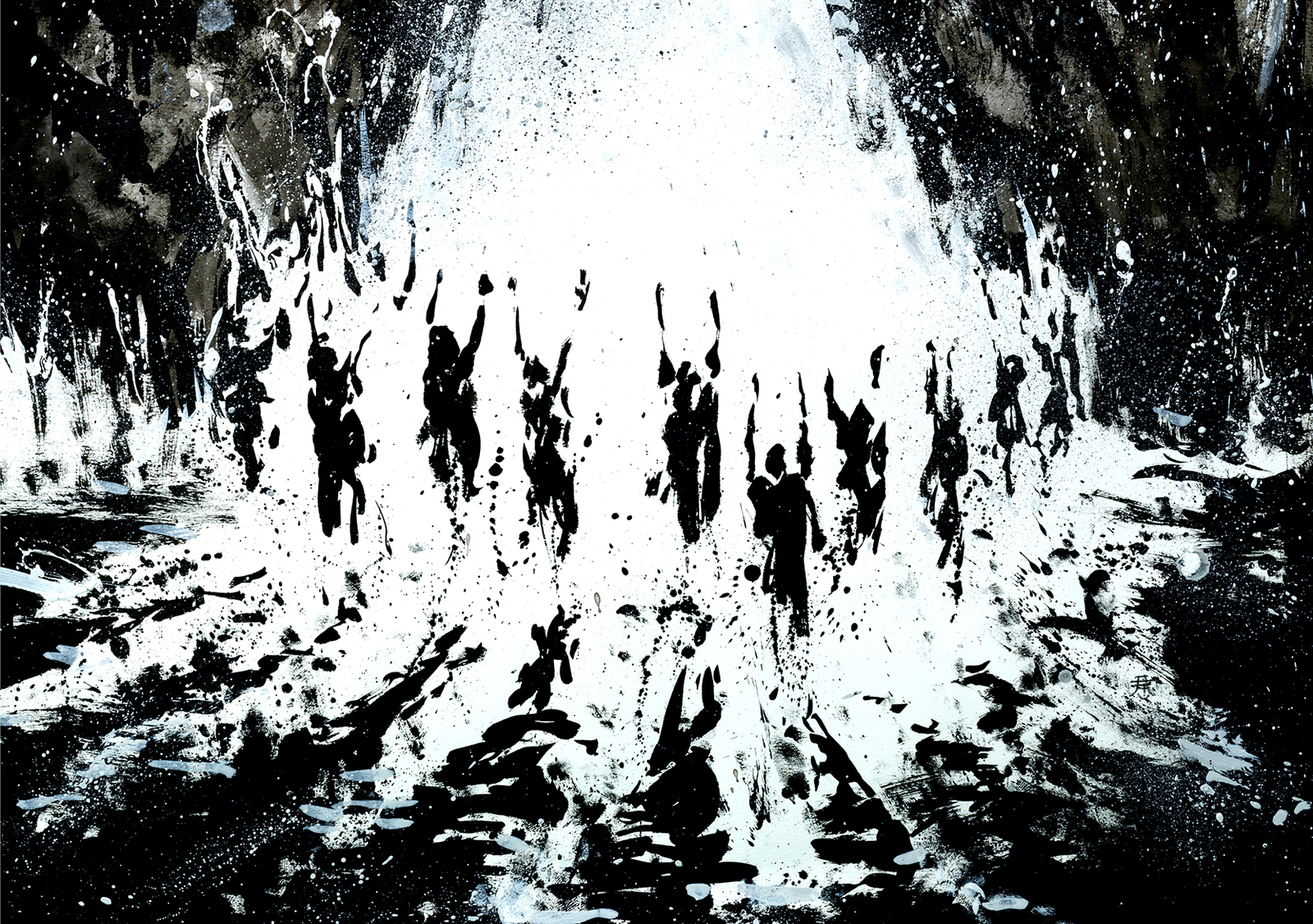
Sylvia drew a square on a piece of parchment. She and Lisl gazed at it by the light of the room’s one lit candle. In a way, Lisl thought it was silly, but she wanted desperately to become a witch. Fourteen was too old to start over. If she failed she would have to go back to her foster family, and be a servant all her life.
Her gaze grew intense. You will see the shape change, Sylvia had said. When it changes, tell me what you see. She had called this a test for mind reading, though what changing shapes on a piece of paper had to do with mind-reading, Lisl didn’t understand.
Suddenly the drawing was of a cube, another square up and right from it and diagonal lines connecting the two.
“Do you see,” Sylvia said, “another square? Forming a cube?”
Lisl stared at the shape with a growing sense of horror.
“With diagonal lines… Up and right?” Sylvia prompted.
“Yes!” Lisl shouted, and she pushed away from the table so hard her chair went over backward and she with it. She scrambled out of it, shaken, and pulled it upright again. Meanwhile Sylvia lit the other candles.
“I saw it,” Lisl said wonderingly. “We saw the same thing.”
“Are you hurt?”
Her heart filled with love for this woman who cared about her, Lisl, before anything else. Her foster mother—her owner, as she thought of her—would have asked if she had damaged the chair, inspected it at once for scratches. “I’m all right,” she said.
“But frightened,” Sylvia said. She reached out for Lisl’s hands and Lisl gave them to her. “It’s the first lesson. The spirit world is proud, and patrols its borders like any empire. Until you learn its ways, you will feel great fear. If you can overcome the fear, you can grow in it and use its power. Most people can’t. That’s one reason true witches are so feared by the Church—they fear the spirit realm itself, fear the power. And it’s one reason true witches are so few. Only a few are capable of understanding.”
Lisl nodded.
“That’s enough for tonight, I think. You’ll learn more tomorrow.” One by one, Sylvia blew out each candle. Lisl’s last sight that night was of Sylvia’s green eyes, her gaze far away as the flame blew out.
* * *
In the morning she went out with Sylvia to her herb shop in the marketplace. Lisl helped her set up the wide, circular tent. Then she went around the outside driving in stakes. Sylvia, inside, unloaded jars and packets from their pushcart.
“Mornin’, Lisl!” old Heimdahl said. The blacksmith held a pail of water. His shop was the largest in the marketplace, a two-story structure of locust wood. He leased the side yard to Sylvia in return for free treatment of his various aches and agues.
“Good morning, Lord,” Lisl said. She liked Heimdahl more than most men, but one could only be informal down the social scale, never up. Heimdahl went into his shop. Lisl paused a moment to watch Goody Schiller drive her ducks down the road. “Get along, you ducks!” she cried unnecessarily. Her stick only drove the lead duck; the others followed.
“Hey, Lisl!” called Krieger, the butcher’s son. “Want me to pound stakes for you?”
“I can do it,” she said shortly.
“I can pound ’em in pretty good. Most of the girls around here can tell you that.”
“I’m sure.”
“Sure! Any time you want a good pounding, just ask. You don’t know what you’re missing.”
She looked up angrily, catching his drift at last. “Just wait till I’m—”
A hand on her shoulder. “Silencio de aurum est,” Sylvia said. “Everything in its proper time and place. Good morning, young Krieger. Do you want any herbs today?”
Krieger blushed. “No, ma’am.”
“Plenty of horse-radish if you need it.”
“I don’t need any damn—” He broke off as a hand appeared on his own shoulder. “This boy of mine bothering you?” the butcher asked.
“Not at all,” Sylvia said.
“If he does, you let me know and I’ll pound his silly skull for him.” He looked down at his son. “Get back to work, you.”
Krieger, defeated, went inside, but he called over his shoulder, “You won’t be so high and mighty when the Inquisitor comes through here!”
“Get your ass to work!” The butcher kicked at his son and the boy scooted inside ahead of the butcher’s shoe. “Sorry, Miss Sylvia, pay him no mind. He won’t cause you any trouble if I’ve anything to say about it.”
“What’s this about an Inquisitor?”
“Oh, the boy don’t know what he’s talking about. Ain’t no Inquisitor, just a Preaching Elder from the Church of Quantria.” Like everyone else in the village, he had heard the rumors that Sylvia was a witch—possibly the head witch of the town of Hartdorf. But it wasn’t polite to mention it. He hitched up his belt, which needed to be tightened another notch. “Well, ma’am, I guess I’ll be gettin’ to work. Morning to you.”
“And to you, sir.”
Sylvia gestured to Lisl, who went into the tent. Sylvia followed and sat down in the one chair in the entrance. She drew the small table with its bowls of samples after her. Lisl sat down on the carpet inside, ready to bring bottles from the shelves as needed. This was her favorite part of the day, sitting in the cool darkness of the tent, listening to Sylvia talk to customers, conversing quietly between sales.
There didn’t seem to be any customers yet. “The Dissidents burn witches,” Lisl said. “Just like the Imperials.”
“Not in Quantria,” Sylvia said. “The Dissidents here are Herrmannists, and they’ve never burned anyone. Nor do they drown Polybaptists.”
Lisl hesitated a moment. “Maybe the new man won’t be against witches?”
“Imperials and Dissidents agree on few things, Lisl, but one thing they do agree on is that the continent is overrun with witches, and most of them think witches should burn. We will not press our luck by revealing anything to him.”
“Yes, mistress.”
* * *
The Church of Quantria was a new thing in the land, the official church of a country where nine-tenths of the people still counted themselves Imperials. It had started when Prince Bern realized his beloved Queen Annabel would never bear children. The Prince had plenty of children already, but under ancient Quantrian law illegitimate children could not inherit.
Any attempt to change the law would have been dangerous. The Barons had never liked having a Prince at all, and preferred short dynasties. Most in Quantria thought the Prince would accept his fate, and that the Apostolic Father or the Barons would pick his successor. An appeal to the Apostolic Father to annul his marriage would have been in accord with tradition, and many thought that was the road he would take.
But Prince Bern listened to the Dissident Scholars. There was great support for the Dissidents in the towns, which held the real power over Quantria’s economy. The Prince surprised everyone by marrying a widowed young Countess, Katarina by name, without divorcing Annabel. The towns were ecstatic. The Apostolic Father, in a rage which made Cardinals fear for their livelihoods and servants in the Apostolic Palace for their lives, placed Quantria under the interdict. The Barons were too stupefied to do anything.
Under the interdict, no marriages could be performed, no funerals, not even the mass. In earlier times it would have brought any Prince of an interdicted land literally crawling to the Apostolic Palace in Vayana to beg forgiveness. Katarina would have been put away, and the Prince’s dynasty ended as the price for sparing his soul. But with the coming of the Dissidents parishioners had somewhere else to go for sacraments and worship. Many Barons had affected sudden changes of heart and converted. The priests of Quantria had begged the Apostolic Father to withdraw the interdict, and after a while he had sullenly done so, though the Prince and his two Queens remained excommunicated. And there, for three years, things had rested.
* * *
Most of the town waited in the village square the day the coach pulled up carrying the new Preaching Elder. The Lord Mayor and his cronies stood on the small platform at the end of the commons. They waited quietly as the surprisingly young man got out of the coach. He wore a scholar’s hat and carried a single bag. “Good Heavens,” he said. “Is all this for me?”
The Lord Mayor, a graying, overweight man of middle age with a scarlet sash to distinguish him, cleared his throat. He peered at a small piece of paper. “Ah, yes. Well… The, ah, town of Hartdorf welcomes the Prince’s loyal servant, the man of God, uh…” He looked appealingly at the preacher, who was standing at the foot of the platform.
“Jacob.”
“Jacob, yes… And we extend to you the hospitality of our town.” He looked up at the people standing on each side of the platform, who raised a half-hearted cheer.
“With one exception!” one said.
A priest came forward out of the crowd and approached the newcomer. Father Johann was old, but tall. He used his height to the full to glare down at Jacob, though the strong morning sunlight made him blink. “Are you going to take over my church now? Pull down the altar, smash the icons, forbid mass? Am I to be forced to renounce the Apostolic Father under threat of burning, as happened in Terra Thousia? Or forced to marry, as happened in New Habsburg?”
Jacob shook his head. “No, sir. You may retain your position and all the trappings thereof, along with your incense, your music, your vain repetitions and your theory of insubstantiation. It is Prince Bern’s will that there be tolerance toward all Christians in his domain. I will raise a church of my own, with the help of those who follow the true Gospel-light, and we will see whom the Lord chooses to prosper.”
Father Johann obviously hadn’t expected that. For a moment he seemed at a loss for an answer. “Numbers mean nothing,” he snapped. “‘Narrow is the road, and few the ones that find it.’ I shall continue to administer the rites of the true Church.” He turned and spoke to the crowd. “Do not be taken in by this heretic! False doctrine is the road to Hell!”
“Indeed it is,” Jacob said. “And perhaps we can debate what constitutes true doctrine. In the meantime, I have no place to stay. Would you allow me to stay at the Rectory?”
Father Johann was speechless. All over the continent, Dissidents and Imperials were killing each other in hot war or cold war, and here was a Dissident who wanted to stay at an Imperial Rectory. “I… If you agree not to corrupt the brothers and altar boys, I suppose—”
“Really, sir—”
“I mean by preaching false doctrine to them! Don’t twist my words.”
“If that is your condition, sir, then I shall observe it. But if they come to my services I will not forbid them.”
Father Johann frowned, and his right hand moved in agitation, tapping his rosary. “Bad influence,” he muttered to himself. “On the other hand… charity. Woman taken in adultery… debate, after all.” He spoke up. “Very well, sir! But don’t expect a free ride! I shall use all our conversation to try to get through your stubborn head the error, the soul-destroying error, of your heretical ways!”
“I am very grateful. And I trust you’ll let me try the same!”
The crowd cheered, this time with some enthusiasm.
* * *
Night. Lisl watched, wide-eyed, from her chair as Sylvia bent over the crystal ball on the table. “Tonight I will use the crystal to foretell the future,” Sylvia said. “It is a small spell, as I will not look very far in space or time. Watch everything I do and memorize it exactly, for tomorrow you will do the same, and if you make any mistakes I will make you wait a month before you may try again.”
“Oh, I won’t,” Lisl said. “I mean, I will. I mean—”
“Hush. Watch and learn.”
Sylvia brought out a tiny creature, a bright green salamander which wriggled in her grasp. Lisl gasped and moved back.
“No, do not fear it. It is a small life very much like your own. A timid creature that lives in the forest, and I want you to give it what love you can, for I am about to murder it.”
“Oh, don’t!”
“You see how quickly fear turns to love? I am glad you are not eager to do this. Nonetheless, you should know how. I don’t want you to use this spell unless you must, but you have to know how.”
She pushed the creature flat on the table and crushed its head with her thumb. She drained the blood into a bowl, then put the small corpse in a square of rag-linen and wrapped it tight. She sifted herbs into the bowl from between thumb and forefinger, then put it on an iron tripod and lit a candle under it.
“Will I have to do that?”
“Have you never slaughtered a chicken?”
“Yes, but… we eat chickens…”
“And have we any more right to do that than to kill for magical power?”
“I… I don’t know.”
“Good. That’s a hard lesson indeed, and one most people never learn: that sometimes the answer isn’t clear. Now, watch.”
She made a series of passes over the bowl and recited words in a language Lisl had never heard. The blood suddenly boiled, steaming into a scarlet cloud which hovered over the bowl, and then moved away from it. Lisl would have screamed if it had come toward her, but it settled over the crystal ball, enveloping it. Then the red color faded into nothingness. Sylvia ducked down and blew out the candle. The room was dark.
The ball started to glow, as if a spark had been struck at its center. The glow expanded, dimming as it went, until it touched the surface of the globe. Inside was a night scene, stars in the distance—and a slight distortion in the cold night air, moving through the forest toward the village. Lisl felt chilled.
“We shall have a visitor, it seems.”
Lisl shook her head wonderingly. No one had come by at night before. “Who is it?”
“I don’t know.” She spoke to the crystal ball: “Quis est?“
Now the distortion became a smudge. Leaves rustled in the trees as the darkness in the air passed through them.
“Whoever it is, is cloaked,” Sylvia said. “It is a magic user. Possibly another witch.”
“Is it someone you know?”
“You are not paying attention.”
“Sorry,” Lisl muttered.
Sylvia tried another language: «Τίς ‘εî;» The smudge narrowed for a moment, then bounded out again. “This person is more powerful than myself, it seems.” She tried once again: “¿Pt å ƒæ?” Again the bounce, this time a little quicker.
“When are they coming?” Lisl asked.
Sylvia shook her head. “Soon. Within the hour. Lisl, go out and drop the salamander in the outhouse. I’ll clean the bowl at the pump.” She struck a flint and relit the candle. The crystal was only a glass ball again. She hefted it and shifted the rug aside with her foot, lifted the trap door, stowed the ball. The trap door banged down and the rug went over it. Then she handed the tiny, linen-wrapped thing to Lisl. “Go.”
“But… if it’s another witch—”
“Not everyone who is the focus of spiritual power knows it. Some work for the Church.”
Lisl finally realized why the trappings of magic were being cleared away. She ran out the door, ran to the outhouse with her small bundle.
* * *
Lisl wanted to wait up to see the visitor, but Sylvia insisted they go to bed. “It is a form of courtesy to another witch, if this is a witch, to pretend you haven’t foreseen her coming.” And so they lay on their respective pallets, a blanket each to cover them. Lisl huddled and wondered and worried.
“Do you want a sleeping spell?” Sylvia asked.
“No, ma’am.”
“Try to relax, then. Use the discipline!”
Lisl forced herself to stretch out, suddenly wishing they were rich and could afford nightshirts—her dress, even without the cord belt, was uncomfortable to lie in. She took a deep breath and held it, let it out. She did it again. Fifty breaths later, she slept.
* * *
Light in the cottage. Sylvia was already dressed and moving about.
“Why didn’t you wake me?” Lisl asked.
“There was nothing to see. The visitor was a witch from another village. Tonight is Sunday; there will be an embat I must attend. And you will come with me.”
“An embat!” Lisl said, sitting up. Her mouth tasted pasty, and her eyes were bleary, but the word excited her. “Uh… Don’t you mean an esbat?”
“Neither a sabbat nor an esbat. An embat is something else, a meeting to decide policy. Since you’ve been to none of these, I’ll have to take time to teach you the proper protocols. I don’t want you to embarrass me!”
“Oh, I won’t! I’ll be quiet as a mouse and won’t get in the way, I promise!”
“I know you mean well, and I trust you enough that I know you’ll get through the meeting. But just remember:
A witch with breath held in a quiet house
Can hear the next-door neighbor’s mouse.”
Lisl nodded.
“And now, get dressed. We’ll eat and go to church.”
“Can’t we skip church for once?”
“Never. A witch never calls attention to herself! Now listen. Starting today, I’ll go to the church, you’ll go to the prayer meetings the Dissidents will hold in Will Siedler’s barn till their own church is built.”
Lisl’s mouth opened in surprise. “Why?”
Sylvia stopped placing bowls on the table and looked at her. “You tell me.”
Lisl thought about it. “One of us on each side?”
Sylvia smiled with half her mouth. “Very good. If the Imperials should ever bring war and retake this village, I’ll be the true believer who held to the old ways, and can convince my headstrong young charge, seduced by the Dissidents, to return to the bosom of the True Church. And if the Dissidents ever try to root out the Imperials, you’ll be the progressive young saint who can convince her foolish old mistress to find the True Gospel-Light. Meanwhile, our relations in public will have to seem a bit formal for a while. Not openly arguing, you understand, just cold and strained. Now get dressed, and come and eat.”
* * *
The Dissident ceremony was the strangest church service Lisl had ever been to. They met in a barn in Will Siedler’s homestead, walking over grass still frosted from the autumn night. The women and girls, all wearing kerchiefs, collected on the left before the makeshift table in the place of an altar. The men stood on the right with their hats removed. Jacob, the new preacher, stood behind the table. He raised his arms.
“Good friends, stand where you will! We do not need the empty legalism of the Patrists here. None of us will attain Heaven through our acts, howsoever good; only a clean heart, given through Grace by the Lord’s unsearchable will, will bring us before his throne with the saved. It’s a cold day, ladies, so I won’t demand you remove your kerchiefs, but if any of you will, let none admonish her!”
“But doesn’t it say in Pavel, ‘Let her be covered’?” The speaker was old Goody Tischhorn, who had risked arrest and imprisonment by clandestine copying of the Book of Books in the vernacular.
“God bless your knowledge of scripture, it surely does!” Jacob said. “And truly, God forbid I should be a stumbling block for you. I meant only that we should let each follow his conscience, deferring to one another in love, rather than depending on a rule. So should one who feels best with her head covered in church, uncover! So as not to tempt a new believer to legalism. And one who feels best with her hair free should cover it so as not to tempt an old believer to abandon. Do you see?”
There was some stirring among the women, but no one moved.
A witch never calls attention to herself!
So Sylvia had said, the woman Lisl most respected in the world. Lisl herself had always been uncertain in public, afraid of her foster parents, afraid of other children. So it was a mystery to herself why she came forward now, to the front row of the standing women, and tremblingly undid her kerchief and smoothed her hair back. “I… I don’t… want to give you any offense, my Lady,” she told Goody Tischhorn. “I… feel better… with my kerchief on, myself, but… things are changing. Everything’s changing, and… do you see what I mean?” Lisl felt charged with courage. She also felt false, as if she were play-acting.
Slowly, Goody Tischhorn smiled. “‘All things are made new’,” she quoted. “Well, maybe it’s all right for you younger folk, but I guess I’ll stick by some of the old ways.”
The service went on.
* * *
Lisl thought Sylvia would be angry, but she only nodded when Lisl told her about the meeting. “If you were touched by something transcendent, I can have no quarrel with your actions. Only beware making a spectacle of yourself again.”
Sunday, after church, was housekeeping day; they swept out the floor of the cottage, washed clothing and sheets in the creek and hung them to dry, dusted and cleaned and set things in order. Lisl hoped Sylvia would tell her how to behave at the embat, but the older witch only said to wait till that evening. “Avoid speaking of ceremonial things in the daytime.”
At last came All Hallow’s Eve. After they ate, Sylvia shuttered the windows and sat at the table with Lisl to rehearse the proper rituals. Lisl listened, wide-eyed.
* * *
Night, with chill breeze blowing across their faces, twigs and leaves crackling underfoot. A cowled figure came up to Sylvia so suddenly that Lisl gasped. She put a hand across her mouth, embarrassed.
“Servant of The Skill, what is the word?” the cowled figure asked.
“The word is samtyr,” Sylvia said.
The figure walked around her to Lisl, planting herself in the path in front of her. “Apprentice of The Skill, what is the word?”
“Uh… samtyr?”
The cloaked one said nothing more, but turned and led the way to a wide hollow. More cloaked figures stood in a rough circle. One stood on the wide, flat stone in the center. She raised her arms and spoke, in a voice midway between speech and a whisper. “Let the ceremony begin!”
“There are more in this coven,” Sylvia said. “And this one is only my apprentice.”
“We have the coven number!” the one in the center insisted. “And I will lead the way!”
She threw back her hood, revealing a white face, hair that could be seen as red in the moonlight. Then she pulled off her cloak and began to undress.
“Now,” murmured Sylvia. She pulled off her own cloak.
“But it’s so cold!” Lisl whispered. “Could I… Could I maybe wait in the back…”
“I will be with you.”
“All right.” Lisl took off her clothing and folded each piece, laying it on a neat pile. The twigs poked her bare feet.
“Come, Lisl. Your wrapping, too.”
Lisl reluctantly undid her loincloth, handing it to Sylvia, who dropped it on the pile. Sylvia, nude, was a beauty, black hair and creamy-white complexion, good figure; strong and healthy. Lisl also had dark hair, though her eyes were brown to Sylvia’s green, but she was short and chunky, her complexion pock-marked. She hated revealing herself to the gathering.
A circle of silent, naked women stood in the moonlight. The one in the center raised a small, blue-glazed bowl so moonlight glinted on its surface. “Esfare ezba ro tu nohmi.”
“Esfare ezba ro tu nohmi!” chanted the women in the circle. “Nohmi,” Lisl added, a moment late.
The red-haired woman dabbed something out of the bowl and smeared it between her legs. “Do that when it comes to you,” Sylvia murmured.
Lisl felt repelled, but was willing to do anything Sylvia did. The bowl came by. She imitated the others, wondering what the point was. Sylvia was last. She handed the red-haired woman the bowl, kissing her hand as she did so.
“Esfare ezba ro tu oamway,” the women chanted.
“Esfare ezba ro tu oamway.” This time Lisl kept up with the others.
She waited. Her nose felt like it was running. The wind was cold on her breasts and limbs. Suddenly the ritual struck her as unreal, as much as those of the Dissidents or Imperials. It was like a child’s game.
“Running and jumping,” she muttered.
She felt light-headed. She noticed she was floating up off the ground.
This is wonderful! she thought.
I told you it would be, Sylvia thought in response.
I’m flying!
I know. We all are.
It was true. The circle of women floated high above the ground. Lisl saw the forest, the nearby village, the farms outside it. She remembered coming from that direction and realized she must have turned around. Indeed, the circle of women was rotating, spinning in place in the air. Her heart beat rapidly as the night winds blew over her body in the sky. This is what a bird sees!
Yes, like a bird, Sylvia said. The stars overhead were brilliant, sparkling like diamonds in the vast blackness.
* * *
Lisl stood on the ground again, cold mud and papery leaves under her feet, though she couldn’t remember landing. Her head ached—or possibly an upper tooth. Mucus dripped over her lip. Embarrassed, she wiped it off and flung it on the ground, hoping no one was watching.
“I will not countenance this,” Sylvia said, far away.
“I prefer to have your support, Sylvia of Hartdorf,” the red-haired woman said. They stood facing each other on the central rock. “I know it seems hard. I know ours is the way of life, as opposed to the way of death followed by the dry mundanes. But you know as well as I that the spirit demands sacrifice. Nothing is easy.”
“But this thing you ask is easy; too easy. And I tell you again that I won’t give my support.”
“What say you, coven of Hartdorf?” the woman asked.
Lisl was only an apprentice, but she knew any requests from a visitor should have gone to the Coven Mistress, not the assembled witches. It was a matter of politeness.
The witches stirred, but none spoke.
“Does your Mistress speak for you, move you, rule you like a tyrant?”
“You know that is not true, Dorca of Ceythia. It is not our way to command others. Everyone speaks, everyone is heard before decisions are made. We are not men, to lord it over one another. We are women, to support and understand and love.”
The redhead laughed, a silvery tinkle unlike her former deep voice. “Lies like that have kept women slaves forever.” She stopped laughing. “Now I will tell you how it really is. Those who shrink from command, and rule, and yes, from execution, are playing the game taught by the rulers. If you want to be free, you need to know both command and obedience. Do you want power? Do you want freedom? Then you need a ruler. Have you no tyrant in Sylvia? Then I will be your tyrant!”
She faced the witches, hands on hips and pelvis thrust forward, an orator. “There is sweetness in submission as well as rule. Let those who will submit come forward and make obeisance to me now.” Her pale complexion was flushed.
At first, no one stirred. Then, slowly, a white-haired old witch walked toward the rock. Lisl recognized Goody Symms, the cobbler’s wife.
“Good,” the redhead purred. “You will have your reward, dear one. Whom else?”
Another witch came forward, followed by another.
Lisl didn’t know if it was the headache or her devotion to Sylvia, but everything the redhead did grated on her. “I’m sticking with Sylvia!” she said. She was afraid she’d spoken too loud, because the redhead fixed her with a stare of pure hate, but Lisl came forward anyway and stood at the foot of the rock in front of her mistress. “Goody Symms, you ought to be ashamed of yourself!”
The old woman sighed. “Child, I still love your mistress. Many’s the time I’ve lain in her arms and watched the moon; studied old books with her in front of a fire; given her sweets and conjured imps to make her laugh. If it’s up to me no harm will ever come to her. But we’ve got to do something now, child, and that’s a fact. My new mistress isn’t in this work for her own pleasure, or to be mean to Sylvia.”
The redhead nodded, looking sad, and Lisl wondered if she’d been wrong. “It is true, young witch,” she said. “Sometimes I become too excited; it’s the way I am. But we must move, and move soon, against this new preacher. Anything that upsets the normal order upsets our place in it, and it is in the wake of fighting between Dissidents and Imperials that witches burn. This man, Jacob, must die. That’s not because I’m in love with death, whatever some have said. But I know what works and what doesn’t.”
“Your way doesn’t work,” Sylvia said.
“How would you know?” the other snapped.
“Jacob hasn’t said anything about witches!” Lisl spoke up again. “Maybe he isn’t against us.”
“Do you know,” the redhead said. “If you haven’t passed your apprenticeship, you shouldn’t speak out at these meetings.”
Sylvia had said the same thing earlier, but now she smiled at Lisl. “You counted her as one of the coven-number,” she told the redhead, but her smile and her eyes were for Lisl.
“Pah! What does the child know.”
“It’s true,” Lisl started. “He—”
“Calpurnius, Dissident of Altenmark, author of The New Israel and the New Babylon, to his congregation: ‘It is, then, obvious that whosoever useth Imperial formulas in prayer, especially of the mass, are witches, and in these days of pure Gospel-light, must burn.’ Antrobius the Great Reformer, in his pamphlet To the Dissident Princes: ‘Though the Imperials accuse us of witchery, in fact we are the greatest witch-burners on the continent’. Need I go on? I speak of self-defense, child, not murder. It is a case of getting him before he gets us. Do not forget your sisters burned in Altenmark!”
She cast her eyes heavenward, raising her arms to the stars. “The souls of your martyred sisters cry out to you from the land of shades! They cry out to you from a thousand, thousand blackened stakes across the continent, and in the colonies! The soul of my own mistress—my own dear, sweet love, the poor old Baroness! She cries to you from her grave for revenge!“
More witches moved toward the line forming in front of the redhead.
“That’s what this is really about, isn’t it,” Sylvia said quietly. “Revenge.”
“Revenge is sacred,” Dorca said, just as softly. “For witches more than anyone.”
“Revenge is for fools. And you don’t strike me as a fool.”
The redhead went pale. “No, but I see the implication. I am not stupid, Sylvia of Hartdorf.”
“I never said you were.”
“I allow no one to insult me.”
“If I have insulted you, I apologize.”
“If! Are you calling me a liar?” Her eyes blazed. “If we are to trade insults, perhaps I have a few for you. I say: you go to mass and like it. I say: you enjoy only the embraces of men, and are afraid to lie with a woman. I say: you know magic only as tales to frighten children.”
“Some tales told to children have truth in them, Dorca of Ceythia. That’s the only true thing you’ve said tonight.”
The other witches backed away from the rock, and now Lisl saw them form into half-circles well behind each leader. “Stay back, Lisl,” Sylvia said.
“I want to help!”
“You’ll only hinder me.”
“Come, child, I’ll go with you,” Goody Symms said, laying cold hands on Lisl’s shoulders. “Call me a liar, will she.” Lisl wondered what had changed the old lady’s mind, then realized that by saying Sylvia lay only with men, Dorca was publicly contradicting Goody Symms. The two stumbled through mud and cracked twigs underfoot. Sylvia’s followers had backed up almost to the trees; they held hands in a line as they faced the rock. Lisl was alarmed to see they numbered only five with herself and Goody Symms—six witches stood behind Dorca.
It began slowly, the two witches circling on the rock. Suddenly, Dorca stepped back off it. Lisl gasped as she saw the woman fail to fall; she stood on air.
Sylvia stepped toward her, then had to leap into the air as Dorca hurled a blue fireball at her feet. The fireball vaporized short of Sylvia’s women, but left sulfur smell on the cold night air.
“Think of everything you hate, and direct it at her,” Goody Symms murmured, squeezing Lisl’s right hand.
“No!” the witch on her left said. “Think of your love for Sylvia, and her beauty, and your concern for her.”
“To each her own, dearie,” Symms said.
Sylvia stood on air now, too. She glided down backward to land on the other side of the rock. Dorca followed her to the ground. The two started circling the rock.
“That’s called, Keeping Things On a Civilized Plane,” Sylvia said.
Dorca spat out something on the ground. “Tee glupaya, skutchnaya, lenivwaya bratchnaya,” she said.
“Spaseeba,” Sylvia said. “Ochen.”
Dorca threw another fireball, this time yellow. Sylvia ducked. When she stood up again, she hurled something of her own. It turned into a ring of gingerbread men in red, green, and blue. They danced around Dorca’s head briefly before vanishing.
“Oh, dear,” Goody Symms said. “She’s still trying to defuse things, poor dear. Doesn’t she know it’s gone too far for that?”
Dorca stooped and picked up a rock.
“Here’s one I don’t know,” Sylvia admitted.
“Yes, you do,” Dorca said. “The natural philosophers call it kindly enclyning; we say sympathetic magic. They both mean things seeking their natural place. And where is a stone’s natural place, but with other things of stone?” She whipped the rock at Sylvia’s head.
It struck with a sput. Sylvia fell back in the mud, blood in her hair. She lifted her head for a moment, then fell back, still. Lisl’s breath stopped, but then she saw Sylvia’s chest rise, and fall back.
“That isn’t fair, you’re supposed to use only magic!” Goody Symms said.
“A witch is practical above all else,” Dorca said. She strode over to Sylvia and looked down at her. “And don’t address me like that again, carrion, or I’ll kick your withered old ass from here to your damned peasant hut. You made obeisance to me; I’ll tell you when you may speak.” She motioned her women forward. The six came up and lifted Sylvia.
“NO!” Lisl screamed. She broke free of the other witches’ hands and ran to her mistress. Dorca looked up, scowling. She snatched a lock of Lisl’s hair, pulling her face down to her own, then grabbed more hair, twisting. Lisl lost her balance and sat down hard on cold earth.
“Look, little bitch,” Dorca said evenly. “You’re new at this, so I’ll give you a second chance. Don’t interfere with your elders and betters, you’ll be sorry if you do. Understand?” With that she flung Lisl away. Lisl’s hands smacked down on frozen grass and earth. Her scalp felt like fire where Dorca had pulled. She rolled over and sat up, wanting to help Sylvia—but afraid.
Dorca stood up. “There is a cave,” she said. “Bring her. The rest of you—when I am forced to fight, sooner or later, I always win. You can be on my side or the grave’s side.”
Most of Sylvia’s followers stood where they were, shocked.
Then, slowly, a few started forward. “I do beg your pardon, my Lady,” Goody Symms said.
Lisl burst into tears. She stumbled to her feet and ran toward the pile of clothes.
“Shall we stop her, my Lady?” Symms asked.
“No. But take her clothes.”
The old woman intercepted Lisl and snatched her clothing before she could reach it. Lisl stood in front of her, crying and afraid. “Goody Symms, please give me my clothes!” Her words were distorted by sobbing, but she couldn’t help it.
“I can’t do that, dear.”
“They’re going to hurt Sylvia!”
“I know, dear, and I’m sorry, but she did lose. Fair’s fair, after all.”
Lisl couldn’t talk any more. She looked back at the other witches. Dorca took one step toward her, and Lisl ran into the forest, hurting her feet on rocks and pine cones. The cold air was pine-scented, but it burned like fire in her lungs as she ran, stumbled, picked herself up again and ran, and ran, and ran. Behind her, a loud, cheerful laugh rang out on the wind.
* * *
Eventually she had to slow down, gasping cold air. Her nose ran freely. Her head ached and her feet bled. Her face, limbs and body bore scratches and bruises from running into pine branches. Once she had hit a tree, knocking the wind out of her for a moment before she ran on.
She realized miserably that she had left the path. The hills cut off her line of sight in all directions.
The ground seemed higher on her left, so she turned that way and climbed. Her right wrist hurt terribly. She couldn’t remember what had done that—probably hitting the tree, she decided.
She got further uphill, but it wasn’t getting her anywhere—trees on all sides still blocked her vision. The thing to do, obviously, was climb a tree and try to look around.
Of course, if she did that, they might be able to see her.
There is a cave… Bring her. They couldn’t see her from inside a cave.
She went to a tree and tried to grasp it, but there were no branches or knots near the ground. “Damn pine trees,” she mumbled. She tried another, and another. Soon she found one with a huge root near the base that stuck out a foot above the ground. If she stood on that, maybe she could reach the lowest branch.
She stood on it and pressed against the tree. The bark hurt, but the numbing cold dulled the pain a bit. She tried to embrace the tree trunk, but it hurt her thighs and her breasts. “Okay, so I eat too much.” Her fingertips brushed the branch overhead, but she couldn’t get a grip on it.
Something moved under her foot.
In a moment she was up the tree and sitting on the branch, trying frantically to peer through the darkness at what had touched her. A rat? she wondered. Oh, God, maybe it’s a wolf cub and its mother will come!
She shifted slightly and made the branch creak. The thing under her chirped angrily.
A squirrel!
She had been frightened almost to death by a squirrel.
She sighed and started up the tree.
* * *
It took a while, but soon she climbed high enough to see over the forest. She wiped off mucus and flung it away, trying to breathe through clogged nostrils. The tree trunk swayed gently next to her.
All around lay forest, the moonlight showing tips of pine trees everywhere. She looked right: more forest. She was in the Wald, the great black forest of the north, where you could meet wolves and trolls and demons.
“And witches,” she muttered. “Don’t forget witches.”
She turned left and inhaled sharply. The trees there gave way to fields. She could see the spire of the church. Will Siedler’s barn wasn’t far off, so she was southwest of Hartdorf. The coven met to the north, so she had gone well off the path, but now she knew where she was.
She climbed down the tree and headed home. Her other dress still hung on the line. She put it on gratefully and went in to collapse on the bed. She rolled over on her back, looking up at the dark ceiling, gasping.
Sylvia’s bed was empty. Lisl started to cry again, her eyes burning.
Where could she go for help? She didn’t know any other witches, and they might all have gone over to Dorca in any case. If she went to the authorities and told them everything, they might arrest Dorca—but then they might all be burned at the stake. Maleficos non patieris vivere—thou shalt not permit a witch to live.
What do I do, Sylvia? What do I do? I can’t let you die!
Go to Jacob, the new Preaching Elder? No, The Dissidents burn witches… Just like the Imperials.
But Sylvia had said:
Not in Quantria. The Dissidents here are Herrmannists, and they’ve never burned anyone. Nor do they drown Polybaptists.
Lisl didn’t know what either Herrmannists or Polybaptists were, but that attitude seemed like a good one. She bounded out of bed and ran toward the Rectory.
* * *
The horse bumped uncomfortably under Lis—the saddle had padding, but not much. Jacob rode behind her; Tom Müller, the Prince’s Sheriff in Hartdorf, rode his own horse. A lantern hung from each saddle.
“Are you sure we shouldn’t raise the hue and cry?” Jacob said. “I’d feel safer with a posse.”
“Don’t need no damn posse to arrest one woman,” Müller said in his loud monotone. Lisl, afraid of witch-burners, hadn’t wanted to tell anyone else, but Jacob had insisted on bringing the Sheriff. “Oh, do hurry!” she said.
“Keep your head, missy.”
The horses walked slowly up the trail. Lisl had wanted them to gallop, but Müller had insisted: “You do that at night, a horse’s liable to stumble, break a damn leg or something. We walk.”
And walk, and walk, Lisl thought angrily. For all they knew Sylvia was already dead. Not that anyone cared but her.
Müller’s horse neighed, and the Sheriff had his sword out before he realized the white figure crashing out of the woods toward him was naked and unarmed. “Help me, help me, help me!” She collapsed against the horse, weeping and incoherent. “Goody Morgen,” Müller said. He dismounted. “Uh… Ma’am?”
Jacob dismounted too. He took off his coat. “Cover yourself, ma’am.” He held it out to her.
“Yes ma’am, that’s a good idea,” Müller said.
“Oh help me, won’t you come?”
“Come where, ma’am?”
“Follow me!” She crashed back into the undergrowth.
“Ma’am! Stop!”
“We’d better follow her,” Jacob said. The two men took off after Goody Morgen. Lisl started to get down, but Jacob turned to her and called, “No! Stay with the horses! Take Müller’s reins!”
Lisl felt frustrated, but understood the necessity. She reached over for the Sheriff’s reins and grabbed them, almost falling, but then sat up straight again. Müller’s horse snorted softly and took a single step.
In minutes the men were back. Jacob led Goody Morgen, who wore his coat. Müller carried a second nude woman, who lolled bonelessly in his arms.
Lisl put a hand over her mouth. “Is she dead? Is it Sylvia?”
“No and no,” the Sheriff said. “Mistress Gehrels, the dress-maker. But she’ll be dead soon if she don’t have a physician. Struck on the head by persons unknown—”
“Dorca, it was one of her women,” Goody Morgen said. “They said what they were going to do to Sylvia, and Heidi tried to take Sylvia away from them, but they clubbed her, and then I ran away, and they beat me and threw me out, oh God, why am I so weak?”
“Don’t take on so, Goody Morgen. Jacob, I’d better get both of them home, and that means I’ll need both horses. You were right about the posse; looks like we’ll need one. You and the girl stay here. Don’t go any closer on your own, these folks are dangerous.”
“No fear,” Jacob said.
“You’re going to raise a posse now?” Lisl asked. “What if they kill Sylvia while we’re all waiting around?”
“What if we go there and can’t handle it, and Sylvia dies anyway, and so does Mistress Gehrels? Don’t talk back to your elders and betters, missy. Get off that horse.”
Weeping with anger, Lisl dismounted. Müller strapped Heidi Gehrels onto Jacob’s horse and mounted his own with Goody Morgen behind him, leaving one lamp with Jacob. They rode away with a great scuffing of hooves. Lisl thought bitterly that now, when someone the Sheriff knew was at stake, he was going with some speed.
“Be of good cheer, Miss Lisl,” Jacob said.
“They’re going to kill my mistress. Should I sing?”
“If you want to do something useful while you’re waiting, why not pray?”
“Your God isn’t mine, Elder Jacob. I worship the Goddess, the White Lady of the Woods.”
“Then was all your posturing in worship this morning pure hypocrisy?”
Embarrassed, Lisl looked away. “I have to go to church. A witch never calls attention to herself, not with the stake waiting.”
“You know the stake isn’t used in Quantria.”
For a moment they were quiet. A far-away call split the air: “Satanas, te inwocamus!“
“What was that?” Jacob asked.
“I don’t know. Something in Latin. Them, I suppose. Killing Sylvia.”
Jacob wiped a hand over his mouth. “The Sheriff told us to wait.”
“If we can hear them from here, so can he, and he can find them without our help!” Lisl said excitedly. “Come on, let’s go!”
“They may overwhelm us,” he said. “But… that chant… It meant, ‘Satan, we call thee’.”
Lisl waited.
Jacob made a fist and shook it at his side, his other hand white-knuckled on the lamp handle. “I can’t stand by,” he said. “I would be like the priest and the Levite who left the robbed man by the roadside. Show me the way.”
“Come on!” Lisl said.
* * *
At the top of a hill they looked down into a small ravine. At its end lay another hill, with a cave mouth at the base. Dim orange light glowed out from it.
Jacob gasped as a hand touched his shoulder. “Don’t do that!” he whispered savagely. Then he and Lisl both gasped as they realized another nude woman stood behind them.
“You’re Jacob, the new Preaching Elder,” she said.
“Goody Schmidt!” Lisl said. Another member of Sylvia’s coven, Schmidt was a small, quiet blonde not much older than Lisl. Both her eyes had been blacked.
“Ma’am, this is no place for a woman,” Jacob said.
Lisl and Goody Schmidt looked at each other and smiled. “This is no place for anyone,” Schmidt said. “Have you come to arrest Dorca?”
“I have, ma’am. Tom Müller is coming with a posse, too.”
“They won’t arrive in time. They’ve already started.”
“Oh, no!” Lisl said. She started to cry, but Goody Schmidt touched her chin and said, “Stop that! Your mistress isn’t dead yet. But she will be if we don’t stop Dorca.”
“How many does she have?” Jacob asked. “How many escaped?”
“There were thirteen to start with. Lisl ran away, then Anna Morgen. Heidi Gehrels was clubbed over the head. I looked for Anna, but I couldn’t find her.”
“Four,” Jacob said. “So there are nine left.”
“Eight. One’s Sylvia. But I think Dorca had her own servants waiting, because there are a lot more than eight in there now.”
“What are they going to do to Sylvia?” Lisl asked.
“Offer her up to a… thing.”
Lisl felt faint. Jacob asked, “What sort of thing?”
“They’ve got a big, black coffin in there, chased with gilt. I think there’s a corpse in it. Dorca mentioned an old Baroness; I suspect that’s her.”
“A vampire!” Lisl said.
“Or something like it.”
“Oh my dear God,” Jacob said to himself. “The old Baroness… God help us all.”
“What is it?” Lisl asked.
“I know,” Jacob said. “I know who she’s got in there.”
“You do?” Goody Schmidt asked, one eyebrow raised.
Jacob nodded. “All the continent knew her, once. Oh, please God we’re in time to prevent them!”
“Who is it?”
“I should have known when Lisl told me the Satanist was Dorca of Ceythia. Her full name is Dorca Petrovna, and her mistress was… is… Baroness Erszebet of Ceythia.”
Goody Schmidt said, “Oh,” very quietly.
“I don’t understand,” Lisl said.
“A Devil-worshipper,” Jacob said. “She murdered six hundred young girls, one after another, for her own evil pleasure. The Inquisition in Puestinia walled her up in her rooms. They would have burned her, but she was King Matthias’s cousin.”
“I heard she bathed in the blood of young girls, to preserve her beauty,” Goody Schmidt said.
“Not true,” Jacob said. “I read the trial transcripts. But she did other cruel things, some of them much worse.”
“Like what?” Lisl asked.
Jacob shook his head. “I… I’m not going to tell a young girl that. I… You know, I had to vomit when I read the transcripts. I thought I’d seen every type of sin as a traveling preacher, but it’s almost unbelievable, even for a believer in Original Sin, how cruel people can be… We have to stop them.”
“We can, now,” Schmidt said. “With her true name, I can stop her. I know the spell to stop the creation of a vampire.”
“Spells and Black Magic are an abomination in the sight of God!” Jacob didn’t shout, so close to the cave, but he came close.
“This is White Magic,” Schmidt said. “If you don’t want to help, don’t. But don’t stop us. Pray to your God, if you think it will help. Lisl, come here.”
Lisl stepped up to her.
“Take off your dress.”
“What?” Jacob said. “Lisl, don’t be mad! You’ll freeze!”
“I’m used to it,” Lisl said. “This is how we worship.” She pulled the dress over her head.
Schmidt embraced her. “Do you love me?”
Lisl felt uncomfortable hugging a naked woman. But Goody Schmidt was warm, and the night air was chilly. Anyway, it was for the magic. “You wouldn’t help kill Sylvia,” Lisl said. “I love you for that.”
“Then kiss me.”
They kissed. Jacob looked away, disgusted.
“Recite with me: By the love in our hearts…”
“By the love in our hearts,” Lisl said.
“By all that is bright and magical and good…”
“By all that is… bright, and magical, and good –“
“I call on the Goddess…”
They spoke in unison. Lisl didn’t know how the words had come to her, but she knew them. She saw Jacob’s eyes grow wide. “To prevent the monstrous birth of that which is dead, which refuses to return to Nature. In the sacred name of the Goddess, we do here vow to hurl the name of the abomination in its face, and force it back by the power of the Goddess to the earth where it should rest!“
Schmidt took a step back and took Lisl’s hand. “Come on.”
They ran down into the ravine. Behind them, Jacob hissed, “Miss Lisl, Goody Schmidt, no!“
Then Lisl heard him following.
* * *
The cave led far back under the rock. It ended at a huge, domed cavern. Torches in iron sconces gave flickering red light.
The coven had donned black, hooded robes. At the center lay a wide slab of rock, which Lisl recognized with some shock as the meeting-place stone her mistress had fought on. Somehow they had moved the multi-ton thing into the cave.
Sylvia lay spread-eagled, naked, atop the rock, her limbs chained. Dorca stood to one side, her hood off, chanting dreamily. A giant, satin-draped black coffin stood on end behind the rock. The coffin was open. Within stood a dry, wrinkled caricature of an old woman, seemingly made of powdered white leather. The corpse wore a gown of black silk. A ruby tiara gleamed in its white hair.
Dorca held up a gleaming copper knife. “The blood calls to the blood. The life is in the blood, and the blood gives life. Take the blood, take the life, and let life spring out of death, soul out of Hell, movement out of stillness.” She raised the knife to her mouth and closed her lips on it. Then she jerked it out, bringing blood. She held the bloody knife out to the corpse.
Slowly, the stick-thin white arm moved out of the coffin, shaking fingers stiffly widening, spreading out until they touched the knife handle.
In the stiff face, the eyes sprang open.
Lisl screamed. She clamped both hands over her mouth too late. The worshippers turned to see her. Goody Schmidt’s hand gripped Lisl’s arm so tight it hurt.
“Intruders,” a hooded witch said.
“Continue… the ceremony!” came a hiss.
The corpse had spoken. Slowly, its hand crawled over the knife handle. It drew the knife close and inserted the blade in its mouth. Its throat pulsed as it swallowed the blood.
“More blood,” it said. It leaned slowly forward, stepped from the coffin, bent over Sylvia. “We will teach her, the nasty, nasty little slut. We will make her pay. Yes. Yes, we will.” The knife bent down.
“I cast you out in the name of the Goddess!” Goody Schmidt shrieked. “You unnatural thing! I know your name! Your name is Erszebet!“
The head slowly lifted. A grin spread across the skull-like face. “You do not know my name,” it said. It laughed sweetly, a real old woman’s laugh instead of the corpse-rustle it had used before. It bent its face to Sylvia, opening its mouth wide. The knife moved closer to the unconscious woman’s throat.
“But I know your name!” came another voice.
Jacob strode down the tunnel, thrust his way between Lisl and Goody Schmidt and tried to pass two cloaked coven members. They made a barrier, but he thrust an arm over their shoulders to point at the corpse. “Your name is Satan, the great Dragon, Liar and Father of Liars! Erszebet of Ceythia is dead and has gone to experience the Partial Judgment, and may Christ have mercy on her soul. You are a Devil and you belong in the Abyss!”
The corpse moaned, dropped the knife, and straightened, rocking back and forth. “Do not cast us out. I, we, want the nice body. I, we, are Erszebet of Ceythia, Erszebet of Puestinia, poor old woman, so cruel to her. So cruel, to wall her up! I, we will be very good! Just want a little blood, just a little blood! Don’t send me, us away again, the dark place!”
“GO BACK TO THE ABYSS! I COMMAND YOU IN CHRIST’S NAME!“
The corpse shrieked. It fell back into the coffin and lay still.
Dorca ran to it and pulled it out, folding it in her arms. “Erszebet!” she wailed. “O, vorbitsi, pentru Sataneu!“
The corpse shifted slightly as Dorca shook it, but didn’t speak.
Dorca let it drop. She whirled around and looked hatefully at Jacob. “Damn you,” she said. There were tears in her eyes. “Damn your spells, Priest of the Bearded God. You’ve taken her away from me again, have you? Well by God I’ll take someone away from you!” And she snatched up the copper knife and raised it high over Sylvia.
A loud SNAP of metal. Lisl and Goody Schmidt turned toward the sound. Tom Müller lowered his crossbow. With him stood a dozen armed men from the village.
* * *
Lisl was waiting at home a week later when Sylvia came back. “I cleaned the place again,” she said proudly. “Oh, Sylvia, did they hurt you?”
The herb-seller sighed and sat down at the table. She shook her head. “They all know me in this town, and they were all there for the trials, or heard about it. Some children threw vegetables. That Krieger was among them—I count him as a child, never mind how many bastards he’s already got on his neighbors’ daughters. But I’m glad it was the stocks and not the stake. They talked about hanging Goody Symms, you know, and some of the others, but I’m glad they didn’t.”
They ate quietly and went to bed. An owl far away hooted softly. After that, the autumn forest was quiet.
“Sylvia,” Lisl said after a while. She almost regretted it, but then rushed ahead: “I don’t want to be a witch any more!”
“I understand,” Sylvia said. “But I am a witch, and I hope you’ll understand that.”
“Even after what they tried to do to you?”
“Yes,” she said simply. “I love the spirits of the forest, I love magic. And I can’t believe in a church that says women should only be servants to men.” She sighed. “I will find others like me, and worship in the moonlight again, and I’ll go on looking for kindred souls and try to avoid the hypocrites. Sooner or later I’ll find them.”
“There are no naturally good people,” Lisl said. “We are all made depraved by sin. That’s why we need Jesus.”
“You’re becoming quite the little Christian. If that’s what you want, Lisl, I’m happy. But it’s not for me.” She paused for a long time, and Lisl wondered if she had gone to sleep, but then she spoke again. “Why did you want to be a witch in the first place?”
Lisl thought about it. “I used to think witches meant everything good. Like spells, and magic, and secret ceremonies, and knowing languages no one else knew. It looked like such fun!”
Sylvia waited for her to go on. Lisl realized her first answer wouldn’t do. “I was a servant,” she said slowly. “I was… a foster daughter… but my foster mother treated me like a servant.”
“And now you are an apprentice, which means a student and a servant, but your mistress treats you like a daughter?”
“Well, yes. And…” Lisl groped for words. “I felt so small all the time. Like… Like the only peasant in a town full of nobles. If I was a witch, I could be secret and important, and know things no one else knew.”
“And look down on the villagers?”
“Well, yes. But…”
Sylvia waited.
“I thought if I didn’t, you’d send me away.”
“Never,” Sylvia said. “Put it out of your heart, dear. It will never happen.” She yawned widely. “And now I really think we should get to sleep.” She curled up under her blanket.
“I want to join Jacob’s church,” Lisl said. “For real, I mean.”
“In the morning, dear, in the morning.”
They were quiet a while longer.
“And Sylvia,” Lisl said. “I also think—”
“Good night, dear,” Sylvia said. She made a gesture at Lisl’s head. Lisl dropped on her mattress. She didn’t wake again until dawn.