Follow The Literary Fantasy Magazine 2026 on BackerKit.

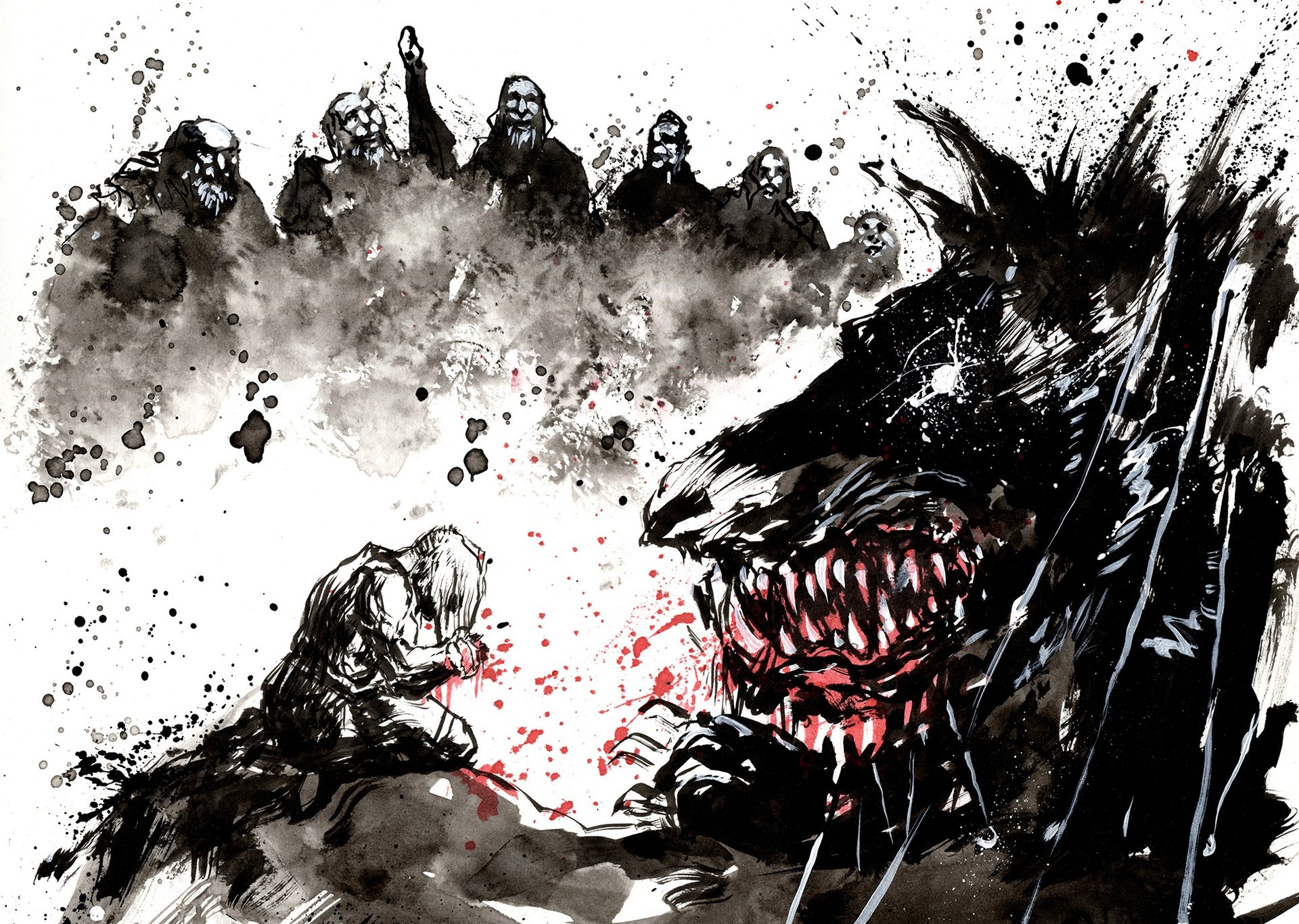
SOIL — Part Four
Ithica, Hromgir, and Baptiste traverse the frozen wastes in search of the Fenris Clan. Tensions rise in the Village in the Shins, and Syr Martikov tightens his grip.
DARK FANTASYSERIAL FICTION
James D. Mills
5/22/202679 min read
FOUR
The bairns speak
trilling voices in the night,
harsh echoes dancing, afright
of the hoary and weighty
squalor of unending sleep.
Messages delivered nigh,
grasped in sharp talons
of ravens, crows, pigeons;
whether the cock-crows
or refuses to show.
May our dreams stay safe;
for our sleeps are fraught
and the days, so dark,
as the sun burrows
deep, quaffs the Devil’s draught,
As if the accursed swill
were as naught
but cool, clear water,
a gentle man’s drink,
atop the Great Mothers’ hill.
Ithica (b. 413).
Journaled year 442.
I
After living in the temperate embrace of the Village in the Shins, Ithica had forgotten just how cursed, how bloody cold were the northern highlands in the shadows of the Guardians. Back home, the snow was considerate of the people and melted after daybreak, though most days were overcast with the clouds like Morgana’s breath choking the world in dim, orange shadows. Beyond the protective aura of home, treading upon soft snow dusting an unmarked trail in snow-shoes of lashed twigs and waxed strands of jute, the wind was bitter and spiteful, digging into her furs with icy fingers. Every howling gust ripped a spray of ivory powder off sagging boughs, pushing fractured branches piercing into undisturbed mounds.
Then silent cessation lay upon the white land.
Baptiste wore his hood drawn, face covered by a mask of birch, cut through with thin eyeslits. ‘Twas sagacious dress for one ascending the Shins—for any traveling across the Wyse, really. The vampyre explained that he was not worried for the cold, but for the sun. Should Bridget or Her Holy Brother break through the clouds whilst Baptiste walked uncovered, he would ignite into a ball of flames, and in an instant, all his years and knowledge and power would be turned to ash.
Hromgir walked twenty paces ahead, his every step worth three of Ithica’s, who heaved beneath the weight of the churning aches that twisted her stomach. At first her stalwart husband had insisted upon staying close, should they be ambushed, but Baptiste argued that Hromgir would serve them better scouting ahead, finding the path.
“As I have sworn, she is safe with me,” Baptiste assured him.
Ithica seethed quietly, loath to allow the men to speak for her, as if she could not speak for herself. She had lived in the Great North all her days, and had done just fine when she and Hromgir left her Da’s cottage for the highlands. But that had been in summer, and Ithica’s bones seemed more brittle than a plate thrown of poor clay. Though she stifled her reservations, she kept a gloved hand resting on the hilt of her Da’s knife depending from her belt, her eyes fixed upon the trail and the frozen lands beyond.
I shall fight for us, too, my husband. Don’t you worry for me.
The first night was comfortless. Cold, inescapable. She and Hromgir shared furs flesh to flesh, while their immortal companion stood a sleepless watch, yet Ithica could not keep her eyes closed, nor cease shivering. Her skin ached. Her breasts and nipples ached. She was at once exhausted and restless, periodically nauseous.
Hours into a malaise of lulling and waking, she snapped open her eyes at the cry of a faraway scream. Blinking away the stupor of sleep, she realized that what she had heard was simply the call of crows on the wind, mustering to discuss the day’s bounty.
She began to drift again when Baptiste called out: “Away from here! Leave us be!”
Hromgir roused then, too, squeezing her arm.
“What’s happening?” Ithica whispered, but her husband said nothing. Gooseflesh sprouted over her shoulders and neck. She turned round and hugged him with all her limbs.
Hromgir sucked in a slow, methodical breath. He rubbed Ithica’s back, and she rubbed his, breathing deep of the searing air. Neither slept after that. Another tense hour passed. When again their nerves warmed, Baptiste shouldered into the tent.
“What is it?” Hromgir asked.
“We are being followed,” Baptiste murmured. “Spirits of the damned; ghosts of the land.”
Ithica shivered. “What do they want?”
“To warn us, perhaps. Though for what purpose, I cannot know.”
Hromgir breathed deep, his whole body rattling upon its release.
“What is it, love? What do you know?”
“They haunt our dreams, attack our sleep.”
“You’ve been having nightmares, too?” Ithica was surprised. Hromgir slept through howling blizzards. He would snooze away the entire winter if she neglected to wake him.
“Aye. I’ve long known this land was haunted...”
“Haunted? By whom?”
“Draugr.”
“Sisters above!” Baptiste said, gesturing across his chest in a fashion southerners used to petition the new gods. “These mountains grow darker by the minute.”
The next day, Ithica began to see the Draugr. At least, she thought she had seen them. The wind grew more furious, gales kicked up drifts, rising upon misty legs to trail their course, as if the land itself protested their passage. At the edge of a blind, just as her vision began to deceive her, Ithica saw small, black forms surrounding them on all flanks... but they stayed clear of their path.
The better part of a week had passed, and Ithica’s stomach ached as much as her bones. She tried to think naught of it. ‘Tis but hunger pains, and fatigue. I’m breaking down from this miserable trek. After all, she had only made such a journey once in her life, and that had been in summer. Doubt crept into the back of her mind, laying out straw and blankets to settle in for the long haul.
She should have stayed home. Her people would starve without her... Her garden would die. ‘Twas a miracle it bore fruit at all, with the solstice round the corner. She never understood why her plants insisted upon growing, season after season, rain or shine, heat or chill. She had always credited the land, the fertile soil and the warm earth melting the snow year round, no matter how bitter the woods became. But no one else could achieve what she had, not even Elder Hama, who had maintained a flower and herb garden for over forty winters.
None else had the power to feed the Village through the long Winter. That was Ithica’s sole responsibility.
“They will all be dead when you return.”
Ithica stopped in her tracks, sucking in a ragged, painful breath.
Baptiste touched her shoulder. “What’s wrong, Miss Ithica?”
“Did you hear it?”
At first, he looked puzzled, then he flattened his thin lips and nodded. “I have been hearing it. The Old God loves to hear itself speak. What did it say to you?”
“Nothing of merit,” Ithica said, though it felt like a lie. Surely, her people would suffer the moment the hunters failed to fell game and the preserves of salted fish from the summer went dry.
“We must keep walking. I believe we are near our destination.”
Ithica looked into the distance; only Hromgir’s shadow was visible through the dusty cloud. “Do the Draugr mean us harm?”
“Come, child,” Baptiste started back down the path.
Reluctant, Ithica followed, dragging her weary feet, which felt like tree stumps lashed beneath her knees. Overhead clouds roiled as a distant storm grumbled amid a din of cawing trills. Ithica looked up, watching in awe as a mass of crows twisted and writhed, fluttering to the ground only to be swept back up by the twisting breeze. Oft Ithica watched the crows gather in their inquisitive forums within her garden, spreading through the plants and out among the trees in cordial communion.
Out on the trail, far from home, the crows instead had mustered for war.
* * *
Shelka once enjoyed visiting Collin’s place, which offered respite from her mother’s overbearing roof. They had spent the night last night, and were staying again this night. She liked the warm paneled walls, and an atmosphere redolent of a real home, but she was not too fond of the ol’codger himself.
For one thing, Collin had helped her Da drink himself to death. For another, there was always this pained glint in his eye, as if he needed something from her, but refused to put it to words. When he looked at Ma, he seemed like a bandit, pondering all the spoils he might gain. But Ma had no spoils. Nor did Shelka. They were no one special; they were just as cold and hungry as the rest. Collin seemed something of a lord, with his massive, castlelike inn, where he dwells alone with all the heaps of food that he forces Ignar to prepare for no good reason. Shelka wondered if the famine might end if Collin stopped cooking up all their stores.
What does he do with it all? Eat it himself? Explains why he’s so damned fat!
There was nothing wrong with being fat, Shelka mused, but there was a problem with getting fat. How could one be so selfish as to get fat while all the rest withered?
Called by her mother to join them in Collin’s sumptuous dining room, adorned with a great chandelier of antlers stolen from the heads of moose and elk, the answer came to her in the form of a plate piled with venison and potatoes and carrots, all of it smothered in white gravy made from the boiled bones of a mother hen. As her hunger fled... so did her bitterness.
She could not help but smile, glad to be away from that old, stuffy house, which somehow still reeked of Da’s ale breath six years after his passing. Even if Shelka’s Ma was at the castle, too, ruining Shelka’s solitude. Hell, ‘twas some ripe whimsy just to see the ol’crone smile. Shelka did not know if she had ever seen such a thing. Sometimes, Ma even laughed, whenever Collin said something with that mirthful red grin he was loath to withhold.
She washed dinner down with cool water, which in the cold of winter, may well have been warm water. She choked as it went down, and the bite of fluid in her sinuses brought with it bitter memories of the night Da was taken from her. Shelka sank into her chair, lamenting all that the gods had taken from her, and renewing her resentment of this new man who dared to sit at the head of the table.
“Remember...” said a ghostly voice, like a whisper of wind slipping through the windows.
Shelka’s heart thumped. She looked round, but the adults were too wrapped up in their lascivious murmurs and ogling stares to have noticed her dismay. Pushing against the table she scooted back her chair, then wandered through the dark corridors deeper into the fortress inn. No one seemed to notice her departure, nor would they for some time.
In the gathering shadows, she saw images of a cave with no ceiling. Another long table, scattered with forage; nothing like the hot meal she had just savored, but somehow more meaningful—nostalgic, even. Upon those plates was the food of her ancestors. ‘Twas what they must have eaten all those cold nights and sunless days. Like her, they subsisted on whatever they could find.
Shelka remembered little from her jaunt in the woods two nights ago, aside from the Valentine outsider carrying her home to Ma to get whipped. For some reason, she thought she had sat across from her Da at that strange long table in the cave. Surely, it could not have been true. Surely, ‘twas naught but her years of unanswered longing and festering sorrow. Surely, that’s all there is to it. A dream, perhaps.
“Remember...”
Or a vision.
The moon hung heavy in the sky when Shelka had had enough of wandering the corridors and stole into the night. But she would not return to the woods—not tonight.
Nigh midnight, she found herself standing by Little Jorn’s window. She had overheard a bit about the knight who slid into town. Of course the one day something bloody interesting happened in the Village in the Shins, she had been locked up in the cabin scrubbing charred pots. Jorn would know more.
His parents had been wealthy enough to build separate bedrooms in their cabin when they came to the Village, so she rapped upon the glass portal to Jorn’s room without fear of being heard; he had a whole room to himself.
Shelka was shivering and rubbing her fur sleeves by the time the window swung open and Jorn’s pinched face appeared behind its sill. “Let me in! I’m bloody freezing!”
Jorn held out a hand and helped her into the warmth of his bedroom. The place was always a marvel to Shelka. Stone floors littered by wooden soldiers, a deer hide rug, clean furs on his bed, a mattress atop it instead of straw.
“Tell me everything!” she said. “I heard there was a knight!”
“Quiet down, Shelka. You’ll wake me Ma—and she’ll have yer head if she catches ye here at night again.”
“Fine,” she whispered loudly. “So tell me quietly.”
Little Jorn regaled Shelka of everything that had happened, according to his mother. His voice was painted with a measure of awe, as if he had seen a grumpkin bounding through the woods with his own eyes. But ‘twas not Little Jorn’s own eyes that saw the dog sled pull the knight into town, nor his ears which heard Baptiste Fournier’s strange, seidr-laced words that stitched together the knight’s wounds. All that had been his Ma, and Shelka, fixed on the boy’s soft, brown eyes, saw the genuine pride he held for his mother. Witnessing the joyous light glittering in Little Jorn’s wide umber eyes, Shelka’s own amazement dwindled.
I wish I could speak so highly of my own Ma... The thought festered in her head, fouling her expression. I wonder what it might be like for someone to think so highly of me. Everyone now thought her a runaway. Everyone expected to find her frozen in the woods, just like so many before her.
Perhaps they even hoped for it.
Jorn must have caught wind of the foul thoughts seeping out of her ears like the heady fumes of a still. He stopped talking and began staring, his cheeks flushed and all the pride drained from him, leaving behind the chubby face of a simpering boy.
“I didnae mean to frighten ye, Shelka.”
“I’m not frightened!”
He raised his hands, swinging his head about as he shushed her, as if his Ma lurked in a corner somewhere. “Then what’s the trouble?”
“Nothing.” Shelka stood and swung about to open the window. Jorn always helped her with the latch; Shelka always turned it the wrong way. But this time he grasped her fumbling hand.
“Ye’re not going back out there!”
“I am.”
“You’ll freeze, Shelka Morn! Stay here, I’ll fetch some extra furs and ye can sleep on the floor.”
“I ain’t sleepy. I am bloody tired of your whining.”
Little Jorn knitted his brow, took a step back. “That ain’t right, Shelka.”
“Ye’re naught but a snot-nosed little boy, still sucking at yer Ma’s teet. Ye dinnae ken nothing of what’s right!”
“Go on, then,” he said, looking down at the dirt floor. “Dinnae come knockin’ again, Shel!”
She sucked in a fuming breath to lash back, but thought better of it. Shelka had done enough damage for one night. She clambered through the open window, which snapped shut behind her. For the second time since the sun sank, Shelka Morn stole into the night.
* * *
In my dreams, my children remain with me. I wish they would seek Morgana’s embrace and know peace. Yet, can I blame them for their unrest? They never had the chance to tire themselves out ‘fore the chill of our bitter land claimed them.
I stood at the edge of the dooryard. Inside, Little Jorn was tucked safely in bed, his father snoring the night away. I knew that I was there, too, my arms interlaced with my husband’s... But dreams have a way of overcoming reality, at least while you’re there. When I slumber, dreams seem more real than life itself.
All five of my lost bairns had gathered before me, wreathed in ivory moonlight. Once, it had pained me to see them so; decayed, paper-thin flesh, spread across thin bones like a linen tent on stakes, blackened and dried-out as if had been set in the smoker to cure overnight. What disturbed me most were their eyes: searing cerulean as the color of flames burning about a jarl’s funeral pyre, flecked with shards of flint.
I knew not whether they still saw me as their mother. They have never addressed me by name nor title. Helgi—Mother. I was neither to them, I was simply a survivor who had failed them. Thus, I was subject to their torments. For why else might one’s perished children visit you in the night? They stood round me as a royal council in the grand halls of Castle Morose, where meets the king and his jarls and his byfogeds, his wardens and his rangers.
“We wish not to cause you distress,” said the tallest of them. I now recognized him; Bolli, my eldest, just a few winters younger than Little Jorn is now, when I lost him. “But you must hear us.”
“Hear your vengeful scorn? I think not!” I screamed. Each time I lived this nightmare, I grew less afraid, more furious. “I am not to blame for what happened to you.”
“We do not blame you, mother,” they said in unison. “There was nothing you could have done.”
My heart all but stopped. “What say you?” I fell to my knees, overcome with long-restrained pain.
“We did not freeze,” Bolli said, his cerulean eyes bright. “We were devoured. Your friend shall be devoured, too, and her unborn babe.”
The moon swelled, lustrous and showering us with coruscating light. The looming trees painted the ethereal landscape with inky, bleeding shadows. A thousand eyes winked open in the sky, in place of stars. This land, this dreamscape was not mine, nor even theirs...
“Find Ithica...” my children chanted as the earth began to quake, an approaching blizzard roiled beyond the treeline.
I fell back, hitting the cold hard ground with bone shattering force. Head twisting with pain, images of snowfields and mountains flashed before me amid a sky of feverish eyes bearing into my soul. My children’s voices warbled and warped, at once discordant and harmonious. I screamed, my temples collapsing as if a hot knife slid into my skull.
I forced open my eyes to a peaceful dusted steppe, overlooked by Bridget, the Great Mother Birth. Her stone face was anything but cold, and gazing into Her eyes of weathered limestone, I learned where I might find Ithica.
I blinked and found myself staring at the dark ceiling of my bedroom. Big Jorn was still snoring, as if nothing had happened.
II
Shelka stomped through the fresh fallen snow, pacing circuits round the village till the moon smoldered bright in the starry sky. Her head boiled like an unattended cauldron left over a fire, her eyes threatening to melt to milky stew. She was unbothered by the nip biting her red, ungloved hands. Nor did she notice the chillblain throbbing in her numb feet, sockless and damp in her Da’s boots.
Bitter mistrals wailed down from the mountains, telling tales of a far away storm. But Shelka Morn paid no heed to nature’s warnings. She wished only to break something, to impose her strength upon something—someone—else. She imagined what it might be like for flesh to break beneath her knuckles, to split beneath a blade. Her Da was a soldier, once, so he had known the pleasure of fighting off the striders who pillaged and burned, defiling everything and everyone in sight.
She found her way back home, but she did not tarry. In the empty, miniscule one-room cabin which she shared with her Ma, Shelka stood before the worktable they used to prepare their meals, then to eat, and everything and anything else that needed a table. Shelka crouched and pulled her Da’s fish knife from the middle shelf beneath the tabletop. Drawing it from the sheath, she beheld its sparkling sheen in the moonlight. There was something special about the gleam of silver in moonlight, which the skalds claimed to be the torch of Morgana, the Great Mother Death.
Sheathing the blade, she grabbed her Da’s belt—its shape still embedded on her aching arse—looped the scabbard over it, cinched and tied it round her waist. Completing her robbery of her own home, she retrieved her gloves, donned a pair of her Ma’s woolen socks, and took the good blanket from their shared straw bed. On her way out, Shelka left the front door hanging open, tickled by the image of her Ma sweeping out a foot of watery snow the following morning.
What’s my plan? I won’t make it out there on my own...
“Go to the stables...”
The stables? I bloody hate horses.
But Shelka Morn was never one to disregard fanciful ideas, being perhaps the greatest strategic mind in the whole blasted village. How often had she spontaneously come across mind-boggling discoveries at the whim of intrusive thoughts?
More than once, at least.
So, to the stables she went, unsure what she might possibly find there, but trusting her intuition. Maybe she would find a pony, broken and saddled, and ride far o’er the horizon, never to be seen again. Shelka would become a mysterious rider, a stranger in some strange land, cutting the ears off goblins and the cocks off orcs. Or perhaps she would become a traveling skald, singing her laments to a captivated audience round a fire where she had never before sat, and not a one in its glowing ring would think of her as a runaway.
What she did not expect to find was a pack of mutts sleeping in the stalls. The place reeked of moldering bread and old ale—a stench one might call wet dog. Most of the beasts slept soundly in piles of straw. As did the horses, for that matter, none of which were saddled or small enough for Shelka to ride on her own. Not that she knew how to ride a horse, which she just recalled, confronted by reality.
Across the aisle on the other side of the stable, a dog panted and bayed. Concerned, Shelka drew closer and realized what she heard was more akin to grunting. Stealthy and brimming with guile, Shelka skulked through the shadows and hid in the adjacent bay. Pressing her ear to the wood, she then heard two voices, not one. A man grunting, and a woman doing a poor job of stifling her moans.
Standing on the tips of her toes, Shelka Morn’s eyes widened. Armelia Cordoba was mounted atop Ignar, pushing him into the ground and biting into his neck. She had hiked up her skirts and tore off most of his clothes in a pale imitation of lovemaking. Not that Shelka knew anything about lovemaking... Beyond the stories she and the boys told to one up each other, ‘twas a mystery. But she knew more than enough to see that the she-devil had seduced the man whom Shelka wished one day to marry; and now the bitch was defiling him—devouring him.
Shelka gripped the hilt of the fish knife, the silver cold, even through her gloves. Anticipation coursed through her calves, her fingers twitching, itching at the chance to destroy the bloody monster who had stolen Shelka’s future. At the same time, she could not look away.
Armelia pulled away from Ignar’s neck and let her head fall back, her mouth lulling open. There was no wound upon his neck, no blood upon her lips, regardless of how the act looked.
I shouldnae be here. Shelka’s heart thumped, and suddenly she felt very ill and even more confused. ‘Tis not for my eyes.
“The vampyre will feed before long, Shelka. You must put an end to it.”
No—that’s not what I want.
“You can be the hero you have always dreamed of becoming. Drive the blade into the girl’s back. Save the holder of your heart.”
No!
“If you do not, she will feast...”
Shelka did not want to believe that Armelia was capable of such things. Scattered memories of the strange dinner in the cave cascaded in her mind. The newcomers had sworn themselves to a life of peace. They had promised as much to Shelka, had they not?
Armelia cried out. Ignar grasped her hips. Convulsing, Armelia’s crimson eyes shot open and she bared her fangs. Ignar, clouded by his ecstasy, did not know the monster atop him. The vampyre sank her fangs into Ignar.
Shelka gasped, but was rooted in place, her blade stuck firm in its scabbard.
Ignar yelped. “What are you doing?”
Armelia gasped and withdrew at once. She rose, backing away and hastily covering herself. Her lip quivered as Ignar’s blood rilled down her chin, dripping into the hay.
“Armelia?”
The vampyre turned and ran out of the barn.
Filled with rage, Shelka hid in the darkness of the bay. Knuckles white, her fingers coiled round the grip of her Da’s silvered knife.
* * *
I am naught but a humble servant to forces greater than myself.
Who am I, then, to question a god’s command? ‘Twas the mind I possessed these last six Winters.
No longer.
When the Old God commanded me to invoke the Curse of Fenris upon a man who did not belong to the indentured clan, I asked him why. Confronted by my doubts, my patron did not balk. The Old God blinked. Left eye first, then the right. His face was a blank canvas you might find upon any stag, but his eyes were full of thought, countless centuries reflected in his round pupils belonging to an old man.
“We cannot survive,” said he, “if we allow the vampyres to persist. The people refuse to exile them, so they must be crushed within the jaws of my wolf.”
“To what end? What do we gain from chasing out these creatures? Will you grow and return to your former power? Shall I return to the village and construct a new cathedral dedicated to your worship, so you may finally ascend from this world?”
“We gain life,” said the Old God, and naught else.
‘Twas all the Old God wanted, simply to live. Is it not what drives the living? The will to exist against all odds, even when the dark road ahead stretches ever onward?
Was there a difference, then, between the Sticks and the Old God? Or were they one and the same? Perhaps the Sticks wished only to disappear, to die and decay in the wilds, while the other clung to its fleeting power that was never meant to be held on to.
Staring into those human eyes, I thought I saw the man he once was, or might have been. I shall never understand why the Old God chose the form he did; a hermaphrodite, caught between humanity and godhood but embodying neither. Perhaps, the choice was not his, and he, like the rest of the ants which crawled upon his face, was powerless to change his fate. Perhaps, he did not wish for change, content to subsist forever and anon.
Could I claim any different? Maimed, yet powerful. Not quite dead. Not quite alive. Free to choose, but bound always to make the wrong choice.
I went off into the woods to quiet my mind, instead filling my senses with the chatter of cardinals and doves, the crackling protest of dancing boughs and boles, bowing from my path so that I may enact our master’s will. I came upon the charred remains of a funeral pyre on the outskirts of the village. The scorched carcass of a dog lay wasted in the ashes. The blaze had cooked its skin, but there had not been enough kindling for a fire large enough to immolate a body in the cold of a winter night. The beast’s innards were mostly intact.
Drawing my dirk, I cut open the dog’s chest and pulled free its still warm and blackened heart. I retreated to my woodland haunt, the dog’s heart clutched to my own. I whispered an incantation that commanded the trees to encircle me, forming a clearing. Another whisper and the clouds parted, making way for the waning blood moon, which now only shone the pale pink of salmon. A word, and the soil sunk to form a hole before me. I knelt, sowing the dog’s heart and buried it. Patting the earth flat, I sang a dirge, a low throaty drone, warbling and churning in the night air, more akin to the din of summer broods than a song.
The ground pulsed like heartbeat, and warmed beneath my knees. I felt the power of the Old God rekindle and ignite like a roaring campfire against a blizzard. Words sloughed off my tongue that I could not hope to understand, but I uttered them nonetheless. My chant crescendoed, rattling my ears and my bones, and I let loose a spell that a mortal man had no right to incant.
For a moment, all was still, consumed by silent cessation. I hoped it may remain so and my people might live in peace. Then, not so far away, a wolf howled and the moon again waxed and burned crimson.
* * *
Garland Musher’s eyes snapped open.
At first, he thought that baleful howl he had heard was an echo of his waking nightmare. One look out the window told him otherwise. The blood moon returned... Garland shivered but put it out of his mind. He had never been a superstitious man, nor one to spend much time ruminating upon things he did not understand.
Embraced by the comfort of log walls and a burning hearth, wolves outside were little trouble. And the irk caused by short-lived baying was paltry compared to the incessant thumping and pounding shaking the ceiling, the muffled, pleasured moans somehow piercing the thick walls. He lay on his back, watching the pine beams shudder in time with the racket, as if a skald was beating a drum on the roof.
Garland looked round. The lord knight was not in his bed. “That bloody dog...” he murmured. “Didnae take ‘im for the type.”
Grumbling under his breath, Garland flipped round and buried his face in his pillows, praying for sleep to find him again, and when it did, that the sounds of a woman’s pleasure might guide him to more pleasant dreams.
* * *
“Did ye hear that?” Gerdur asked once they had settled back in the damp sheets. The air was heady with the scent of their combined sweat. “‘Twas a wolf, to be sure.”
The round window overlooking the village was fogged up and iced over; beyond the blood moon was renewed, burning a hole in the fabric of the night as would an unnoticed ember in a blanket.
Collin settled back on his side of his bed, the slope of his old mattress aggravating a kink in his back. ‘Twas a strange feeling, to share his bed. He did not even remember the last time he had. Must have been at a pleasure house back in Olarhos, when he was a lad. Collin had long since grown accustomed to sleeping alone, laying splayed in the middle like a man drawn and quartered. But having a woman curled up in his arms... he would trade all other comforts to hold on to that one.
“I heard nothing but you, my sweet.” Collin stared up at the A-frame ceiling, feeling mighty pleased with himself. “You’ve a sweet tongue, by the way, when you wish to.”
Gerdur shook her head, but wore a wry smile behind her auburn tresses, mussed up and dangling in her face. A decade seemed to have fallen from that face, lit by candlelight and the stars, relief spreading across her usually rigid features.
Collin watched her rise, admiring the shapely curve of her legs, her fair, freckled skin shimmering in the red moonlight. She was of an age with him, and looked it, her flesh beginning to thin and sag, her belly a tad round and marked by carrying a babe. She was the most beautiful creature he had ever laid eyes upon. Long had he watched her from afar, pretending not to notice the way her furs and linen overclothes stretched across her hips... her breasts... how freely they swayed within. Long had he wondered what was hiding beneath her garments. Finally, and unexpectedly, Gerdur had revealed all to him. And then some.
His stomach cramped as she bent forward to retrieve her shift and everything just lingered in the air for a moment, suspended in time. He almost said something, but refrained. Collin was no flirt, and he wished not to make an arse of himself after this night had somehow gone so well.
“I ought to check on Shelka,” Gerdur said, pulling on her woolen leggings. “Haven’t seen her since dinner. Ye made a room for her?”
“Aye. Had Ignar put it together before he left with his lassie.”
“Shelka’s been disappointed ‘bout that whole development. She’s been sweet on yer lad since she could walk.”
Collin huffed, resting his hands on his own hairy belly, which, for the moment, he did not feel so ashamed of. “Helgi’s boy is more of an age with her, anyhow. It’s those twins I worry over. If no one else shows up, one of them two girls will spend her life alone.”
“Bein’ alone ain’t so bad.”
“No?”
“I been happy as a bee since me husband did us the courtesy of freezin’ to death.”
Collin held his tongue, afraid of what might roll off of it.
With a smirk Gerdur sat back on the edge of the bed, shook her head. “Snorri Morn was a bloody beast. Only reason I married him was me Da was worse. Besides... Snorri had some gold to his name, once. Ye’d never ken lookin’ at him, but Snorri’s family was powerful; least, as far as power goes in the frozen north, outside the black walls of Castle Morose.”
“I’ve never heard of the Morns.”
“Nah, you wouldnae. Long dead, the lot of ‘em.”
Collin put his hand atop hers. “Why’d you keep his name?”
She threw her head back and scoffed. “I ain’t kept it. Shelka did. She loves her Da more than life itself. She was too young to see him for what he was.”
“What he was...” Collin remembered all those nights ol’Snorri Morn drank away, all those pennies that he dropped into Collin’s pockets instead of into his home. ‘Twas a nasty thought, but the night was good, so he shut it away with the rest of the nasty thoughts, writhing like red elder beetles breeding in the spring.
“Ye ken, I dinnae blame you?” Gerdur croaked, as if she had to squeeze the words out a near empty waterskin. “He was a drunkard. If not here, he’d have found somewhere else to get what he wanted. Or worse, he might have brought it home with ‘im.”
“That’s mighty generous of you to say, my dear.” Collin was unable to meet her eyes. “But that man is why I now stop the tap after two pours.”
Gerdur squeezed his hand and rose again, heading for the door. “I’ll be back, Just need eyes on the girl.”
He smiled at her exposed back as she shouldered on a nightgown, but it fell off his face as she disappeared into the dark beyond the door. Without her in front of him, distracting him, intrusive thoughts came rushing in. Questions upon questions.
How long will this last?
Are the newcomers truly blood-drinkers?
What is this Ancient that lurks in our woods?
Are our lives in danger?
Are our souls in danger?
“Collin!”
He launched out from under the covers, wrapping his naked waist with a plaid blanket. Gerdur met him at the doorway. “What’s wrong?”
“Shelka’s not here.”
“You checked the correct room—last one on the right?”
She nodded, her eyes wet, tears pooling in the corners.
They both rushed to dress, scrambling in the dark. Collin put on his socks inside-out, his tunic backwards, then struggled to get his swollen feet into his moccasins. They rushed down the stairs and threw open the front door. Tiny footprints led from the stoop towards the square.
“Shelka!” Gerdur cried, and Collin echoed her cry. Following the tracks through town they ended up behind Helgi and Big Jorn’s cabin. Gerdur was about to knock on their front door when a man’s scream tore a shrieking hole in the sky.
Collin’s very bones ached. That scream was too familiar.
Dressed in their night clothes Helgi and Big Jorn rushed onto their porch, looking to Collin for answers he did not have. He was speechless as his eyes traced more of Shelka Morn’s tracks leading towards the stable, and the scream, where came a tumult of slamming and snapping wood and then... nothing.
Following Shelka’s trail, Collin ran as fast as his old feet would allow.
* * *
Shelka stared at the rubrous moon. Sucking in a tremulous breath, the frigid air burned her lungs. She shivered, huddled in the icy snow behind the stable, clutching her Da’s fish knife, now slick with blood.
Her mind was blank after what she had seen... what she had done.
She glanced at the bloodied blade in her red hands, then forced closed her stinging eyes. Frostbitten and bloody. Red upon red. When had she taken off her mittens? Where was Ma’s blanket?
“What did you do?” A woman’s snarl prowled down the alley.
Shelka swiveled her head towards the speaker. Armelia stood before the alley’s mouth, heaving and panting furiously like a Fury sent by the gods to strike Shelka down.
“I—” Shelka tried to force out the words, but her chattering teeth and shaking hands devoured her will. She dropped the knife. “I didnae...”
Moving too swift for Shelka’s weary eyes to perceive, Armelia now stood in front of her. Looming over Shelka, the vampyre bared her fangs. “What–did–you–do?”
Shelka could only shake her head. She had done nothing. Nothing which mattered. That was the problem.
“You will confess your crime to the byfoged,” Armelia said, her fair, pretty face dark with wrath. “You will answer for this.”
At first, Shelka had no clue what she meant by that. She had only grazed the beast—it did not even notice that she was there... Then Shelka saw the furnace burning behind Armelia’s loathsome sneer.
Armelia had already left; she did not see. The beast was gone, taking with it any chance of a reasonable explanation for why she held a knife, smeared with blood.
“Not me...”
Armelia snagged Shelka by her tangled ginger mane, yanking the girl to her feet, and dragged her back towards the square. Already the townsfolk were heard gathering into a murmuring throng before the stable. A man’s lugubrious wail silenced them all.
* * *
At first, Collin could not comprehend what he was looking at. Butchery gone wrong, like an apprentice who had failed to bleed a boar before carving it. He collapsed before the spattered remains in the bay, wet hay chilling his bare knees.
The lupine howling had roused the whole town; everyone gathered outside already babbling their gossip. But Collin heard not their words, whatever intention backed them. Nor did he feel the many hands grasping his arms, caressing his shoulders.
Gazing upon the dead man, and only after staring at him for a good, long while, did reality finally set in.
The air was heavy with carnage, yet sweet with passion. The musher’s dogs panted and whined, confined in their bays. Some scratched at the doors, perturbed, itching to flee into the night.
Ignar lay splayed out in the hay in a pool of his own blood, mounted by a pile of his own innards. His clear umber eyes stared at the ceiling. Though gutted, the rest of Ignar was unharmed, save for two weeping punctures upon his neck.
‘My apprentice and I are vampyres,’ Baptiste Fournier had told Ithica while Collin hid behind their cabin, dropping eaves like a bored spinster. ‘To survive, we must drink life’s blood.’
But the old man had already left town. Collin had checked Ithica’s empty house that morning to be sure. Even two people together cannot survive travel in the Wystran winter, though one be wizened to the ways of the wild, such as Hromgir. He would not have taken his wife into the wastes without assurance of her safety.
That leaves the girl... Did she lose control in the throes of lovemaking? Or was she simply waiting to be freed from her master’s heel?
“What is the meaning of all this?” Byfoged Jukil stomped through the milling crowd to Collin’s side. “Collin, explain why you’ve...” he trailed off, his breath quavering, hitching in his throat. “Bridget’s blood! What’s happened?”
Collin shook his head. “Gerdur and me... found him like this.” He squeezed shut his eyes, a vain attempt at holding back tears. ‘Twas in vain; the tears streamed like the rapids back home after a summer thunderstorm.
“We must inform Syr Martikov, at once!”
The byfoged hollered something to someone—Collin had no interest in what nor whom—then started upon a frantic tirade, barking orders at the townsfolk, beating them back with a bludgeon of curses.
All the while, Collin could not look away from Ignar’s eyes, still bright with life... potential. He touched the lad’s hand, still warm. His spirits still lingered, Collin felt them standing beside him. Though his Hamingja, his luck, had long fled, the guiding Fylgja lingered in solidarity with the guardian Dís, standing a mournful vigil o’er the fallen Hamr. Back home, in Olarhos, death priests communed with the dead, could discern the perpetrator of grisly murders.
Alas, Collin was no weaver of sorcerer nor speaker of incantations. All he could do was whisper his unwilling goodbye.
* * *
Where the hell is Martikov? Garland wondered, sitting alone on a stump in the town square while the villagers wailed and mourned. He had only just wandered outside, after all the yelling and hollering pulled him from his belabored sleep.
One did not need to be a clairvoyant to divine what had happened in the stables. Someone was killed, and the body was found. Being a stranger in these parts, he had not the heart to check on his pack. That would be bloody rude—so he resigned himself to wait until the crowd dispersed.
Above, the heavens roared a ghastly dirge, dark clouds churning amid the scarlet moon. A storm raged down the mountain, mercifully leaving the town out of its destructive path. Thick, fluffy clumps fell from the clouds, drifting side-to-side like spring blooms falling from fruit trees. Laced about the square were countless muddy foot trails and pot holes, freshly dusted. Concerned onlookers paced about, waddling between slush and mud to keep their feet dry.
We’ll be hit soon enough... snowed in with a bloody killer. So where in hell is Syr Martikov? Is this not why he dragged me here?
Surely, the lord knight could not still be at the inn, pouncing his romp. He would have heard the commotion. Perhaps he was already on the move, chasing down whomever—or whatever—caused all this upset.
“Over here! I have her!” A young Valentine woman emerged from an alley, dragging a little girl by her fiery locks. Both looked worse for wear, but the girl’s hands were painted redder than her mane.
Byfoged Jukil rushed out from the stable, Garrick and Torrin close on his heel. “Come no closer!” the byfoged commanded as the woman drew near. As if to put a finer point on it, his sons stepped close beside him, drawing their swords.
“It’s the girl!” cried the woman. “I found her behind the inn holding a bloodied knife!”
“Unhand Shelka Morn at once! I’ll not say it again!”
The woman’s expression faltered, and then she seemed very confused. “Shelka Morn killed Ignar, sir, I can prove it!”
“Dinnae heed the she-devil’s wiles!” Byfoged Jukil called to his sons, blanching as if a nightwraith manifested ‘fore their eyes. The byfoged turned a terminal leer upon the woman. “I know what manner of monster you and yer sire be. Let the girl go, and come easy, now. We needn’t spill more blood this night.”
A sheen of understanding spread across the young woman’s face. She let go of the girl’s hair, who fell on her hands and knees and scrambled away from her captor.
The byfoged withdrew a set of shackles from his belt, and carefully approached the woman, his sons brandishing their blades on their father’s flanks. “You will be held until we locate your master,” the byfoged said, clasping the shackles round her wrists. “Then you both will face trial in the Black House, by order of Syr Edmund Martikov.”
Garland sat still as he watched the byfoged drag away the woman, as if he might be next should he draw notice. The little girl’s mother ran from the stables and swept her up in a weeping embrace. He glanced over his shoulder; the townsfolk had finally begun to clear away from the stables. Shrugging, he rose and checked on his dogs.
Dinnae want them gettin’ a taste for man-meat.
III
They neared the peak of the Guardian, where dwelled the Fenris Clan, who, Hama had claimed, knew the secret that might banish the Ghost of the Mountain, the Old God. For days, Baptiste feared a blizzard awaited them beyond the horizon. Frigid winds kicked and howled, assaulting the road-weary troupe at every turn.
Snow drifts blew this way and that, scattering then piling again, changing the shape of the white sloping land stretched before them. The trees dwindled the higher they climbed. The skies grew darker, the clouds thickening, as if they were made of cotton stained with soot.
In his prime, traveling overland had never posed an issue. Even now, were Baptiste on his own, he would have little trouble traversing the brutal wastes by night. But he swore to look after Ithica and Hromgir, who, unlike him, could freeze or starve or go thirsty. That presented more of a challenge. He was forced to expend a steady stream of potential to keep up the warming wards, which protected his companions from the elements. At first he conjured a globe, but that quickly became a strain, with Hromgir scouting so far ahead. Instead, Baptiste placed an invisible coat on his companions, insulating them against the cold using the warmth of their own flesh.
On their own, such spells were naught but minor enchantments, easily managed. Complication arose with the steep inclines, the dizzying drops, sharp rocks like claws jutting from the earth, and darker threats, which lurked in the ivory gloom. Baptiste remained ever vigilant, never resting.
And the striders, traveling in bands of a dozen or more, were an ever present menace. An ambush could fall upon them at any moment, would mean death for Ithica and Hromgir, and likely Baptiste, too, should he fail in his vigil. Baptiste had known countless years, but he was far from invincible. One well placed strike could take a limb. If an attacker happened to carry silver on his hip, Baptiste would simply, unceremoniously, perish the moment the cold metal pricked his heart.
For reasons long forgotten, silver was anathema to all things less-than-natural—aside from the fae, who could be killed only with iron and sorcery. Iron had never been an issue for mankind, and silver had always been manageable, and thus mortals have culled the dwindling populations of the supernatural, even if they never knew they were doing it. The Skjöldrúnnar clans understood the power of silver. Any strider was likely to carry at least a silver cheese knife, and even that—if placed by a well-aimed thrust—could mean the end of Baptiste Fournier.
Biting winds shrieked down from between the crags rising like fangs all around the band. Baptiste’s searching gaze swept over the surrounding peaks.
We are in Fenris territory now. I can only pray it does not come to blows.
There was also the troubling matter of the Draugr. Baptiste had chased them off over the last several nights. The spirits haunting the troupe were not the lost warriors and elder kings of ancient epics but the spirits of children, who bore the same mark as Ithica and Shelka Morn. Unobtrusive in their dreadful appearances, Baptiste thought they meant to provide warning. For what, Baptiste could only guess. Was such a warning a threat, or an act of solidarity? The spirits walked only behind or beside the troupe. Clearly, they were not bound to the limits of physicality, and if they chose to, could block their path or cause harm to the mortals in his care.
If Baptiste were allowed to rest—rather, if he allowed Hromgir to take watch for half a night, which he would not—he might have allowed one of the spirits to touch his dreams, just to see what would happen. Then they might parley and Baptiste could discover what the spirits wanted.
But that was impossible; he could not afford a moment of weakness in his watch. Baptiste was a beacon to powers beyond mortal ken, as were the spirits on their heels, and even more terrible powers lurked in the frozen wastes. His unending watch was all that kept at bay the fell demons of Pandemonium, which had climbed the Great Stair and emerged from Mt. Vragognev, where Dusk’s undead army fights to keep the ranks of Hell out of the realm of the living. Despite the Great Mother’s efforts, not every black soul is accounted for, and thus monsters manifested in the world where none existed before.
If that damned fool atop Grahtzildahn’s throne did his bloody job... But Baptiste could not resent the impotent Demon King-regent. His incompetence, after all, had allowed Baptiste to escape Pandemonium a few centuries after Dusk destroyed his sire, and was subsequently ensnared by the Scarlet Chair.
Another night came and went without incident, but not without notice. Once his mortal companions retired in their tent, Baptiste refused even to sit, for they had become a spectacle for a host of unseen onlookers. Countless Draugr lingered in the shadows, seen only by Baptiste’s third eye. They were each short and frail, wearing darkling clothes of myriad northern styles; some plain, others luxuriant in their obscured braided patterns. Their formless bodies were vague and ill-defined, aside from their flashing eyes, burning like the lazuline signal fires lining the floating shores of Phrygia.
Behind the wall of spirits were the prowling devils. Only a few dared to intrude within Baptiste’s immediate awareness. Draugr more-or-less manifested in uniform. But demoniac beings, borne of black, tortured souls, are unique as fingerprints. There were three that Baptiste determined had given them chase, watching on from afar. Two were benign scavengers that would only show themselves if blood was shed and left unattended.
But the third... Gods, it’s massive! It warps the very space around its unwelcome presence.
Occasional tremors shivered in the earth, like a faraway cavalry charging into battle. But there were no cavalries this far north, this high in the Shins, upon the peak of the tallest Guardian. Only striders, ghosts, and demons. All of whom watched the troupe’s ascent with unsettling interest.
Among all the distractions, Baptiste’s awareness of his apprentice had begun to fray. He sensed her life force, knew that she remained in the Village, but her aura had twisted, growing somehow disturbed. It flickered when normally it flared, which might happen if she were on the edge of starvation. But she’d never skipped a meal before. Why would she now?
That was a troubling thought, but there was nothing to be done. Still, Baptiste could not help but to worry.
Baptiste looked up, startled to find a wild man standing by the campfire, his head cocked and his menacing eyes wide. Despite the chill and the wind, the bastard wore naught but fur lined trousers, boots and a cloak, leaving his chest exposed to the elements. Dark lines of sweeping circles were etched into his bulging pectorals, his rippling shoulders. He brandished a wicked broadaxe, the long, bearded blade tapered to a toothlike point and glinting silver in the firelight.
“You caught me unawares, warrior,” Baptiste said, unsure if the man could understand the pidgin Valentine trader tongue. If not, then the heads of his charges, and his own, would likely decorate the drifts in a few moments. “If you come in peace, you are free to share my fire.”
A dozen more figures emerged from where they hid beneath snow drifts, men and women, all carrying bows and axes and arming swords. All of them, stinking of the Old God’s mark. Who hasn’t this beast claimed?
“Blood drinker,” the warrior hissed. “You sully these lands.”
“I have spilled no blood.” Baptiste’s eyes darted about as the squad closed in on the camp, the warmth of their boiling blood radiating scarlet waves into the ether. “I protect two mortals. They have come to seek an audience with the Chief of Clan Fenris!”
The warrior shook his head, not a drip of compassion to be found upon his windswept face. “Lies.”
A scrape of leather; Hromgir emerged from the tent, half naked and brandishing his own axe, his own faded tattoos on full display; his patterns were fluid, where the Fenris markings were jagged. The warrior regarded Hromgir carefully, poised to strike.
“Sparrow,” the warrior called, as if the word beggared respect. “You’re far from home.”
“Home is no more, my brother.” Hromgir stepped in front of Baptiste. “Clan Sparrow has perished. My loyalty now lies in the blood of mine blood. My wife is with child. Bring us to your Elders.”
“You keep foul company.”
“Aye. But he has sworn to me a blood oath.”
The warrior barked a laugh. “A blood-drinker swearing a blood oath! Show me the scars.”
Hromgir and Baptiste each held out their palms. The warrior let his axe fall to his side, suspended by the loose grip of his left hand. He bent down, examining the wounds, sniffing their hands like a hound. “Fresh. You speak true, Sparrow. Very well. I am Hinir, Breaker of Stone and son to Vok. I am thane to Ramr Fenris, the Black Wolf.”
“Hromgir, son of Thorm,” the once-strider said, pounding his chest.
“We shall guide you to the Temperate Valley, Hromgir, son of Thorm.” Hinir glared at Baptiste with eyes that must have seen a hundred tricksters lose their heads. “You are watched by powers blacker than the Fenris Wolf. We depart at first light.”
The men clasped hands, and the war party lowered their weapons, converging on the fire. It baffled Baptiste, how the striders constantly straddled the knife-edge of a bloodbath and a sea of ale. A moment ago the Fenris warriors had meant to steal their heads, and now they reveled and roasted snared martens on spits.
Ithica wandered out of the tent sometime later, wrapped up in her flannel blanket. Her face was painted red with chilblain and frigid apprehension. Likely, ‘twas the first time she had encountered striders in their own lands, men so unlike her gentle husband.
Baptiste absorbed her concern and offered a reassuring nod in return. “All is well, child. Rest easy.”
She forced a grin, and sat beside her husband at the fire, who was already telling war stories to their newfound companions in their native tongue. The warriors welcomed her with wide smiles, strands of meat wedged between their yellow, filed teeth.
Baptiste stood by the edge of the camp, his heart lightened by the retreat of the stalking demons. But the Draugr remained, watching with rapt attention. And Armelia’s aura was still dim, and growing dimmer.
* * *
As the Mourning Sun rose and fell behind the gloomy clouds, Ithica wished not to move. Every part of her felt heavy, unbalanced. Nauseous and faint, she rose and wriggled into her tunic and breeches, layering on heavy furs that chaffed her aching paps as she followed the band of wild men and women down the northern slope of the Guardian.
Hinir and his scouts found the path through the freezing wastes. Thick tufts rained upon their heads, covering their tracks within seconds of imprinting them. Towers of frost loomed upon either flank, growing larger by the hour. By noon, the striders led them down into a dale, where the air grew warmer and wetter, as did the ground. Mud took the place of snow. Hromgir fixed himself to her side, scowling and baring his teeth at every tattooed Fenris man that looked her way; and a woman, too, who seemed to be more forward with the crude outstretching of her long, illustrated tongue.
At first her husband’s sudden territorial aggression bothered Ithica. ‘Twas so unlike him to play the part of a beast. Then, in a moment of calm, when the last round of curious would-be suitors slunk back into their cliques, Hromgir flashed her his gentle smile, wan and weary, and Ithica realized they were, for the first time, among his kind. Not hers.
“I’m something of an oddity it seems,” Ithica murmured, her eyes fixed on the woman with the long tongue; she was taller than most men in the village, her lithe form layered with lean, corded muscles, sharp tattoos covering the entirety of her exposed, sunkissed flesh.
“Aye.” Hromgir grunted. “Ye’re a noble lady by their ken. Clear and fair of skin, thin of frame.”
“Should I be worried?”
“Nay—you are blood of mine blood, carrying mine child. Our child. He who touches you shall lose his bedeviled hand.” He rolled his smoldering gaze towards the warrior woman, who promptly averted her probing stare. “And she.”
“They understand this?”
Hromgir nodded grimly.
As they descended further into the dale, green made a vivacious return. Sparse sentinel firs gathered into verdant clusters, painting the ground amber and umber with aromatic fallen needles. As the sun sank below the horizon, which occurred earlier in the day with the solstice drawing closer, the narrow mountain path opened on to flatlands.
Her bones cringed with every footstep, and she struggled to hold her piss, needing to free it on the top of every hour. The air was thinner here in the dale, which was higher up on the Guardian than even the village, which was the highest Wystran settlement in the Shins.
By nightfall, the black storm roiling on the horizon drifted south whence they came, towards home. The sky above remained gray, but the ground beneath Ithica’s feet did not sap the heat from her, a comfort she had not known since departing a week and a day ago.
Steam floated off the damp grass in a gloomy mass. White plumes rose beyond a slope. Cresting the slope, the troupe meandered towards a scattering of moose-skin tents and flickering campfires that speckled the landscape like so many stars adorning the purple sky above. The Fenris village seemed not so different from the Village in the Shins, aside from the troubling lack of fields and gardens. So too, they did not keep sheep or hens or cows, nor even horses! It seemed the striders refused any semblance of a sedentary lifestyle.
How can they possibly survive all the way up here?
All the village had gathered to witness the outsiders’ arrival. The craftswomen and children rallied to the return of their warriors, then gave a wide berth when they laid eyes upon Baptiste, whom they gawped at as if he were a grotesque troll traveling with a circus.
The women outnumbered the men by double, and dressed in revealing furs pinned with bronze brooches, their hair woven in intricate braids close to their scalps. Some bore the same warrior tattoos of those who had escorted them there, but more yet decorated their tanned skin with images of wolves and elk and moose, tin talismans and carved bone trinkets displayed across their bodies.
The bairns wrapped woolen cloaks tightly round their forms, pinned with iron rings. Ithica could not hope to identify who was parent to whom, and perhaps such specifics mattered not to the Fenris Clan—children were children, and all would be cared for and taught to live off the land.
The village women whispered amongst themselves, some spitting at their feet. A few others yelled obscenities, to which Hinir barked back his own bleating insults.
In the center of the village stood a makeshift longhouse, constructed of lashed boughs and roofed with an upturned ship, whose hull had not tasted salt for generations, stuck high on the Guardian and riddled with dry rot. Three tall spearmen wearing iron half-helms emerged from the hide flaps closing the longhouse and arrayed themselves in a semicircle. Their escort came to a halt before the helmed warriors. Ithica held close to her husband. Baptiste stood several paces off to their side. How exposed he must feel...
“My chief!” Hinir bellowed. “We have returned! We bring visitors to our lands!”
All was still, save for the howling winds baying in the heavens.
A hand clad in black fur emerged from between the flaps of the longhouse, then a fur clad arm, and when the massive chieftain fully emerged into the light of the moon, Ithica realized he was not clad in anything at all, for the fur the man wore was his own. Two heads taller than the tallest of his guard and naked, save for a thin loincloth barely concealing his manhood, Chieftain Ramr Fenris was more beast than man. At first glance, it seemed he had the head of a great, black wolf, but one look at his busy black beard dangling past his hairy pectorals, climbing up his cheeks towards his scintillating silver eyes, revealed that he only wore a hood fashioned from the remains of one.
“Tell me, outsiders,” cried Ramr Fenris, his voice a sonorous boom of stone against stone. “Why have you come to my lands? And why have you brought—a monster?”
Hromgir stepped forward, sinking to his knee. “I am Hromgir, son of Thorm, once of the Sparrow Clan. We come to you, Black Wolf, for aid. Our village is plagued by the Ghost of the Mountain.”
Murmurs rolled through the throng of villagers. The chieftain cocked his head, lifting his top lip to reveal a canine, filed razor sharp. “Rise, son of Thorm. See my eyes! What you ask of us is blasphemy. Grøde, the spirit of the land, has watched over my people since before our ancestors crossed the North Sea.”
Ithica’s heart lurched. She heard the shuffle of weapons, the clenching of fists round the hilts. We’ve traveled all this way. We cannae die here. She looked at Hromgir, standing proud and undeterred before the massive chieftain. His umber eyes shone with that resolute certainty that could never be broken. ‘Twas the very same look he had so oft given her when she worried she might never become a mother. ‘Dinnae fash, my love,’ he would always tell her, ‘we shall succeed yet! Have faith.’
Have faith. ‘Twas all Ithica needed to do. Her husband had spent most of his years round these strange people. If anyone can reason with them...
“I confess,” the chieftain went on, “that Grøde has failed my people. Look upon us, see our dwindling numbers! We are but half of what we were in mine father’s reign. Our young still in the womb, yet the spirit demands we sacrifice twofold! In the days of our ancestors, we gave children and bounty for life!” He spat the word, as if the very notion of life had soured. “To live is to grow, to flourish. And here, we wither...”
Chieftain Ramr Fenris paced round his warriors, placing a giant hand atop each of their helms, then to the onlookers, caressing the cheeks of devoted women, mussing the wild manes of bairns. “My people starve. We die. Still, each solstice we give the Old God his tribute. How many babes must die before we are delivered from suffering?” He turned to Hromgir, stepping within a hand’s reach, towering over him with a mad haze over his dark, bearded face.
“Yet, mighty son of Thorm, warrior of the deceased Sparrows, you dishonor me by bringing a blood-drinker into my lands.” His silver eyes flashed to Baptiste. “If you would call upon me for aid, then you must win my trust in the circle. We shall settle this dispute with blades!”
The Fenris warriors let out a collective hugh! clashing their weapons against shields, stamping spears into the dirt in a steady rhythm as they formed a ring round Hromgir and Ramr Fenris.
“Hromgir...” Ithica whined, grasping his hand. “You cannae accept.”
He grimaced, as if both his wrists were bound robes, tied to opposing ships sailing in opposite directions. “I must, my love.”
“No!”
Hromgir turned, his eyes wide, teeth bared. “You will not survive the night should I refuse! Now back away, and trust that I will return to you!”
A cold hand squeezed her shoulder as Ithica opened her mouth to argue further. She swung about and found Baptiste’s mournful frown.
“Come child,” he said. “Let us watch from a safer distance.”
Ithica nodded, knowing that she was powerless to intervene, and loathing that knowledge with all her heart. Two warriors stepped aside, allowing them a path.
Baptiste and Ithica stood upon a mound on the outskirts of the ring, overlooking the living arena. Warriors yipped and hollered, chanting in time with the beat of their steel, passing shields and spears to those not already armed. They closed in on Hromgir and Ramr Fenris, planting hafts in the dirt, the spears pointed inward, toward the combatants. Hromgir drew his broad axe, which he had carried since before the day he arrived at her Da’s farm.
How many men has he chopped down? Her husband placed his life at risk as if it were no stranger than having a cup of water in the morning. How many times has he done this?
She had never asked Hromgir about his old life. The life he spent among his people, reaving the seas and raiding the land. She oft wondered in the heat of their passions what brutalities his massive, callused hands had committed. So soft and tender had they been, stroking her back, firm and deliberate, grasping her thighs and her breasts... How could those hands belong to a killer?
The chieftain drew his arming sword, the pattern-welded blade honed to a deadly grind and silver scrollwork inlaid along its length and pommel. Ramr Fenris barked a command to one of the warriors, who threw his round shield at Hromgir. Hromgir caught it and looked to the chieftain, puzzled. “You will not fight me crippled,” the chieftain said. “An axe in one hand calls for a shield in the other.”
Hromgir nodded. “Claim your own shield.”
“I just told you—you will not fight crippled!”
Hromgir beat his axe against the iron boss of his shield; Ramr Fenris pressed the pommel of his sword to his chest and bit the blade, bloodying his tongue. They both assumed fighting stances. They stood motionless, Hromgir behind his shield, his axe raised above his shoulder; Ramr’s blade low, leading with his empty off-hand, presenting an immediate opening.
Hromgir waited. He was nothing, if not patient.
Then, Hromgir dashed to the side, his axe hovering overhead. Ramr snarled and lunged. Hromgir caught the blade on his shield, swung with his axe. Ramr withdrew his blade, parrying. Hromgir shifted his grip, capturing the chieftain’s blade under the beard of his axe.
Ramr roared, kicked Hromgir’s shield. Stumbling back a step, Hromgir’s eyes went wide as the beastly man pressed forward with a furious onslaught of savage swipes and cleaving cuts. Steel drummed on basswood, rang against iron. Hromgir retreated with every strike, hunched behind his shield.
Fervent and monstrous, Ramr’s tongue sloughed from between his grinning teeth, and he threw back his arm for a high, killing cut. Hromgir, steady, calm as ever, saw the opening. He punched the shield’s iron rim cracking into Ramr’s ribs and shouldered forward, driving him back.
Hromgir flung his axe high—Ramr dropped his sword and tore Hromgir’s shield free, then snared him in a bear-like hug, pulling them both sprawling into the mud near the ring’s edge.
Clansmen cheered as their chief punched Hromgir in the jaw. Ramr rose, arms raised and laughing like a madman, reveling in his own showmanship.
Struggling to his feet, blood pooled in his mouth, seethed from between his bared teeth. He spat on the ground and retrieved his shield.
Ithica gasped, covered her eyes, a sour sickness curdling in her throat. I cannot lose you! Bridget—Morgana have mercy!
Baptiste squeezed her shoulder and regarded her sternly. “Worry not, my child. The battle is not finished.”
A clarion of steel pulled her attention back to the circle.
Hromgir swung wildly at Ramr, who had recovered his sword, carving alternating sweeping arcs with every step. Ramr reeled, parrying and evading most, but also bearing the pain of a few glancing cuts. The chieftain strafed wide, sword held high. Hromgir withdrew his axe, lifted his shield. Ramr slung a brutal overhead slash, then pulled back, dropping the blade low, and thrust towards Hromgir’s belly.
Hromgir dove to the side. The desperate move spared him his life, but shattered his shield on the landing, allowing the chieftain’s runic blade to carve a strip from Hromgir’s axe-arm. Ramr followed through with a heaving slurry of strikes as Hromgir rolled back to his feet, again on the retreat. His axe lacked the nimbleness of a sword, too top heavy; he could not match the chieftain’s furious deathly chain. Thrown off balance he slipped in muck. The chieftain howled and dove for his prey, ravenous silver eyes shimmering in the moonlight.
Ithica’s head rushed as if she were heaved off a cliff.
Then surprise smeared across Ramr’s face and he halted his attack as Hromgir drove his boot between the chieftain’s legs, crushing his exposed manhood.
Hromgir tackled the monstrous man, driving him viciously into the mud. They rolled and struggled, grasping and groping. Mounting his injured foe, Hromgir pinned the chieftain’s sword arm to the ground. Ramr pawed with his off-hand, searching for the dagger at his belt. Hromgir roared and smashed his forehead into Ramr’s nose.
Ramr cackled as blood sprayed, giggling as Hromgir beat him senseless, bloodying his fists against the chieftain’s jaw and cheeks and eyes. Ramr’s hands fell limp at his side, twitching with every blow—but his laughter never ceased. Hromgir struck him again. Once, twice, thrice, then he drew his dirk and drove it into the man’s throat with practiced precision.
The chieftain’s gurgling mirth congealed in Ithica’s ears. Mother’s mercy... What are you?
Hromgir pulled free his dirk and fell back on his haunches, staring up at the sky, the bloody knife dangling at his side. The clouds twisted and roiled, lapping over on themselves like the milky, foaming eddies of a river in early spring.
All was silent, save for the howling wind and the grumbling of an approaching storm. Thunder cracked. Lightning lanced between darkling plumes. The clouds parted in the wake of the waxing moon swelling anew, blood seeping into its alabaster light.
Ramr’s eyes flashed open, blazing silver. He curled upward and slammed Hromgir on his back. His noxious guffaw renewed, along with an odious tumult of snapping bones and splitting flesh. His flesh bubbled and undulated, then Ramr Fenris grew.
Rising on all fours over Hromgir, Ramr Fenris took the shape of a monster unlike any Ithica could have imagined. Slitted yellow eyes stared down at Hromgir, a great long maw filled with knife-like fangs opened wide, dripping slaver on his chest. The Fenris wolf clamped his massive jaws upon the wrist of his shield-arm and swallowed.
Hromgir screamed.
Ithica fell to her knees, assaulted by nauseating terror, dizzying fury. Baptiste held her by the shoulders, and together they watched on, helpless to intervene.
“Tales of the Sparrows’ prowess ring true,” rumbled Fenris Wolf, the creature’s voice venting out its mouth from its boiling guts, where Hromgir’s hand simmered and digested. “You have earned the right to learn our secrets. But every blessing must accompany a curse. ‘Tis the way of the Fenris.”
IV
The trees staggered against the blast of moaning gusts, undulating like water lilies atop a flooding riverbed. Birds and martens burrowed inside hollowed boles, and those which crawled upon the ground sought refuge deep beneath the soil. Silent was the world when the wind screamed. All shrank before the oncoming storm. Even I, in my preternatural state of dominion o’er the land, feared the flurries blotting out the sweltering blood moon, which burned anew by the black will of the Sticks.
I retreated into the stillness of the cave, heart racing on the backs of boyhood memories of long, vociferous nights.
A man should always respect, even fear, the forces of Nature, no matter how much power he has acquired. But the tantrum blotting the skies this night was in no way natural. ‘Twas the work of the Old God.
Deep in the shadowed caverns, through a labyrinth of narrow, denticulate passages the Old God labored in the center of a magic circle, its twelve points capped by jagged candlesticks, rough with powdery rust. He bleated and quivered, sinking beneath his own weight, his thin legs trembling in ecstasy.
“I hunger...” the Old God whined. “Servant—I require sustenance.”
“The village is in a rage over the cook’s death. Luring the few children left to them would be nigh impossible. We cannot turn to Clan Fenris, for they have turned against you.”
“Faithless fools!” The Old God’s sonorous voice quaked the earth, reverberated through the limestone, as if it originated from somewhere deeper yet. “They shall spurn my boon? I demand sacrifice! I crave it, require it! Do you think my powers infinite? My efforts drain me. I must feed.”
I stood silent before my gluttonous patron. I despised his overconsumption, his vile hunger, his waning purpose. The Fenris Clan sacrificed their young every new moon; yet the Old God was never sated. Perversely loyal, still I tried. And with my merciless efforts to sate his hunger, the Village in the Shins had lost countless bairns, drawn into the woods by mine own deceptions. For what end? For what good?
I knew better than to ask questions. But with so many now lost to the Old God’s predations, there was nothing else left. “How can I deliver unto you that which is no longer? You have all but consumed the wasted remnant of human life given into your care.”
The chamber grew hot, the air shimmering with wavering mirage as the Old God’s rage mounted. “Obey me, servant! Or I shall let age take you, and you can face Morgana’s hellish judgement!”
“If you must eat—eat me. I shall deliver your perverse meals no longer.”
A frantic guffaw shook the cavern. I turned my back upon my patron and started up the slope and stopped. Why do I still stand? Gazing over my shoulder, the Old God had closed his human eyes, antlers loping low, his long cervid tongue lolling from his mouth.
“What are you doing?”
But the Old God ignored me, and I knew well the answer. The stock of ideal chaff ran low... The Old God withdrew from a sacred reserve.
I ran from the cave, braving the brewing storm, using the last of my power to bound atop the snow as a hare. Swiftly I ran, and soon found myself panting, hunched over at Hama’s salt line. My bones ached and muscles cramped; body failing, my god-given powers were draining with each second lost.
“Hama!” I screamed amid the torrential din. “Hama! Hama!”
She heard me not—or she ignored me.
Shivering, my extremities bitten by frost, I gazed at the salt line before my withering feet and stepped across it freely. An incredulous laugh escaped me, like the mewling of rusted hinges. I stumbled onto the porch and burst through her door, collapsing to my knees upon her mud rug. So beauteous she was, even then, rising in terror at my unannounced appearance like a midnight apparition. Perhaps that was what I had become; I lifted my tremulous hands and marveled at their deathly pallor, the flesh cracking and drifting as ash upon the devouring winds at my back.
Kneeling before the woman I had always held so dear, had always kept at a distance, for fear I might ruin her, that she might turn away mine reluctant affectation, I told all—as much I could say as my lungs withered to prunes in my chest, not taking a moment to breathe, until the moment came when I could breathe no more.
My vision rose towards the ceiling as my remains hit the floor, and I drifted into the wind, pulled to a faraway place by two gorgeous spirits that had, somehow, stayed with me through all my sins.
* * *
Though his bed was warm, Collin’s heart was cold. Blood trickled through his veins like chilled mountain brooks, and the hours flowed past in a languorous stream. It was afternoon by the time he found himself floating through those damned shadowed corridors. And it would still be afternoon, by the time he found himself back in bed, retreating into the comfort of dreams.
Collin never had nightmares. ‘Twas the one true gift the Great Mother had given him. All these nights alone in the damned frigid north, he always knew he could find succor in dreams. He did not dream of the horror of the previous night. He had dreamt of nothing at all.
“Collin?” Gerdur called down the hall. Her voice was a pluck of a lyre on his aching ears, hot with lugubrious rage.
He drifted into the doorway, staring in her general direction. At the sight of him, she flattened her pretty plump lips that had tasted so good before his joy had turned to ash in his mouth. He had not bothered to dress, wearing only his small clothes, which fit too small. What little hair he had left was matted on the side of his head upon which he always slept.
An oblivious traveler, taller than the door, stood with her at the entrance. Collin did not recognize him until the traveler joyously shook Collin’s hand and started running his lips, his words barely intelligible. Something about barrels of spirits.
“Aye...” Collin squinted at the man. “What’d I owe ye?”
“Ten’s weight in silver.”
Collin nodded and shambled to the kitchen, wincing at the cutting board and remnants of chopped venison still strewn upon the counter, just about spent. He withdrew a heavy pouch from his strongbox in the pantry, and returned to the Wystran caravaner.
“Here.” Collin tossed the sack at him. The man caught it without issue, but seemed wounded somehow. “More than enough, I’m sure.”
The caravaner opened the pouch and gawped. “Sir, I cannot—”
“Don’t bloody call me that,” Collin snarled. “Take the coin and go! This whole place is going to shite anyhow.”
“Aye,” the man bowed, and bowed again to Gerdur. “Missus.”
She shook her head. “Be safe on the road now,” she said. “Storm’s comin’.”
“We’ll stay an extra night.” He looked to Collin. “If it’s agreeable.”
Collin had already started wandering off, his only concern the warmth beneath his covers. “If there’s a bed, sleep in it,” he rounded a corner, and called out, “I don’t give a damn!”
As Collin retreated into the dark hallway, a cold breeze exhaled out of the kitchen. He lingered a moment in the shadows, his gaze threading between corners, probing towards the back door, hanging ajar. Syr Martikov had come in like a wraith, disheveled and haggard as if he had hunted throughout the night. The lord knight, believing himself alone, took a sliver of raw, spoiled meat and sucked it into his mouth.
If he were of a different mind, Collin might have said something to spare the man the stomach ache. Drained of everything he had, he shrugged and made for his bed.
* * *
‘Twas one thing for a bairn to freeze. ‘Twas another altogether for a boy, nearly a man grown, to be butchered by his own lover. Or worse, by the red-maned she-devil who was always near at hand whenever my only living son inevitably came to harm.
Despite the groaning protests of my husband—whiny and pathetic with spurned lust, after weeks of worry sapped what little desire I still held for the lout. I slept in Little Jorn’s bedroom, on the rocking chair in which I had nursed all six of my babes. And I would remain there, each and every night, until a definitive killer was brought to justice; be it the beauteous foreign maiden, the jealous spawn of the bastard, Snorri Morn, or even a rogue beast in the night. Before I ceased my vigil o’er the last son I shall have the chance to raise into an honorable, kind man, I must know that justice has been served.
Little Jorn fell asleep within minutes of his small head touching the pillow, tucked under his furs, topped with a green linen blanket that my mother had woven for my firstborn before we left Wystra. His breaths were slow, a tad labored with the beginning of a grown man’s snore that would soon shake the walls, just like his Da. Lips trembling with every breath, he seemed an angel cast in marble while he slept. His hooded eyes were relaxed and sealed shut; his fair, chubby cheeks blushed against the cold of winter outside, and the warmth of the hearth within.
I dozed with a waking dream on the surface of my mind, invading my waking reality. No longer was I the worrisome shrew, but the blissful young woman rocking her newborn to sleep, an old lullaby flitting off mine tongue. ‘Twas not Jorn I rocked, nor was it Bolli, but perhaps all six of my children at once, coalesced into one form, swaddled in the furs of the starving wolf that had stalked our wagon through much of our journey to the Shins.
I closed my eyes, let the gentle sleep take me. My head drooped, and took the rest of me with it, sinking into a black abyss.
Startled, I awoke clutching my empty hands to my chest. But I was not awake, at least I prayed so.
Again, I found myself beneath a field of congealing stars, gazing upon me like a carpet of eyes, each bloodshot, jaundiced and rheumy. Human, yet void of humanity. My five darkling bairns stood over me. They bent down, wrapped icy fingers round my arms and eased me to a sitting position. Bolli’s decrepit face hovered ‘fore mine, his luminescent, cerulean orbs digging holes to my very core.
“Mother...” he said. “The storm approaches. You must go.”
“For us,” said Halae, my second daughter.
“And everyone else,” all five said in unison.
Lightning flashed, revealing an army of wraiths standing at waist height, save for a scant few sentinels sprouting throughout their ranks like so many rogue pines amidst southern maples. The swarming chill closed in. They chanted together in a discordant din of forgotten hope. Their dead voices rattled my ears, but rather than bury me, consuming me, they lifted me to my feet and opened my eyes.
I stood in the snowy field beneath Bridget’s watch, outside a fur tent. The amorphous forms of two men scrambled to and fro, shouting a muffled argument. One sound rang strident in the malaise—the incensed howl of a woman in agony.
I gasped, suddenly waking safe within the warmth of my son’s bedroom.
Little Jorn sat upright in bed, staring at me with a concerned, wan expression which belied his boyhood. “What’s wrong, Ma?” he asked, his voice grim.
I was not sure if I had yet left my dreams behind. “Naught, dearheart. Back to sleep with you.”
“I cannae. I’m having bad dreams.”
“Tell me, son, what haunts your dreams?”
He gazed out the window into the dooryard, covered in a thick blanket of fresh fallen snow. The land curved with smooth slopes out to the treeline, appearing soft as a shaggy pup’s rump. Still, by some fell force of seidr magic, the full moon loomed blazing red in the blackened sky.
“The stars were eyes,” my son said, “and my brother told me that you must find Miss Ithica.”
My blood froze, coagulating into sharp clusters. I stared at him with fervent bewilderment, as if he had peered into my very soul and witnessed all that a mother should keep hidden from her bairns.
I rose, my breath tremulous, and left him without another word. No matter how deep I breathed, the air did little to fill my shriveling lungs. Retreating into my own bed I wrapped my arms round my feckless husband, growing lethargic in his miserable complacency. I reveled in the swell of his hairy belly as he snored, and the familiarity with the discomfort of cuddling him.
I did not sleep for the rest of the night. Each time I closed my eyes, I saw those of the others blink open o’er the ephemeral horizon of my visions; and I heard a woman’s scream.
I heard Ithica scream....
* * *
The warriors parted as Ithica rushed to her husband’s side, Baptiste close behind like a ghost flitting in her wake. The once-strider thrashed and writhed, grasping the bleeding stump where his hand had been severed. The Fenris Wolf sat back on its haunches, a mirthful, fang-filled grin peeled across its lupine snout.
Baptiste knelt beside Hromgir. Primal urges stirred from the depth of his being at the sight of Hromgir’s hot, familiar blood. Long had he resisted temptation; so too, his starvation. He sucked in a tremulous breath, the chatter of his teeth nearly inaudible.
Ithica pulled her husband into a weeping embrace, rocking him back and forth. Hromgir's head lolled to the side, his body convulsing, wracked with tremors.
“I must act now!” Baptiste howled amidst the laughing clansman. “Permit me, chieftain, to enact my art to save him!”
“Go on, blood drinker!” rumbled the Fenris Wolf. “He has paid the price for your offense.”
“Ithica,” Baptiste said, touching her wrist. “I must work now, please back away.”
She peered up at him with wet, dissenting eyes.
“His life depends on it.”
Ithica nodded, kissed her husband on the forehead, and rose standing naught three paces back with the grim resolve of an old soldier.
She reminded him of Armelia, the day after the horrific night that Lord Hernan Cordoba had learned of his wife’s infidelity, of the girl’s stolid resolve, when Baptiste informed her that both her parents had perished... that her mother had refused the gift which would have saved her. Oh Sylvia! If only you were beside me, now... He recalled the Stoic glint in Armelia’s newly blooded eyes, her thin fingers atop the sorcerously stitched wound upon her breast, mirroring the open gash staining her mother’s gown. Of course, he had tried first to enact a miracle, to call upon the blood needed to petition the Great Mother Death’s mercy, but Dusk is a fickle matron, and that night she had need for the souls of both mother and daughter. And I stole one back from Her cold embrace. Great Mother, smile upon me tonight, for I shall do everything in my power to steal this man’s soul, too.
The jeering throng quieted as Baptiste invoked his forgotten native tongue, dead upon the lips of mortals. Shadows gathered and the sky darkened. Throughout the Fenris village trees and shrubs withered and died; hardy cardinals fell dead from their nests, and martens, from their brumal perches.
He took Hromgir’s severed wrist into his hands; spurting blood slowed to drip, and every droplet hung suspended in the air, forming a circle around the men.
Baptiste’s chant warbled and he threw back his head, moved by the rhythm of his sanguine sorcery. “Great Mother Death, take not this soul to cross your bridge! For he leaves behind a life yet lived, and duties yet filled. Spare this soul the shame of abandoning his unborn babe and his wife, marked by darkness. Great Mother, I beseech you! Grant me the power to save this man!”
His voice pitched and power surged forth, dispelling the veil of shadows, the silvery light of the moon spilling again through the parting clouds. One by one, droplets forming the blood circle winked out of existence, and all Baptiste’s waking energy drained into the soil. Wavering, overcome with sudden fatigue, Baptiste stared at the gaping hole upon Hromgir’s wrist, praying that new flesh would grow over the torn, mangled meat.
A new droplet fell to the mud.
“Baptiste!” Ithica cried, kneeling before him. “What’s happened? Tell me he’ll live!”
“There is but one thing left I can do...” Baptiste croaked, avoiding the young woman’s earnest, mournful gaze. “I am sorry.”
“You’re sorry? Why...” Realization dawned upon her. “You dinnae mean to—”
“The Great Mother has denied my call! It is all I can do to save him!”
The Fenris Wolf rose, hackles raised. “I shall not have another blood-drinker in my domain!”
Baptiste seethed. He rose, dark sorcery still coursing through him, churning within his very being, and turned on the Fenris Wolf. “This is your doing, dog! We came to you in good faith, seeking aid. Yet you curse us and cast us aside! Be you so devoted to the black god who would see your people starve? Be you so cruel as to savage your guests when you should offer salt and bread? Stand down, Ramr Fenris, or know the fury of an Ancient!”
A hand touched Baptiste’s thigh. “Peace, my brother.”
He swung round, his rage fleeing in an instant. Hromgir sat upright, his face sallow and weary—but his wound had closed, pink flesh stitched where once was his hand.
“Bridget’s grace!” Ithica ran and tackled Hromgir, kissed him once on the forehead, then slapped him across the face. “Never again, you fool! How dare you do this to me!”
Hromgir laughed, holding his wife with his one good hand, attempting to do the same with his ghostly limb and fell silent. The lovers parted, and terror smeared Hromgir’s face as he gazed upon his new reality for the first time.
“Bastard took me hand...”
“Aye!” roared the Fenris Wolf. “And you drove your dirk into mine throat, forcing me to borrow this wretched shape. ‘Tis the way of the Fenris, whom you have sought for aid. Gaze upon my people, see their scars and deformations! Our bodies are but temporary vessels for the four ghosts that make us whole. Wear your survival with pride, Hromgir of the Deceased Sparrow, for you still live.
“Now, shall we continue to yip and whine like pups o’er bygone foibles? Or shall we feast and tell the tale of Grøde, the Old God of the Mountain, who hath forsaken us?”
For a reason Baptiste shall never understand, Hromgir smiled wide, showing all his teeth. Ithica seemed small and despondent beneath her husband’s massive mirth. Surely, only a Strider of Skjöldwe could see cause for joy on this night of blood.
Hromgir rose, his wife clinging to his side, and pressed his fingers into the softness of her hips, as if reveling in every precious sense of touch that yet remained to him. “We shall hear your tale, Chieftain! So too, shall we drown ourselves in mead!”
* * *
Shelka Morn sat in Miss Ithica’s lush garden, hugging her knees, staring into the crimson sun as it crested the snow-capped Guardian. Eyes watering, she watched the prismatic splotches blooming in her vision churn and morph. It would be a rare, clear day for once; ‘twas not a cloud in sight. Yet an overbearing cloud had cast her fiery locks in shadow.
Ignar is dead... and Armelia is in chains. She had thought Armelia’s capture might have brought her some satisfaction, some vindication. The bloody minx who had stolen her man was locked away, never again to see the light of day. And perhaps it would have, had Shelka not known the truth of what occurred that night in the stable. ‘Twas no blood-drinker that killed ‘im.
Though the morning rays bathed her with warmth, Shelka shivered. The air hanging in the overgrown garden was heady with austral humidity, as if Summer had come far too early, leaving the wet soil to feed the lush oasis that had somehow bloomed in the midst of winter. Shelka had gone there to speak with ol’Miss Ithica; Ma was too busy fussing over Collin like an orphaned pup. But Ithica was gone.
Gods, please tell me that wretched beast didnae get her, too...
With the light of day illuminating the tangled grounds, Shelka searched the perimeter for any signs of foul play: incongruous paw prints, blood, bodies… anything. But there was nothing. If she had managed to find evidence, she had no clue what to do with it. The Martikov Knight was a feckless lawkeeper; without a second thought, he had blamed Armelia and her adoptive Da for Ignar’s mauling, ignoring Shelka’s protests.
There had been paw prints in the stable, bloody giant ones, but none of the townsfolk believed a word she had said. Kartha said the tracks belonged to the musher’s dogs, yet he refused to take a second look to prove it.
A runaway she was. A runaway she would forever be. ‘Twas the curse of living in the Shins—once branded, there be no escaping its searing mark. No one would ever listen to her again. ‘Twas better, she mused, to live up to her charred reputation and disappear. Go somewhere else, somewhere new, anywhere void of vampyres and strange voices mummuring in the wind. Some place without old fat men who would steal her ma from her... somewhere without Ma.
Shelka shrieked and kicked a clump of wet soil, sending a spray of detritus over the wide brimmed canopies of the zucchini forest, now nearly as tall as she was. The spade shaped leaves had grown so broad and dense the hairy, thorny stalks drooped wearily with the effort of holding them up; the crops below were bulbous and knobby, appearing more like pumpkins.
Clenching her fists, heaving with fury, she lifted a foot over the oversized zucchini. High, familiar voices echoed o’er the bend, ascending the hill, and lifted Shelka out of the pit she had nearly plummeted into as she lowered her foot back to the soil.
Vander, Gertrude and Angelika in tow, appeared at the gate. Behind them stood the twins’s da, Hod, whose face was pale and smeared with the grime and despair of a sleepless fortnight.
“Shelka!” the twins called. “Shelka Morn! What are you doing out here all alone?”
Shelka feigned annoyance—‘twas what asserted her dominance as leader—but her eyes were already hot with tears.
“I came lookin’ for ol’Ithica!” she hollered, and stomped toward the gate.
“Ithica’s gone, lassie,” Hod murmured. “Her strider husband, too.”
“Aye.” Shelka looked up at the codger with skepticism. “I dinnae think them hurt. I’ve looked round—”
“Ye should come back with us, lassie. ‘Tis no longer safe for a bairn alone.”
“I’m no bairn!” Shelka growled.
“Shelka...” Vander whined. “Just come back to town, please. Wystran traders came with lots of good stuff! Byfoged says they might not come back till Spring.”
“You think they’ll take me when they leave?” They all laughed, though ‘twas no jest.
“Come now, lassie.” Hod opened the gate. “Dinnae wish to worry your poor Ma, do ye?”
Shelka could not care less about her Ma, nor did she imagine that Ma was over worried, dazzled by her latest fanciful distraction. ‘Twas always somethin’ or someone more important than ol’ Shelka Morn. Always. Still, she walked with her cohorts down the hill, if for no other reason, than because they came looking for her and naught else.
“What’s become of Miss Ithica?” Shelka asked Hod, as the redolence of the village’s smoking chimneys wafted with the chilly breeze.
“Byfoged Jukil and Lord Martikov believe the newcomer—Baptiste, I reckon; not the lass—is taking people in the night,” Hod said, scowling as if the strange, ghostly man were the source of all his woes. “‘Tis important ye stay put, now. If someone goes lookin’ for ye, they’re apt to get taken, too.”
But Shelka was not worried about Baptiste taking her. Rather, she was worried about what had become of him. Ithica and Hromgir, too. She knew Ignar’s true killer, though no one would ever believe it. And that beast was no blood-drinker.
* * *
Sweltering rage and cool relief pulsed through Ithica in commingled waves. Sitting next to Hromgir in the chieftain’s longhouse, which had become a narrow tunnel of rumbling grunts and jeers and boasts, she could not stop staring at her husband’s severed wrist. It seemed he had somehow already forgotten about his mutilation. She clutched his remaining hand with avarice, as if the Fenris tribe yet sought to steal it, too. Hromgir withdrew his hand gingerly to quaff his mead and chomp a hearty bite of meat before covertly returning it to her. Outwardly, he roared and boasted in his guttural native tongue, though the glint in his eyes that only Ithica knew belied his bravado. Bridget, how could this happen? How could these Skjöls be so cruel one moment, and so joyous the next?
A roasted wild boar centered the longtable, its lifeless eyes staring up at the ceiling, surrounded by platters of rare horse meat. Casks of mead were strewn about the back of the hall, stamped by myriad marks of artisans from across the Wyse. Ithica shuddered when she saw half of a crimson handprint crusted over one of the lids. Gooseflesh skittered down her back, congealing to a sickening knot in her gut. Suddenly the heady stench of rare meats pressed upon her and the din of raucous warriors stabbed at her ears.
“Ith?” Hromgir whispered, moving his hand atop hers. “Are you alright?”
“Aye—need air.”
Hromgir swept Ithica onto her feet and hurried for the door. A dizzying veil fell over her, muddying her senses. Candlelight coruscated, strobed, morphed to moonlight. Painful, bilious pulses roiled in her guts, and she thought might shite and vomit at once. Sucking in a harsh breath of brisk night air, Ithica’s awareness slowly drifted back to the ground. Hromgir said something to someone, and then she felt a cold touch upon her back.
“Drink, child.” Baptiste held a waterskin to her lips.
She drank greedily, as though water had never before crossed her lips.
“Thank you, Baptiste...” Ithica sighed and reached for Hromgir’s hand, instead closing her fingers round warm, mottled skin. He grimaced; pain flickered in his warm, steady eyes. “And thank you, dearheart; even now, even with this great harm befallen you... you are my soldier.”
The whites of her husband’s eyes burned red, glistening in the moonlight. “My body is your shield, my love.”
“Miss Ithica...” Baptiste’s sunken face was drawn with worry.
“What is it?”
“Your shadow darkens.”
At first she thought the vampyre had meant to be cryptic, but turning to gaze upon her shadow, it was indeed blacker than the others. Fluid but viscous, it seemed to have manifested as something material, and all at once she felt its subtle weight dragging on her spirit.
“Pan’s fetid breath...” Hromgir whispered.
Ithica looked at Baptiste. “What does it mean?”
“I know not—but ‘tis safe to assume the Old God knows of our mission here.”
The longhouse door creaked open, the portal darkened by the massive silhouette of Hinir, who stumbled into the moonlight, his rough, scarred face blushed by drink.
“All is well, my brother?” the warrior asked Hromgir.
Hromgir nodded. “Has the merriment simmered down?”
“Aye—Shaman Bor awaits you.”
Hromgir turned to Ithica, entwining his fingers with hers.
“We shan’t keep the shaman waiting,” Ithica said, despite the pain twisting her insides. “Let us hear the secrets of the Old God.”
* * *
Gjafadagr was an empty, pointless affair without the sunny presence of my friend, whom I had scorned at every turn. Ithica and her husband had been missing since the night the innkeep’s boy was killed. The byfoged and the lord knight of Castle Morose had joined forces in search of that uncanny newcomer, Baptiste Fournier.
My gaze swept over the desolate market; our village had become a husk, with only a faint suggestion of the vitality that once flowed through empty streets and blackened homes now numb with cold. Should that stop us? We in the Shins were nothing if not cold blooded, apt to bite... So too were we fiercely loyal, once, fertile and bountiful. But we in the Shins were a dying breed. The starving shells shambling listlessly about the square proved as much.
Standing in the grumbling line at the hunters’ stall, awaiting the only meager source of food left to us with Ithica gone, I wondered how many might disappear with the Wystran caravaners, come morn. Rumors of newly vacated homes already rolled about the market in perturbed murmurs; folks were vanishing. Whether they be devoured by blood-drinkers or runaways was unknown.
The byfoged’s middle son, Torrin, patrolled the square, bouncing the rusted head of a blackjack in his palm, scrutinizing all who crossed his sight, as if one of us had killed Collin’s ward. I clutched Little Jorn’s tiny hand in mine, worried the entitled bastard might summon my son into the byfoged’s dank cellar for questioning. So thin and frail, he had always been; only more thin and frail had he become, since the winter famine began. He would never survive such a trial.
The caravaners were just as uneasy as we Shinfolk, and still I watched those lowland men with gluttonous envy. Hungry and cold, they stopped in the Shins at the tail end of their train, yet warm beds, full plates, safety and certainty awaited them back home in the shadow of Castle Morose. How many years had it been since I last laid eyes upon those black walls, burnt long ago by dragon fire? Too many, I reckon, and yet not enough.
“What’re ye looking at, Ma?” Little Jorn asked. He had recently begun to speak with more confidence, as if filling his belly with wind before he uttered anything. Unlike his indolent father, my son spoke slowly, and with intention.
“Naught, love. Worry not.”
“I am worried.”
I knelt down beside him, forcing a smile. “Dinnae fash, now. All will be well.”
He shook his head. “It shan’t.”
I never could lie to my wee boy; he gazed upon the world with the same scrutinizing gray eyes, which we both inherited from my Da—Morgana rest his weary ghost.
“We should go with them.” Little Jorn pointed at the Wystrans. “‘Fore the byfoged returns with the rangers.”
“Why in the name of all that is good—” I cringed beneath Torrin’s attention, his dark squinting eyes, the weight of his bludgeon bobbing in his hand. He started towards us.
“Why would we do that?” I whispered, kneeling down to my son’s height.
“Miss Ithica is gone,” he said, more serious than any bairn had right to. “Bolli told me—told us both where she be. I dinnae ken for why, but we should leave.”
I looked back towards the caravaners. Not a one seemed apt to leave anytime soon, no matter how anxious they may be to depart ‘fore the rangers arrived. There were clear skies above, yet roiling black clouds loomed on the horizon. No one was going anywhere until the coming storm passed.
“Ho! Helgi!” Torrin called, a few paces behind me. My heart clutched.
I spun round on my heels. “Aye, sir—” My words lodged in my throat as I laid eyes upon Torrin’s elder brother, dragging a bonnie Wystran lassie by the tangled mop upon her head. A merchant, perhaps her father, trailed behind, cursing and arguing, yet keeping a safe distance from the flanged mace gripped in Garrick’s other hand.
“With me, idjit!” Garrick spat at Torrin. A rakish grin spread across the younger brother’s face. “This one’s seen some’ and refuses to say what!”
“My lass has seen naught, bloody fool!” howled the girl’s father.
Torrin turned from Helgi and flung his blackjack into the man’s shoulders, dropping him face first in the mud. The girl screamed; Garrick wrenched on her hair to silence her and dragged her out of the square, his swaggering younger brother in tow.
Breathing deep, I tried to put the incident out of mind. Our town was falling into Pan’s eager maw, and there was naught I could do to help. I looked to my boy’s wide, incensed eyes and I remembered Ithica’s warm, melancholy countenance when I first told her about my first five bairns, lost to the cold. Rather, if my dreams are to be believed, lost to something altogether darker. I knew not if dreams were to be believed, but my boy was adamant.
I will never understand what possessed me in that moment, but I left the line for our week’s ration of venison, dragging Little Jorn behind me. He pulled free his hand and walked in step with me as we greeted the Wystrans.
“Greetings, ma’am!” cried one of the traders. “We’ve some fine bolts of linen left, southern wine—”
“Nay. None of that.” I looked round, ensuring no prying eyes watched on, nor eager ears “Have ye seen a statue of the Great Mother on yer travels? Somewhere in the peaks?”
The trader exchanged worried glances with his cohorts. “Aye, I know the place. Why do you ask?”
“I’ve never seen it and I need a guide.”
“Sure, but ‘tis a perilous journey.”
“As they all are, these days.”
The trader smiled. “I can take you. We’ll embark in a few day’s time.”
“I must leave today.” I clenched my fist, filling my chest with all the air I could muster to stand a hair taller than the men before me. “Within the hour, preferably. I’ll pay ye, whatever fare.”
“‘Tis not a matter of pay, ma’am. A blizzard will hit us by nightfall!”
“Won’t take more than seven hours to reach the shrine,” said one of the younger traders. He was heavy-built, his slender face etched with scars, dark green tattoos peaking beyond the cuff of his fur lined sleeves. “What’s yer business there?”
“A friend is camped in Bridget’s shadow. I fear for her life.” My eyes flickered to Little Jorn; he beamed with approval, as if I had become a hero of myth in his eyes.
“We must be swift,” the young strider said, retrieving gear from the trader’s wagon. “Storm will be here by dusk, but if we make haste—and do not stop—we shall make it with daylight to spare. Can you keep up?”
“Aye,” I said. Big Jorn and I had spent years in the lowlands, searching for frozen holes to fish out of. Hard trails and long nights. I crouched low and grabbed my son’s shoulders. “Go home, love. Tell yer father I’m staying at the inn to help Gerdur and Collin prepare for the burial.”
“No.”
I knitted my brows. “Pardon?”
“I’m going, too.”
“Boy,” the strider shook his head, “this is no easy journey.”
“I ken!” Little Jorn said. “But I’m going with you.”
What in Morgana’s black halls had gotten into him? I opened my mouth to admonish my willful boy but could not find it in me. Not once had he stood up to me—to anyone, for that matter.
“Aye,” I murmured, squeezing his arms. “Ye need to learn the land, anyhow.”
“Ye’re all mad as fevered curs!” cried the older trader. “Ye’ll all find ye’re hoary deaths this night!”
“We may,” I said, a skitter of uncertainty piercing my chest. “But ‘tis no small matter, sir, I assure you.”
“You’re not going alone,” croaked an ancient voice behind me. “Ithica will need us both.”
I swung about, shocked to see Elder Hama dressed in traveling furs adorned with etched charms of bone hanging from every wrinkle in the hide. Thin legs twice wrapped with green wool, she leaned upon a staff of blackthorn.
“Would if I had a pack of dogs!” laughed the strider. “All the better, I say. More bodies to survive the night, should we be caught in Winter’s frigid breath.”
I did not understand how Elder Hama knew of Ithica’s presumed plight. Yet the old woman’s words gave me heart; for a dream lived thrice is no dream, but a vision. ‘Twas high time I made up for all these months of senseless hostility. How foolish and selfish I was, to look down upon a young, hopeful lass, seeking only to gain what I had lost.
“Let us waste no light,” I said, for there was no time to question our serendipitous quest. I was only glad not to be alone in the wilderness with a strange, wild man with my wee son.
Thus, we marched out of town for the high, looming peak of the Guardian unquestioned and, Bridget willing, unnoticed.
* * *
Baptiste’s eyes boiled in the bright morning shine, despite the coverage of the razor thin slits in his birch bark mask. He had covered the entirety of his flesh with layers upon layers of linen wraps, and carried a full bodied fir branch, heavy with dense needles, as a makeshift parasol. The sudden warm weather did not surprise him in the least—not after hearing the shaman’s words, which scratched at his mind like a verse penned in troubled times.
‘The Old God of Summer rules alone over our skies, determines the direction of the winds. ‘Tis why our village remains temperate and warm, when all the land is seized by frost.’
Carried to the new world on the sails of songs sung by ancient Skjöldrunnar explorers, and now long forgotten, the Old God lay fallow, withering as his worshipers died out and his name, Grøde, shriveled from the world.
A likely myth, but is it the truth? To that, Baptiste could not attest. Shaman Bor had told the whole tale, shed the secret of the Old God’s residual claim to power; every blood moon the Fenris gather round a circle of standing stones and offer the life of a babe to pay for their lupine gift, which is all that has kept the clan fed. The shaman believed the babe’s ghost is ingested by the god, and regurgitated within a vessel; a grail forged of tarnished metal at the heart of his cave.
‘The ground thrums amid the standing stones, connected to Grøde’s cavern home down the mountain,’ The shaman had said. ‘Pulsing—thump, thump! Like a man’s heart beating in the soil!’
And that, Baptiste thought, sounded far too familiar... How could a dying god of Skjöldwe acquire Sanguine’s accursed throne? ‘Twas a troubling thought, considering the mythic tale of Cain the Redeemer, who had driven his fabled blade into the very seat of the Scarlet Chair’s power, destroying it and liberating the Great Mother Death from her bonds of corruption.
Next to him, Ithica groaned and collapsed suddenly. Baptiste threw down his fir branch and his troubled thoughts, catching her before she hit the wet snow. His head blared as the sun beat down on him, his wraps and mask red hot in the direct sunlight. Hromgir scouted ahead, barely within sight.
“Dear Ithica, what is wrong?” Baptiste said breathlessly, his hold on the young woman tremulous and shaky. He lowered her gingerly to the ground. A wan pallor had chilled her face, blue veins webbed across her cheeks.
Thump, thump. His eyes snapped to the swollen artery throbbing within her frail neck. Thump, thump. He shivered, unhanding her at once.
Gods! I have fasted too long!
“I’m not...” Ithica croaked, her eyes lulling, fluttering open and closed. “Not well... Baptiste.”
“No,” he gasped, fighting the ravenous hunger churning inside him. He ran up a slope and called for Hromgir to return. The once-strider wasted no time doubling back, his hard face cast with questions of which Baptiste held no answer. “Your wife needs to rest. Can you pitch the tent?”
“Aye,” was all Hromgir said, but Baptiste saw the accusations scrawling behind the man’s eyes.
Baptiste walked past him and dove face first into a snow drift, far away from Ithica, reveling in the chill against his searing flesh, the soothing bath of darkness upon his eyes, threatening to melt within his sockets. As the sun approached its zenith, Baptiste’s back smoldered and smoked, like preserved embers wrapped in maple leaves. His fangs chattered as he cringed against his savage, loathsome impulses, entirely immobilized by his simultaneous starvation and the fiery demise breathing upon his back, but a cloak’s breadth away.
“Baptiste,” Hromgir rumbled above him. “Come into the tent. Ithica needs you.”
“No.” Baptiste grimaced. Gods, how he wished he could help! “I cannot, my friend. This sudden illness... her vulnerability... I cannot withstand the sight of it.”
Baptiste heard a huffing sigh, the tremors of rage radiating in the earth. “You swore a blood oath.”
“I did, which is why I must stay away...”
Whipping wind like the snapping of a sail; then Baptiste knew again the relief of shade. Hromgir had draped him with a leathern tarp.
“Won’t rain tonight, but a blizzard’s brewing.” Hromgir took a few steps away, then stopped. “Please come back to us, Baptiste, once you’re able. I do not know how to help her.”
Baptiste squeezed shut his dry eyes. The strider’s pained voice plucked his heart like a sonata ending in the dissonance of a diminished seventh. Gods, why must I be so wretched? He tried to rise, assaulted immediately by the sweet, decadent aroma of Ithica’s inner blood, untainted by the flesh, so exposed to sunlight.
“Go to her... she is bleeding. You must go to her.”
“What do I do? Tell me, foul creature, if you shan’t help!”
“Ithica has a bundle of small, white flowers—shepherd’s purse—in her pack. Boil it into a tea. With luck... that should stem the bleeding until I get hold of myself.”
Finally, Hromgir left him in his doleful state.
* * *
Ithica saw naught but blurry shapes flitting around her like haunting wisps. Her head was a swilling cauldron, fetid butter in the devil’s churn. Her breaths were shallow and rapid; not a one adequately filled her lungs. The pain had started at the Fenris encampment. She had thought naught of it, believing it just the normal discomforts of a woman’s body changing to bear a babe. They had left before the sun rose that morning, without a whisper of sleep between Hromgir’s bloody battle, the raucous feast, and the shaman’s tale.
‘And now the Old God knows,’ the shaman had told them, ‘And so you must leave at once.’
She had wondered what the old man had meant, why they could not stay another day to recouperate. Hromgir had thought it all the better. The sooner they returned home, the sooner they would be free of the fiend haunting their woods, their wombs.
A hand touched her as she lay in the shade of the tent. Rough and callused, large and heavy. Her husband. Though she knew he was right next to her, his questions echoed somewhere distant.
Then she was alone again, her insides cramped, her body drained. As if her entire life were seeping out of her and returning to the soil. Wiggling her fingers, she touched her bare thighs. She was naked save for the fur blanket over her. Rubbing forefinger and thumb, they were slick with blood. No... And the pain became the furthest thing from her mind. Bridget, have mercy, please!
Hot metal touched her lips and scalding liquid crawled down her throat. She coughed, heat splashing into her sinuses. For a moment her awareness returned, and Ithica saw her husband hunched over her like one of the gargoyles said to be perched above the gates of Castle Morose.
Cold crept through the tent flaps, and Ithica was wracked with shivers. Perhaps she had been shivering the whole time. Silently, Hromgir crawled into the covers beside her and stroked her hair with his remaining hand, a folk song of his homeland thrumming on his lips.
“Our bairn...” Ithica whispered. The words stole the air from her aching lungs.
“Dinnae fash,” Hromgir said, kissing her temple. “I’m with you.”
“Stay with me.”
“No force could part us.”
“I’m bleeding.”
Hromgir held her tighter, braiding his fingers into her tangled mane. “I’ve seen so many that I love, swallowed by Pan...” he croaked, his fingers tensing. “I shall not allow the same fate to befall you.”
* * *
Hours he remained there, until the sun seeped into the western horizon. Beneath the cover of the tarp, Baptiste no longer knew the searing blaze of day, but his thirst was unbearable. Had it been any other day, he could have vanished into the woods and snacked on a marten or two, and he might have been able resist the temptation to ravage the poor girl he had sworn to protect.
Baptiste had long tempered his primal desire for blood, but the inner blood of one’s organs remained a most precious delicacy to those of his ilk—pure and sweet, rife with vigor and irresistible, even to him. Perverse images of Sanguine’s feast hall, before the discovery of the Scarlet Chair had rendered such things obsolete, flashed behind his clenched lids. Victims disemboweled, laying dead and atop the longtables, their organs spread about on golden platters. Back then, Baptiste reveled in his superiority, addicted to the power awaiting him within a man’s intestines.
Dangerous, and powerless against his hunger, Baptiste held himself rooted beneath the snow, and wept for poor, sweet Ithica. There was but one explanation for her ill—and he would not wish it upon his greatest adversaries.
‘The Old Gods feasts,’ Shaman Bor had said, ‘upon our babes, born or no, for the liberties he grants us... But his take has long outweighed his boons’
Ithica’s scream tore through the evening sky, her agony rattling his bones.
Baptiste emerged from his hole like a leprous gremlin, skulking towards the tent. I must do something... Winds howled o’erhead, and thunder gurgled and cursed as black clouds gathered. He gazed at the darkling sky; the cruel sun had sunk behind the Guardian’s peak, casting a merciful shadow across the wastes.
No, not the Guardian... but a Goddess. Standing tall atop the mountain was a massive spire of carven limestone, shaped to resemble a supple, full bodied woman with open arms. Baptiste recognized the likeness, having seen the sculpture once before, in another life.
“Merciful Dawn, watch o’er us!” Baptiste roared at the storm. “Protect the lives of these warm souls, of their unborn child! Give us the power to rebuke this Old God, who defies the Trinity’s dreams, and desecrates the waking world!”
Gales screeched in protest, painting the landscape with broad strokes of gray crystalline frost, nearly knocking Baptiste off his feet. Night fell fast within the wintry grasp of the blizzard. Sonorous rolls of thunder shook reality as snow poured furiously from the heavens. Lightning arced between swollen blooms of clouds, like divine spears hurled between the Great Mother Birth and Grøde, the Old God of Summer.
Ithica’s wails were drowned in the storm's wicked lament, and Baptiste feared his companions may freeze if he failed to conjure sufficient protective warmth. So many responsibilities, and I am but one man. Oh Armelia! Had you been with me, I could have shown you how to help me. Oh Sylvia… Had you not refused me, we would have been stronger together!
As he began to incant the ancient words of his spell, Baptiste caught the scent of sweat in the wind, felt the radiant warmth of living beings ascending the slope. Yet another threat? Pulled every which way, Baptiste could not see the narrow path for the perilous pit-filled ravines. The sky lit up, revealing a throng of shadowed children converging on the camp. As the land was again consumed by darkness, their glowing azure eyes speckled the shadows like a sea of stars.
“Be you so enthralled by my impotence!” he howled at the indifferent Draugr. “Must you mock me so?”
Wordlessly, the ethereal children raised their arms, pointing down the slope, towards the approaching interlopers. Confused and grieved, Baptiste knew not if the Draugr offered a warning or a threat. He was loath to leave Hromgir and Ithica to the Draugr... So too was he loath to stand idle. Against his own judgement, the ephemeral flashes of divine affirmations drawing the gaze of his mind’s eye, Baptiste abruptly turned and dashed a league down the slope in a but a moment, expecting to find naught but a hoary omen of his and his companion’s terrible demise. Instead, he found a troupe fighting to penetrate the wall of snow: a man who was unknown to him, and three villagers.
Among them was Elder Hama, who had sent them on this perilous quest...
And the only other person with the knowledge to save Ithica!
“Come with me!” Baptiste screamed amid the tumult raging in the sky. “I shall clear a path!” Thus, instead of a globe of warmth, he conjured a cone before him, cleaving snow and wind from their path, and escorted the troupe to the safety of his camp.
* * *
We nearly perished on the long ascent up the Guardian. Winter’s breath blew upon us before the sun even thought to set, leaving us in the open to be buried by piling snow. It came down in drifts, mounds and hills rising all around us.
I clutched Little Jorn’s hand. Were we to die, I would meet Morgana with my boy at my side. Just as my steps began to slow, my senseless hand locking round Jorn’s thin wrist, a form appeared to us in the gloom.
I had thought never again to see Baptiste Fournier, but he appeared to us like a rogue Fylgja, come to guide our breathing ghosts to some unseen sanctuary. He called to us and cast strange spells of seidr, as he had the day he healed the bleeding knight. Back then, he had darkened the skies with his sorcery; now, he emitted golden light that shone like a signal fire atop a coastal cliff.
Amid the blowing whiteout, I soon saw a looming, motherly form watching over our retreat towards a near buried tent, the encroaching white walls barely held at bay by a choking campfire, breathing its last. Heart racing, I ran behind our uncanny savior, dragging my son behind me, Elder Hama in the arms of our courageous strider guide. At the entrance, I shoved my son through the flaps and held them open as the strider carried in Hama. I awaited Monsieur Fournier but he lingered by the edge of camp.
“I must remain out here!” He called over the wailing winds.
“Ye’ll catch yer death!”
The strange man vanished into the writhing white. I thought to go after him as strange foreign words boomed above the quarrel of thunder and wind. A shimmering globe manifested around the camp, scintillant in the glow of the fire. Gone were the winds and the snow settled above us, as if suspended in mid air.
I gazed up at Bridget’s likeness atop the Guardian, whispered my thanks. I retreated into the warmth of the tent.
* * *
Ithica rocked back and forth between slumber and wakefulness, neither restful nor fully aware. More voices murmured in the tent and she wondered if they were the hushed tones of her ancestors, welcoming her to Morgana’s Silver Valley.
Hromgir rose, and though she knew not what he said, there was a crack of relief in his voice, a bright chime of hope. A warm compress settled on her tummy, more warm liquid seeped down her gullet. The aroma of herbs and poultices suffused the air, and slowly the red hot irons prodding her skull withdrew.
She lay still for many hours, awaiting Death’s retreat to crest a distant peak rising at the edge of eternity; and when finally Her black tresses disappeared o’er the horizon, Ithica returned to her body and found the tent suddenly filled with people.
“It’s you...” Ithica croaked, squeezing her visitor’s hand.
“Aye, ‘tis me,” Helgi said, her eyes shining with tears. “We all thought ye gone.”
A weak smile settled on Ithica’s sore face. “Nay... not me.”
Helgi enfolded Ithica’s frail frame into her big arms. “I’m so sorry, Ith. For the way I’ve treated you... For this loss.”
Though tears rilled down her cheek, Ithica was too weak to sob. No amount of tears nor screaming could ease the sorrow that had introduced itself in her stupor. A bearded kiss pressed into the top of her head; Hromgir sat behind her, supporting her head in his lap, stroking her hair. Anguish knotted her stomach and a pained groan swelled in her throat as she struggled to sit up. Ithica reached for her old friend; Helgi took her hand. A deeper warmth than that offered by the fire suffused her. And tears of sorrow were then mingled with tears born of a deeper understanding.
“You’re here now.”

Art by Kim Holm
Logo by Anastasia Bereznikova
Contact: editors@thearcanist.net | business@thearcanist.net
Copyright © 2025 The Arcanist: Fantasy Publishing, LLC
ISSN: 3069-5163 (Print) 3069-518X (Online)